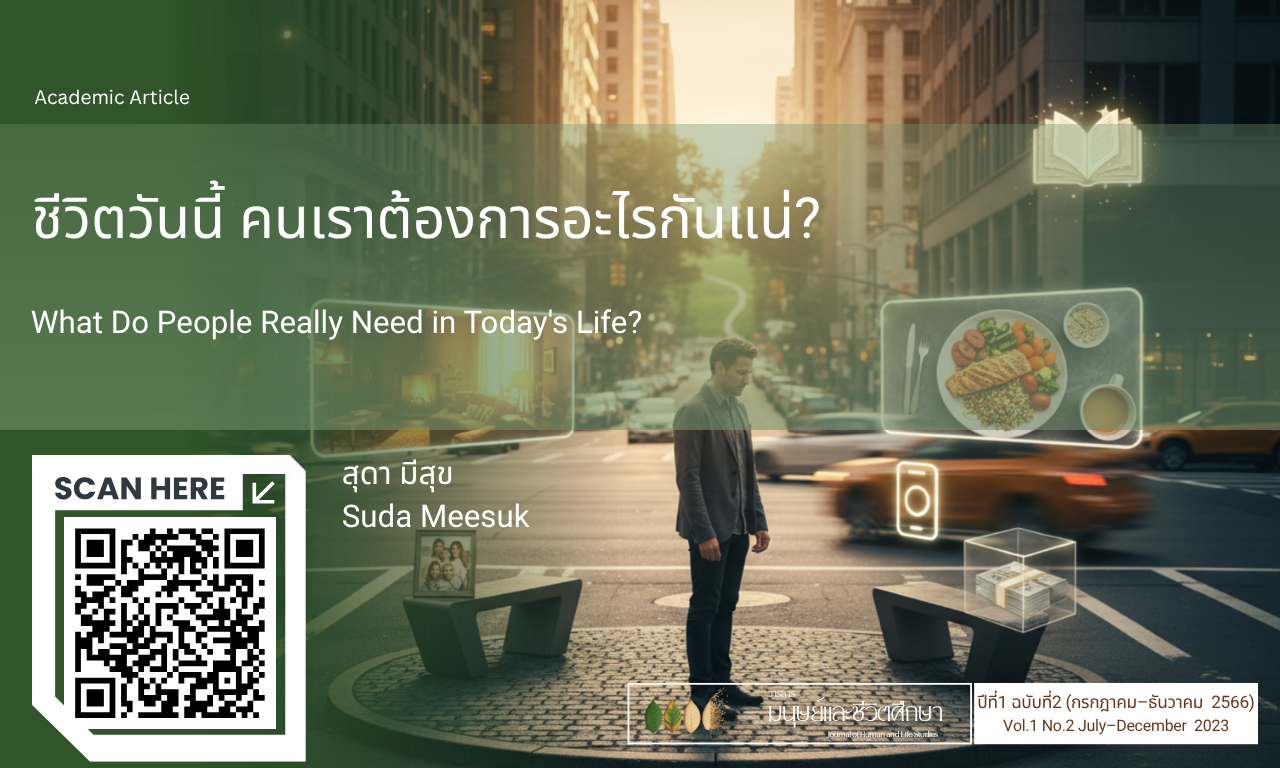
What Do People Really Need in Today's Life?
ชีวิตวันนี้ คนเราต้องการอะไรกันแน่?
Keywords:
human needs, contemporary life, hierarchy of needs theory, well-being, meaning of life, knowledge modelAbstract
บทความวิชาการนี้มุ่งสำรวจและวิเคราะห์ความต้องการพื้นฐานของมนุษย์ในบริบทสังคมร่วมสมัย โดยพิจารณาจากมุมมองของจิตวิทยา สังคมศาสตร์ และปรัชญา เพื่อตอบคำถามสำคัญว่าในโลกที่เปลี่ยนแปลงอย่างรวดเร็วเช่นในปัจจุบัน มนุษย์ยังคงต้องการสิ่งเดิมหรือมีความต้องการในรูปแบบใหม่ที่เกิดขึ้นมาแทน ประเด็นนี้มีความสำคัญอย่างยิ่งต่อการออกแบบนโยบายสาธารณะ การจัดการศึกษา การพัฒนาเมือง และการสร้างสรรค์เทคโนโลยีที่สอดคล้องกับชีวิตมนุษย์อย่างแท้จริง บทความนี้ยังเสนอ "โมเดลองค์ความรู้ว่าด้วยความต้องการมนุษย์ร่วมสมัย" (KMCHN) ซึ่งบูรณาการทฤษฎีสำคัญ 5 กลุ่มเข้าด้วยกันอย่างเป็นระบบ เพื่อเป็นกรอบวิเคราะห์ที่นำไปใช้งานได้จริงในทางปฏิบัติ
ผลการวิเคราะห์พบว่าความต้องการหลักของมนุษย์ยังคงประกอบด้วยปัจจัยสี่กลุ่ม ได้แก่ ความต้องการทางกายภาพ ความต้องการทางสังคมและความสัมพันธ์ ความต้องการด้านความหมายและคุณค่า และความต้องการด้านเสรีภาพและการเติบโตส่วนบุคคล แม้เทคโนโลยีและสภาพแวดล้อมทางสังคมจะเปลี่ยนไปอย่างรวดเร็ว แต่แก่นแท้ของความต้องการมนุษย์ยังคงเชื่อมโยงอยู่กับความต้องการความรัก ความปลอดภัย การยอมรับจากผู้อื่น และการค้นพบความหมายในชีวิต ข้อค้นพบเหล่านี้มีนัยสำคัญต่อการออกแบบนโยบายสาธารณสุขจิต ระบบการศึกษา การพัฒนาเมืองและชุมชน และการออกแบบเทคโนโลยีที่เป็นมิตรต่อมนุษย์ในยุคดิจิทัล
References
Frankl, V. E. (1946). Man’s search for meaning. Beacon Press.
Fromm, E. (1941). Escape from freedom. Farrar & Rinehart.
Harris, T. (2017). How technology hijacks people’s minds — from a magician and Google’s design ethicist. Medium. https://medium.com
Harvard Study of Adult Development. (2015). Over nearly 80 years, Harvard study has been showing how to live a healthy and happy life. Harvard Gazette. https://news.harvard.edu
Maslow, A. H. (1943). A theory of human motivation. Psychological Review, 50(4), 370–396. https://doi.org/10.1037/h0054346
Max-Neef, M. A. (1991). Human scale development: Conception, application and further reflections. Apex Press.
OECD. (2021). Health at a glance 2021: OECD indicators. OECD Publishing. https://doi.org/10.1787/ae3016b9-en
Putnam, R. D. (2000). Bowling alone: The collapse and revival of American community. Simon & Schuster.
Ryan, R. M., & Deci, E. L. (2000). Self-determination theory and the facilitation of intrinsic motivation, social development, and well-being. American Psychologist, 55(1), 68–78. https://doi.org/10.1037/0003-066X.55.1.68
Seligman, M. E. P. (2011). Flourish: A visionary new understanding of happiness and well-being. Free Press.
Tay, L., & Diener, E. (2011). Needs and subjective well-being around the world. Journal of Personality and Social Psychology, 101(2), 354–365. https://doi.org/10.1037/a0023779
Twenge, J. M., Joiner, T. E., Rogers, M. L., & Martin, G. N. (2018). Increases in depressive symptoms, suicide-related outcomes, and suicide rates among U.S. adolescents after 2010. Clinical Psychological Science, 6(1), 3–17. https://doi.org/10.1177/2167702617723376
World Health Organization. (2023). Depressive disorder (depression). https://www.who.int
กรมสุขภาพจิต. (2566). รายงานสุขภาพจิตคนไทย ปี 2566. กระทรวงสาธารณสุข.
สมพร รุ่งเรืองกลกิจ. (2564). การแสวงหาความหมายในชีวิตของคนรุ่นใหม่ไทยในยุคดิจิทัล. วารสารจิตวิทยาและการพัฒนาการ, 12(2), 45–62.
สุวิมล ว่องวาณิช. (2563). ความต้องการพื้นฐานทางจิตวิทยาและความเป็นอยู่ที่ดีของนักเรียนไทย: การศึกษาตาม Self-Determination Theory. วารสารการศึกษาไทย, 17(1), 88–105.
อาภาพร เผ่าวัฒนา. (2565). ความขัดแย้งระหว่างอัตลักษณ์ที่ต้องการและอัตลักษณ์ที่คาดหวังในคนรุ่นใหม่ไทย. วารสารสังคมวิทยาและมานุษยวิทยา, 41(1), 23–46.
Downloads
Published
How to Cite
Issue
Section
License
Copyright (c) 2023 Journal of Human and Life Studies

This work is licensed under a Creative Commons Attribution-NonCommercial-NoDerivatives 4.0 International License.
Published articles are copyrighted by the Journal of Human and Life Studies.
The contents of each article in this academic journal represent the personal opinions of the individual authors and are not affiliated with the Journal of Life Studies or any other editorial team within the publishing house. The responsibility for all content of each article rests with the individual authors. Any errors or omissions are solely the responsibility of each individual author.