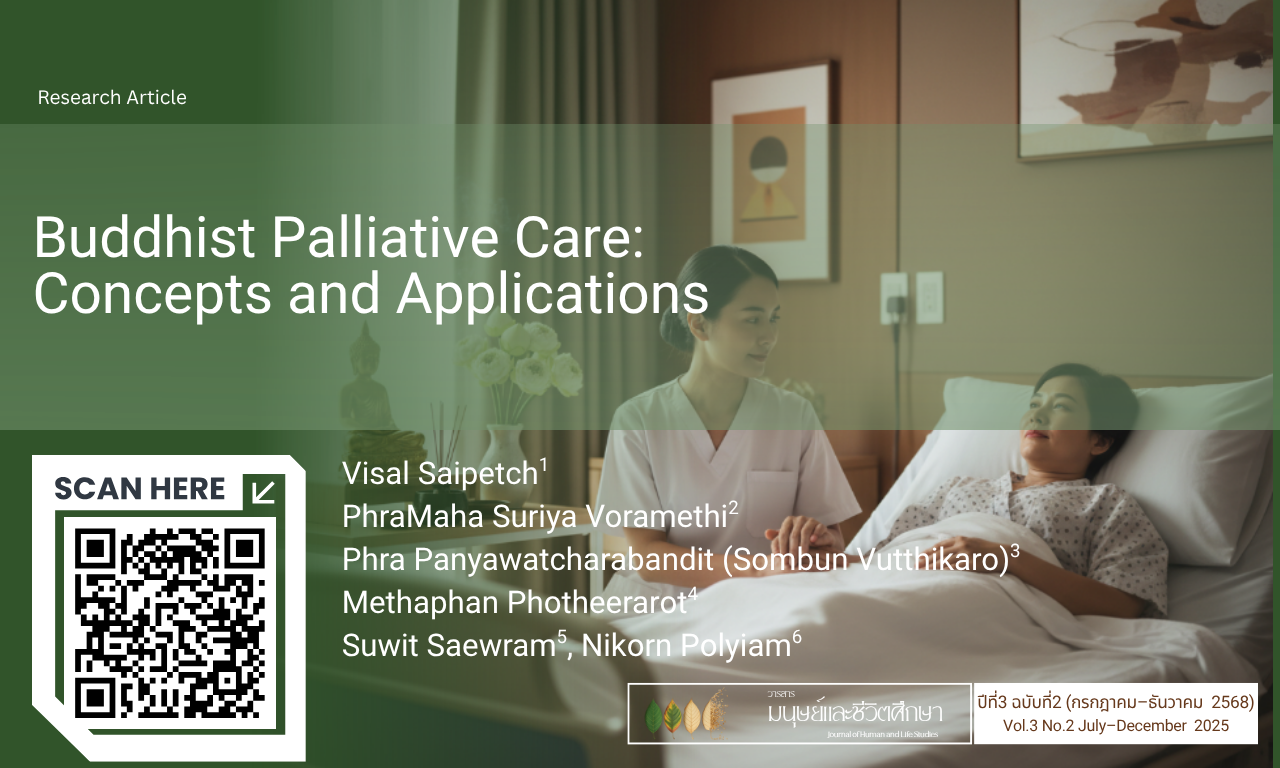
Buddhist Palliative Care: Concepts and Applications
การดูแลผู้ป่วยแบบประคับประคองตามแนวพุทธ: แนวคิดและการประยุกต์ใช้
คำสำคัญ:
Palliative Care, Buddhism, Mind Healing, Spiritual Well-Being, Three Characteristics of Existenceบทคัดย่อ
This research article aimed to: (1) examine the concepts of palliative care grounded in Buddhist principles; (2) analyze the process of caring for the spiritual and psychological well-being of terminally ill patients from a Buddhist perspective; and (3) propose guidelines for applying Buddhist teachings within the contemporary Thai healthcare context. The research employed a documentary methodology, utilizing the Three Characteristics of Existence (Tilakkhaṇa), the Threefold Training (Tisikkhā), and the Four Brahmaviharas as the conceptual framework. Data were collected from the Tipiṭaka, Aṭṭhakathā commentaries, and 42 academic publications indexed in the TCI and Scopus databases. Content analysis and descriptive narration were employed for data analysis.
The research results were found as follows: 1. The Three Characteristics of Existence (Tilakkhaṇa) and the Four Noble Truths (Ariyasacca) form the foundational Buddhist framework supporting death acceptance among terminal cancer patients in Thailand, with acceptance occurring through three dynamic phases: engaging with suffering, becoming open-minded about death, and adhering to Buddhist practices for increasing death consciousness. 2. Buddhist practices—particularly mindfulness (sati), loving-kindness meditation (mettā bhāvanā), and Dhamma recitation—significantly enhance the spiritual well-being (SWB) of terminally ill patients. Patients engaging in Buddhist practices more frequently demonstrated significantly higher spiritual well-being scores. 3. Effective application requires integrating the roles of Buddhist monks, family caregivers, and healthcare teams within a Three-Pillar Model encompassing physical, psychological, social, and spiritual dimensions of care. The knowledge generated by this research contributes to the development of culturally and religiously congruent palliative care standards aligned with the Thai Buddhist context, ultimately enhancing the quality of life for patients in their final stage of life.
เอกสารอ้างอิง
Attarung, T. (2023). Mind healing: A Buddhist perspective in mental health care. Journal of Life Studies, 1(1), 12–24. https://so16.tci-thaijo.org/index.php/LS/article/view/2391
Department of Mental Health, Ministry of Public Health. (2023). Mental health situation report of the Thai population 2023. Cooperative Agricultural Printing House of Thailand.
Kamonrat, S., Rujirek, W., & Anuwat, P. (2022). How Buddhist religious care is incorporated for end-of-life stroke patients receiving palliative care at home during the COVID-19 pandemic. Religions, 13(10), Article 1000. https://doi.org/10.3390/rel13101000
Kongsuwan, W., Chaipetch, O., & Matchim, Y. (2012). Thai Buddhist families' perspective of a peaceful death in ICUs. Nursing in Critical Care, 17(3), 151–159. https://doi.org/10.1111/j.1478-5153.2011.00473.x
Mahachulalongkornrajavidyalaya University. (1996). Thai Tipiṭaka (Mahachulalongkornrajavidyalaya University edition). Mahachulalongkornrajavidyalaya University Press.
McCormick, A. J. (2013). Buddhist ethics and end-of-life care decisions. Journal of Social Work in End-of-Life & Palliative Care, 9(2–3), 209–225. https://doi.org/10.1080/15524256.2013.794060
National Statistical Office. (2018). Religion survey report 2017. National Statistical Office of Thailand.
Pfeil, T. A., Laryionava, K., Reiter-Theil, S., Hiddemann, W., & Winkler, E. C. (2015). What keeps oncologists from addressing palliative care early on with incurable cancer patients? An active stance seems key. The Oncologist, 20(1), 56–61. https://doi.org/10.1634/theoncologist.2014-0031
Phra Paisal Visalo. (2016, June 3). Buddhist perspectives on end of life care – A conversation with Phra Paisal Visalo. ehospice. https://ehospice.com/usa_posts/buddhist-perspectives-on-end-of-life-care-a-conversation-with-phra-paisal-visalo/
Pokpalagon, P., Hanucharurnkul, S., Popkul, W., & Thanasilp, S. (2022). Spiritual needs, spiritual well-being, and Buddhist practices of patients with terminal illness, Thailand. Palliative & Supportive Care, 20(5), 652–660. https://doi.org/10.1017/S1478951521001978
Saipetch, V. (2023). Buddhist mental health: Integration of Buddhist principles with contemporary mental health care. Journal of Applied Humanities Studies, 1(1), 1–19. https://doi.org/10.65680/jahs.v1i1.6639
Thanasilp, S., Ngamkham, S., & Matchim, Y. (2020). Death acceptance from a Thai Buddhist perspective: A qualitative study. Palliative & Supportive Care, 18(4), 419–428. https://doi.org/10.1017/S1478951519000774
Thanasilp, S., Suwannaroop, N., & Popkul, W. (2022). Death acceptance process in Thai Buddhist patients with life-limiting cancer: A grounded theory. International Journal of Palliative Nursing, 28(4). https://pmc.ncbi.nlm.nih.gov/articles/PMC9284199/
World Health Organization. (2020). Palliative care. https://www.who.int/news-room/fact-sheets/detail/palliative-care
ดาวน์โหลด
เผยแพร่แล้ว
รูปแบบการอ้างอิง
ฉบับ
ประเภทบทความ
สัญญาอนุญาต
ลิขสิทธิ์ (c) 2025 Journal of Human and Life Studies

อนุญาตภายใต้เงื่อนไข Creative Commons Attribution-NonCommercial-NoDerivatives 4.0 International License.
บทความที่ได้รับการตีพิมพ์เป็นลิขสิทธิ์ของวารสารมนุษย์และชีวิตศึกษา
ข้อความที่ปรากฏในบทความแต่ละเรื่องในวารสารวิชาการเล่มนี้เป็นความคิดเห็นส่วนตัวของผู้เขียนแต่ละท่านไม่เกี่ยวข้องกับวารสารชีวิตศึกษา และกองบรรณาธิการท่านอื่นๆ ในสำนักพิมพ์ฯ แต่อย่างใด ความรับผิดชอบองค์ประกอบทั้งหมดของบทความแต่ละเรื่องเป็นของผู้เขียนแต่ละท่าน หากมีความผิดพลาดใดๆ ผู้เขียนแต่ละท่านจะรับผิดชอบบทความของตนเองแต่ผู้เดียว