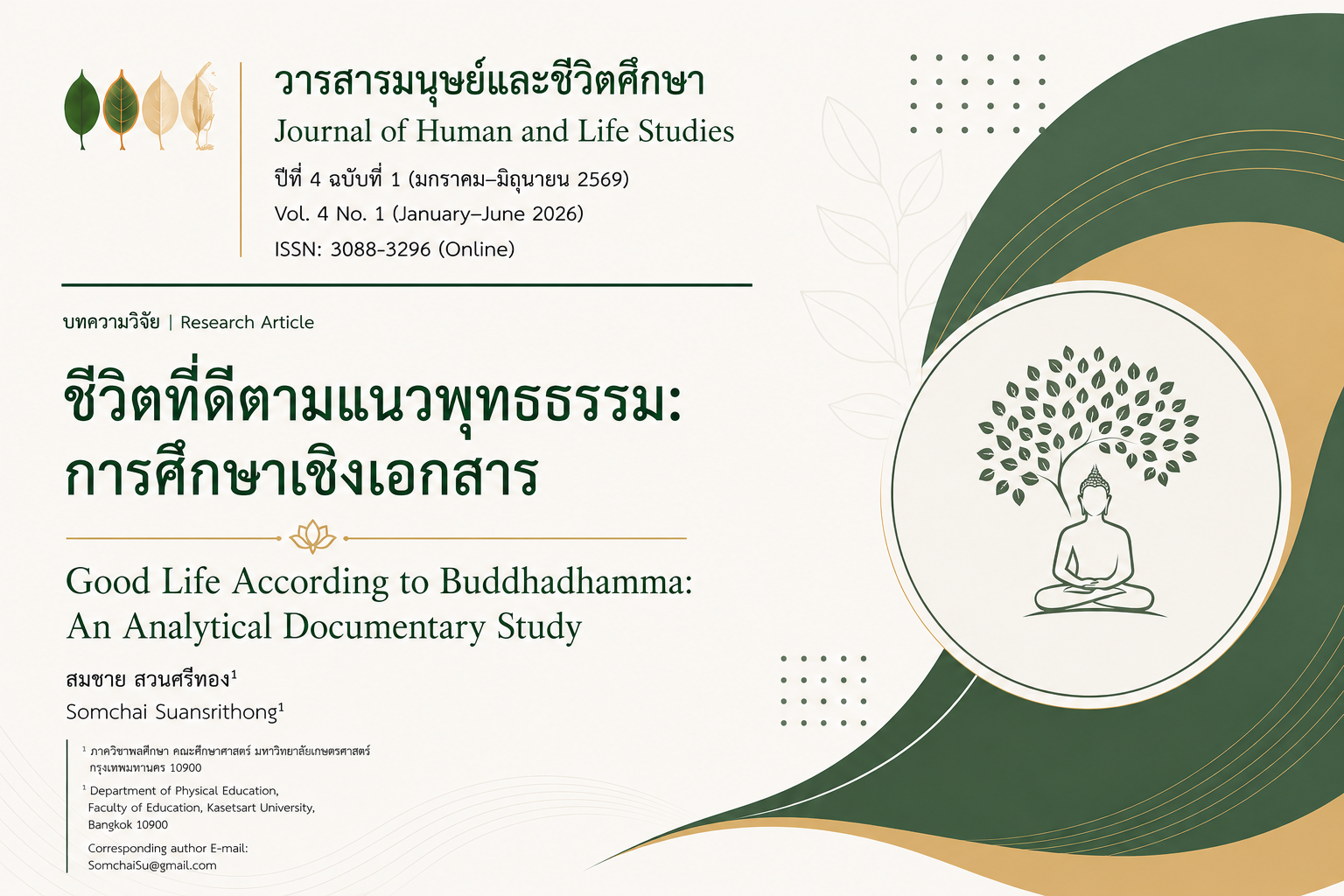
Good Life According to Buddhadhamma: An Analytical Documentary Study
Keywords:
Good Life, Buddhadhamma, Threefold Training, Fourfold Development, DiṭṭhadhammikatthaAbstract
This research article aimed to: 1) study the meaning and components of a good life according to Buddhist principles; 2) analyze the Buddhist teachings leading to a good life; and 3) synthesize guidelines for cultivating a good life based on Buddhist principles for people in the modern era. The research employed a qualitative approach using analytical documentary research. The conceptual framework was based on human development through the principles of the Threefold Training (Tri-sikkhā) and the Fourfold Development (Bhāvanā 4) proposed by Somdet Phra Buddhaghosacariya (P.A. Payutto). Primary sources consisted of the Thai Tipiṭaka published by Mahachulalongkornrajavidyalaya University, particularly the Dīghajāṇu Sutta and the Dhammāññū Sutta in the Aṅguttara Nikāya, Aṭṭhaka Nipāta. Secondary sources included Buddhadhamma (Expanded Edition) and the Dictionary of Buddhism (Compendium of Dhamma). Data were analyzed through content analysis and presented descriptively.
The findings revealed that: 1) a good life according to Buddhist principles is a holistic life developed in terms of physical, moral, mental, and intellectual aspects, enabling self-reliance, inner peace, and harmonious coexistence with others; 2) the Buddhist teachings leading to a good life can be classified into three levels of benefit: present benefit (diṭṭhadhammikattha), future benefit (samparāyikattha), and ultimate benefit (paramattha). Important principles include the four conditions conducive to present welfare, the Threefold Training, the Fourfold Development, and the Seven Qualities of a Good Person (sappurisadhamma); and 3) the guideline for cultivating a good life in the modern world is continuous holistic self-development, beginning with economic stability and positive social relationships, leading to morality, mental peace, and wisdom that realizes the truth of life. The body of knowledge derived from this research is the integration of the three levels of benefit with the four dimensions of human development as a framework for enhancing quality of life, education management, and human resource development in contemporary society.
References
พระณัฐวุฒิ วุฑฺฒิโก (สัพโส), ภาณุวัฒน์ ภักดีวงศ์, เอื้อมพร หลินเจริญ และประพัฒน์ ศรีกูลกิจ. (2555). แนวคิดการพัฒนามนุษย์ในพระพุทธศาสนาจากคัมภีร์ทีฆนิกาย. วารสารศึกษาศาสตร์ มหาวิทยาลัยนเรศวร, 14(2), 1-15.
พระธรรมปิฎก (ป.อ. ปยุตฺโต). (2540). พุทธธรรมกับการพัฒนาชีวิต. กรุงเทพฯ: ธรรมสภา.
พระพรหมคุณาภรณ์ (ป.อ. ปยุตฺโต). (2546). พจนานุกรมพุทธศาสตร์ ฉบับประมวลธรรม. กรุงเทพฯ: การศาสนา.
พระพรหมคุณาภรณ์ (ป.อ. ปยุตฺโต). (2552). พจนานุกรมพุทธศาสตร์ ฉบับประมวลธรรม (พิมพ์ครั้งที่ 17). กรุงเทพฯ: สำนักพิมพ์จันทร์เพ็ญ.
พระภูชิสสะ ปญฺญาปโชโต. (2562). การสร้างกระบวนการเสริมสร้างสุขภาวะตามหลักภาวนา 4 ในตำบลยางฮอม อำเภอขุนตาล จังหวัดเชียงราย (วิทยานิพนธ์ปริญญามหาบัณฑิต). มหาวิทยาลัยมหาจุฬาลงกรณราชวิทยาลัย.
พระสุนทรกิตติคุณ. (2560). หลักพุทธธรรมกับการดูแลสุขภาพแบบองค์รวมในบุคลากร. วารสารมหาจุฬาวิชาการ, 3(1), 11-25.
มหาวิทยาลัยมหาจุฬาลงกรณราชวิทยาลัย. (2539). พระไตรปิฎกภาษาไทย ฉบับมหาจุฬาลงกรณราชวิทยาลัย. กรุงเทพฯ: โรงพิมพ์มหาจุฬาลงกรณราชวิทยาลัย.
สมเด็จพระพุทธโฆษาจารย์ (ป.อ. ปยุตฺโต). (2559). พุทธธรรม ฉบับปรับขยาย (พิมพ์ครั้งที่ 47). กรุงเทพฯ: สำนักพิมพ์ผลิธัมม์.
สมเด็จพระพุทธโฆษาจารย์ (ป.อ. ปยุตฺโต). (2561). พจนานุกรมพุทธศาสน์ ฉบับประมวลศัพท์ (พิมพ์ครั้งที่ 31). กรุงเทพฯ: สำนักพิมพ์ผลิธัมม์.
สมเด็จพระพุทธโฆษาจารย์ (ป.อ. ปยุตฺโต). (2562). ไตรสิกขา: ระบบการศึกษาซึ่งพัฒนาชีวิตที่ดำเนินไปทั้งระบบ. นครปฐม: วัดญาณเวศกวัน.
Downloads
Published
How to Cite
Issue
Section
License
Copyright (c) 2026 Journal of Human and Life Studies

This work is licensed under a Creative Commons Attribution-NonCommercial-NoDerivatives 4.0 International License.
Published articles are copyrighted by the Journal of Human and Life Studies.
The contents of each article in this academic journal represent the personal opinions of the individual authors and are not affiliated with the Journal of Life Studies or any other editorial team within the publishing house. The responsibility for all content of each article rests with the individual authors. Any errors or omissions are solely the responsibility of each individual author.