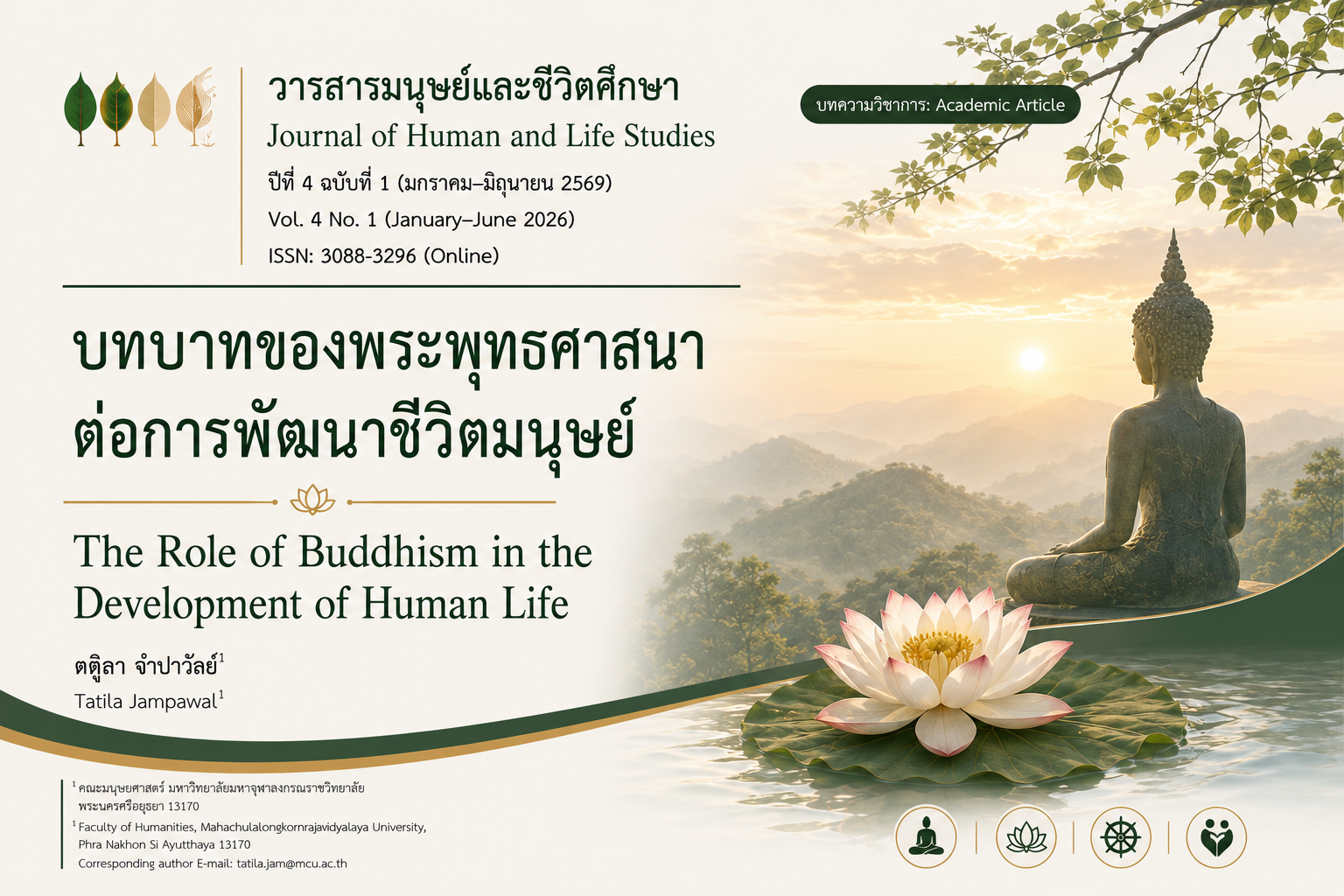
The Role of Buddhism in the Development of Human Life
Keywords:
Buddhism, Human Life Development, Fourfold Bhāvanā, Threefold Training, HolisticAbstract
This academic article aims to analyze the role of Buddhism as a system of thought and a way of practice that significantly contributes to human life development in four major dimensions: the physical dimension, the behavioral and social dimension, the mental dimension, and the intellectual dimension. The study employs the frameworks of the Fourfold Development (Bhāvanā 4) and the Threefold Training (Tri-sikkhā) as analytical tools. The findings reveal that Buddhism proposes an integrated approach to life development that holistically combines body, behavior, mind, and wisdom, with the Threefold Training—morality (sīla), concentration (samādhi), and wisdom (paññā)—serving as the core of self-cultivation. In the physical dimension, Buddhism encourages moderation in consumption and proper bodily care through the principle of moderation in eating (bhojane mattaññutā). In the social dimension, the principles of morality and the Six Principles of Cordiality (Sāraṇīyadhamma 6) promote harmonious coexistence based on respect and loving-kindness. In the mental dimension, the cultivation of meditation and the Four Sublime States (Brahmavihāra 4) enhances emotional well-being and the quality of the mind. In the intellectual dimension, the development of insight wisdom (vipassanā-paññā) leads to understanding life as it truly is, reducing attachment, and attaining inner freedom. These roles are consistent with holistic approaches to human development recognized in positive psychology and contemporary education. The article recommends applying the principles of the Fourfold Development and the Threefold Training in educational systems, human resource development, and mental health care in Thai society in order to cultivate citizens who possess both quality of life and moral integrity, which is regarded as the ultimate goal of life development according to Buddhism.
References
มหาจุฬาลงกรณราชวิทยาลัย. (๒๕๓๙). พระไตรปิฎกภาษาไทย ฉบับมหาจุฬาลงกรณราชวิทยาลัย. กรุงเทพมหานคร: โรงพิมพ์มหาจุฬาลงกรณราชวิทยาลัย.
พระพรหมคุณาภรณ์ (ป.อ. ปยุตฺโต). (๒๕๔๖). พุทธธรรม ฉบับปรับปรุงและขยายความ (พิมพ์ครั้งที่ ๑๑). กรุงเทพมหานคร: โรงพิมพ์มหาจุฬาลงกรณราชวิทยาลัย.
พระพรหมคุณาภรณ์ (ป.อ. ปยุตฺโต). (๒๕๕๒). พจนานุกรมพุทธศาสตร์ ฉบับประมวลธรรม (พิมพ์ครั้งที่ ๑๗). กรุงเทพมหานคร: โรงพิมพ์มหาจุฬาลงกรณราชวิทยาลัย.
พระพรหมคุณาภรณ์ (ป.อ. ปยุตฺโต). (๒๕๕๐). การพัฒนาที่ยั่งยืน (พิมพ์ครั้งที่ ๑๐). กรุงเทพมหานคร: สหธรรมิก.
พุทธทาสภิกขุ. (๒๕๔๙). คู่มือมนุษย์. กรุงเทพมหานคร: ธรรมสภา.
สมเด็จพระพุทธโฆษาจารย์ (ป.อ. ปยุตฺโต). (๒๕๕๙). วิธีคิดตามหลักพุทธธรรม (พิมพ์ครั้งที่ ๑๒). กรุงเทพมหานคร: ผลิธัมม์.
Kabat-Zinn, J. (2003). Mindfulness-based interventions in context: Past, present, and future. Clinical Psychology: Science and Practice, 10(2), 144–156. https://doi.org/10.1093/clipsy.bpg016
Seligman, M. E. P., & Csikszentmihalyi, M. (2000). Positive psychology: An introduction. American Psychologist, 55(1), 5–14. https://doi.org/10.1037/0003-066X.55.1.5
Downloads
Published
How to Cite
Issue
Section
License
Copyright (c) 2026 Journal of Human and Life Studies

This work is licensed under a Creative Commons Attribution-NonCommercial-NoDerivatives 4.0 International License.
Published articles are copyrighted by the Journal of Human and Life Studies.
The contents of each article in this academic journal represent the personal opinions of the individual authors and are not affiliated with the Journal of Life Studies or any other editorial team within the publishing house. The responsibility for all content of each article rests with the individual authors. Any errors or omissions are solely the responsibility of each individual author.