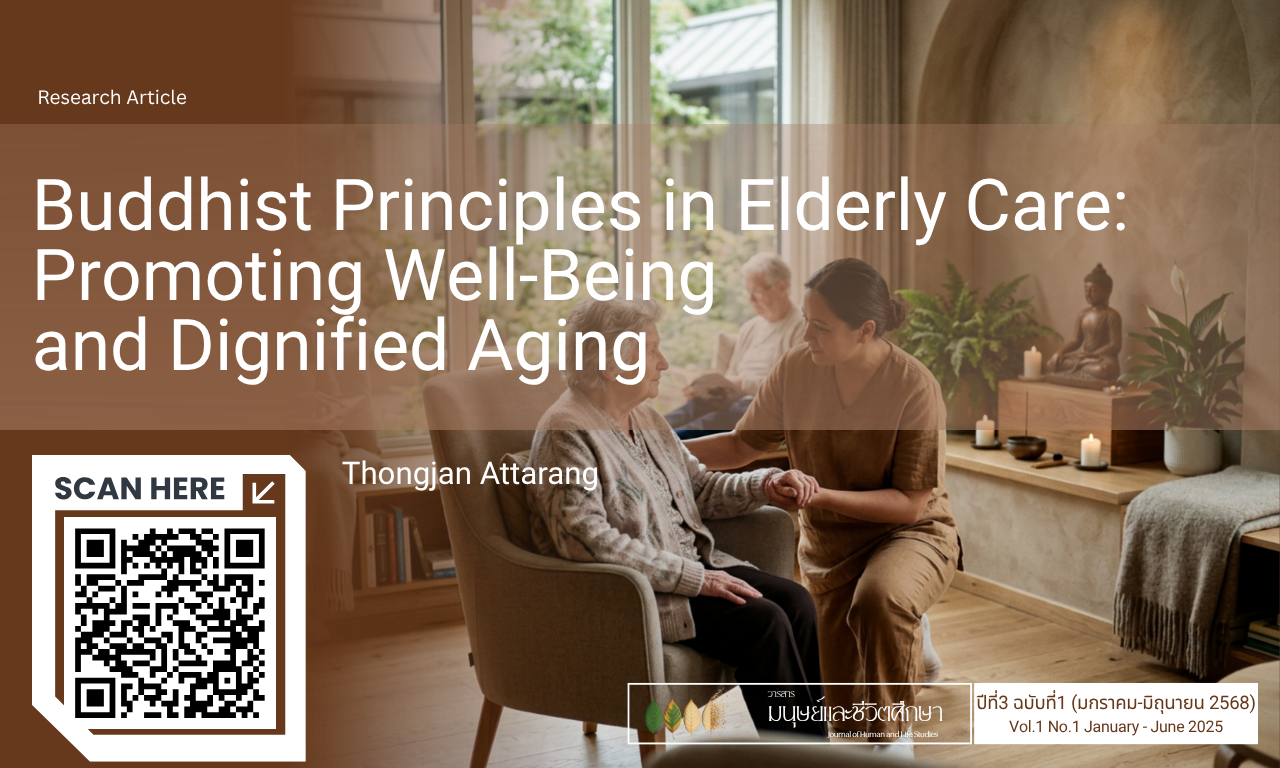
Buddhist Principles in Elderly Care: Promoting Well-Being and Dignified Aging
คำสำคัญ:
Mental healing, Buddhism, Mental health, Buddhist integrationบทคัดย่อ
This article aimed to study: (1) Buddhist principles relevant to elderly care, (2) the application of Buddhist teachings to promote well-being among older adults, and (3) a synthesized Buddhist Elderly Care (BEC) Model for Thai society. The research employed a qualitative documentary methodology, drawing on Buddhist philosophy and holistic care theories as the research framework. The target sources comprised 42 academic documents and research articles published between 2018 and 2023, selected through purposive sampling. The research instruments included: (1) a document analysis form, (2) an expert interview form, and (3) a credibility verification form. Data were analyzed using content analysis and conceptual synthesis.
The research results were found as follows. 1. Key Buddhist principles for elderly care include the Four Qualities of a Householder (gharavāsa-dhamma), the Four Bases of Social Solidarity (saṅgaha-vatthu), and the Four Foundations of Development (bhāvanā 4), which together promote holistic well-being in later life. 2. The application of Buddhist teachings promotes elderly well-being across four dimensions: physical (kāya), mental (citta), social (saṅgha), and wisdom (paññā). These findings resonate with Attarung (2023), who demonstrated that Buddhist principles provide a comprehensive framework for mind healing applicable across the life course, including in older adulthood. 3. The Buddhist Elderly Care (BEC) Model consists of four components: Physical Care (kāya-pariharaka), Mental Nurturing (citta-bhāvanā), Community Connectedness (saṅgha-sambandha), and Wisdom for Peaceful Death (paññā-maranaṃ). This model provides a culturally grounded framework for dignified and spiritually meaningful aging.
เอกสารอ้างอิง
Attarung, T. (2023). Mind healing: A Buddhist perspective in mental health care. Journal of Life Studies, 1(1), 12–24. https://so16.tci-thaijo.org/index.php/LS/article/view/2391
Buddhadasa Bhikkhu. (2021). Mindfulness with breathing: A manual for serious beginners. Wisdom Publications.
Department of Mental Health, Ministry of Public Health. (2023). Report on the mental health situation of the Thai population 2023. Cooperative Agricultural Printing House of Thailand.
Dhammapitaka (P. A. Payutto). (2023). Buddhadhamma: Expanded and revised edition. Sahadhammika Publishing.
Goleman, D., & Davidson, R. J. (2020). Altered traits: Science reveals how meditation changes your mind, brain, and body. Avery.
Kabat-Zinn, J. (2019). Mindfulness for beginners: Reclaiming the present moment—and your life. Sounds True.
Kittinannik, K. (2023). Application of vipassana meditation in treating patients with depression. Journal of Psychiatry of Thailand, 48(2), 123–138.
Mongkolsuk, S. (2023). The use of right view (sammā-diṭṭhi) in managing occupational stress. Journal of Community Mental Health, 11(1), 78–95.
National Statistical Office Thailand. (2023). Report on the elderly population of Thailand 2023. National Statistical Office.
Phra Dhammakittiwoong (Thongdee Suratecho). (2023). Wisdom in Buddhism and mental development. Journal of Buddhism, 61(4), 112–127.
Saipetch, V. (2023). Buddhist mental health: Integration of Buddhist principles with contemporary mental health care. Journal of Applied Humanities Studies, 1(1), 1–19. https://so09.tci-thaijo.org/index.php/J_AHS/article/view/6639
Santorelli, S. F., Kabat-Zinn, J., Blacker, M., Schweizer, S., & Meleo-Meyer, F. (2023). Mindfulness-based stress reduction (MBSR) authorized curriculum guide. University of Massachusetts Medical School.
Somdej Phra Nyanasamvara (Somdej Phra Sangharaja). (2022). Dhamma for life: Mindfulness practice in the modern age. Mahamakut Rajavidyalaya Printing.
Sophaborn, P. (2022). The Four Noble Truths and mental healing. Mahachulalongkornrajavidyalaya University Press.
Srisuk, S. (2022). The effectiveness of loving-kindness practice in reducing anger. Journal of Buddhist Studies, 17(3), 45–62.
Williams, J. M. G., Crane, C., Barnhofer, T., Brennan, K., Duggan, D. S., Fennell, M. J., ... Russell, I. T. (2022). Mindfulness-based cognitive therapy for preventing relapse in recurrent depression: A randomized dismantling trial. Journal of Consulting and Clinical Psychology, 90(1), 52–65.
World Health Organization. (2022). Mental disorders. https://www.who.int/news-room/fact-sheets/detail/mental-disorders
ดาวน์โหลด
เผยแพร่แล้ว
รูปแบบการอ้างอิง
ฉบับ
ประเภทบทความ
สัญญาอนุญาต
ลิขสิทธิ์ (c) 2025 Journal of Human and Life Studies

อนุญาตภายใต้เงื่อนไข Creative Commons Attribution-NonCommercial-NoDerivatives 4.0 International License.
บทความที่ได้รับการตีพิมพ์เป็นลิขสิทธิ์ของวารสารมนุษย์และชีวิตศึกษา
ข้อความที่ปรากฏในบทความแต่ละเรื่องในวารสารวิชาการเล่มนี้เป็นความคิดเห็นส่วนตัวของผู้เขียนแต่ละท่านไม่เกี่ยวข้องกับวารสารชีวิตศึกษา และกองบรรณาธิการท่านอื่นๆ ในสำนักพิมพ์ฯ แต่อย่างใด ความรับผิดชอบองค์ประกอบทั้งหมดของบทความแต่ละเรื่องเป็นของผู้เขียนแต่ละท่าน หากมีความผิดพลาดใดๆ ผู้เขียนแต่ละท่านจะรับผิดชอบบทความของตนเองแต่ผู้เดียว