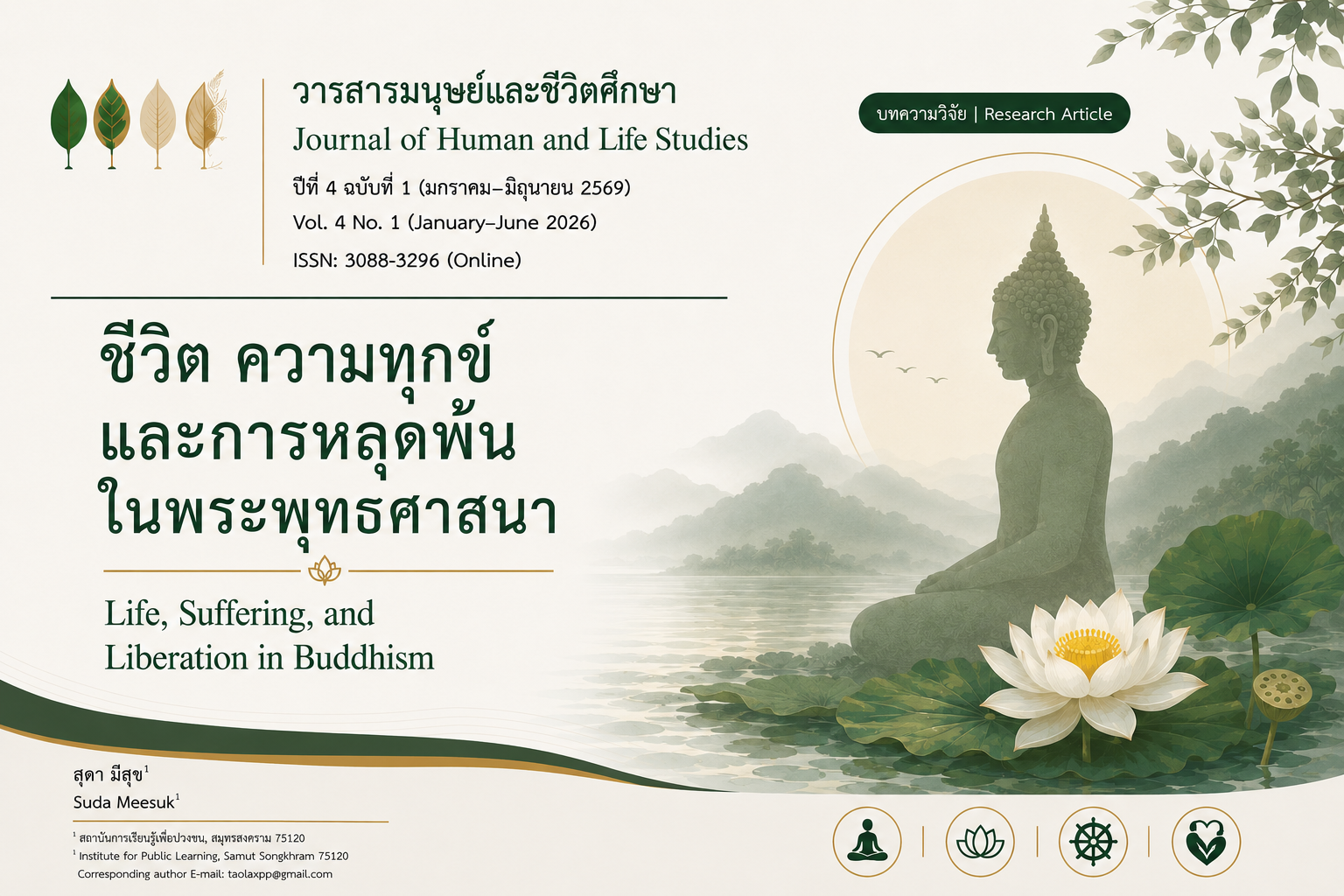
Life, Suffering, and Liberation in Buddhism
Keywords:
Life, Suffering, Liberation, Four Noble Truths, Dependent OriginationAbstract
This research article aimed to 1) study the meaning and nature of life and suffering in Buddhism; 2) analyze the causes and processes of suffering according to the Four Noble Truths and Dependent Origination; and 3) synthesize the path leading to liberation from suffering through the Noble Eightfold Path. The study employed a qualitative research methodology based on documentary research. The conceptual framework was grounded in the Four Noble Truths and Dependent Origination. Primary sources consisted of the Thai version of the Tipiṭaka published by Mahachulalongkornrajavidyalaya University, particularly the Dhammacakkappavattana Sutta and the Anattalakkhaṇa Sutta. Secondary sources included Buddhadhamma (Expanded Edition) by Somdet Phra Buddhaghosacariya (P.A. Payutto). Data were analyzed through content analysis and presented descriptively.
The findings revealed that: 1. Life in Buddhism is understood as the combination of the Five Aggregates (pañcakkhandha): form, feeling, perception, mental formations, and consciousness, all of which are subject to the Three Characteristics of Existence: impermanence (anicca), suffering (dukkha), and non-self (anattā). Suffering is a condition of oppression inherent in the Five Aggregates and can be classified into ordinary suffering, conditional suffering, and universal suffering that encompasses all phenomena. 2. The causes of suffering are the three forms of craving: sensual craving (kāma-taṇhā), craving for existence (bhava-taṇhā), and craving for non-existence (vibhava-taṇhā), all rooted in ignorance (avijjā). The process of suffering is explained through the Twelve Links of Dependent Origination, which demonstrate the cyclical relationship of causes and conditions. 3. Liberation from suffering can be attained through the cessation of craving by practicing the Noble Eightfold Path, which can be summarized as the Threefold Training (sikkhā). This practice ultimately leads to Nibbāna, the highest state of happiness. The body of knowledge derived from this research is the integration of the Four Noble Truths, Dependent Origination, and the Three Characteristics as a systematic framework for understanding life and liberation. This framework can be applied to problem-solving and the improvement of human quality of life in the contemporary world.
References
นวลวรรณ พูนวสุพลฉัตร และคณะ. (2562). ความสัมพันธ์ระหว่างปฏิจจสมุปบาทกับอริยสัจ 4. วารสาร มจร บาฬีศึกษาพุทธโฆสปริทรรศน์, 5(2), 35-46.
ปรเมธ ศรีภิญโย และอิศเรศ จิณฤทธิ์. (2566). ธรรมชาติของขันธ์ 5 ในพระไตรปิฎก. วารสารเสฏฐวิทย์ปริทัศน์, 3(1), 1-13.
พระครูวินัยธรสุวิจักขณ์ มหาปญฺโญ (อริยวงศ์ชัย). (2565). ศึกษาขันธ์ 5 ในมุมมองของพุทธทาสภิกขุ. วารสาร มจร อุบลปริทรรศน์, 7(1), 271-282.
พุทธทาสภิกขุ. (2549). อริยสัจจากพระโอษฐ์ (ภาคต้น–ภาคปลาย). กรุงเทพฯ: ธรรมทานมูลนิธิ.
มหาวิทยาลัยมหาจุฬาลงกรณราชวิทยาลัย. (2539). พระไตรปิฎกภาษาไทย ฉบับมหาจุฬาลงกรณราชวิทยาลัย. กรุงเทพฯ: โรงพิมพ์มหาจุฬาลงกรณราชวิทยาลัย.
มหาวิทยาลัยมหาจุฬาลงกรณราชวิทยาลัย. (2556). อรรถกถาภาษาไทย ฉบับมหาจุฬาลงกรณราชวิทยาลัย. กรุงเทพฯ: โรงพิมพ์มหาจุฬาลงกรณราชวิทยาลัย.
สมเด็จพระพุทธโฆษาจารย์ (ป.อ. ปยุตฺโต). (2559). พุทธธรรม ฉบับปรับขยาย (พิมพ์ครั้งที่ 47). กรุงเทพฯ: สำนักพิมพ์ผลิธัมม์.
สมเด็จพระพุทธโฆษาจารย์ (ป.อ. ปยุตฺโต). (2561). พจนานุกรมพุทธศาสน์ ฉบับประมวลศัพท์ (พิมพ์ครั้งที่ 31). กรุงเทพฯ: สำนักพิมพ์ผลิธัมม์.
สมเด็จพระพุทธโฆษาจารย์ (ป.อ. ปยุตฺโต). (2562). ไตรลักษณ์: อนิจจตา ทุกขตา อนัตตตา. นครปฐม: วัดญาณเวศกวัน.
Beck, J. S. (2011). Cognitive behavior therapy: Basics and beyond (2nd ed.). New York: Guilford Press.
Hayes, S. C., Strosahl, K. D., & Wilson, K. G. (2012). Acceptance and commitment therapy: The process and practice of mindful change (2nd ed.). New York: Guilford Press.
World Health Organization. (2022). Mental health and COVID-19: Early evidence of the pandemic’s impact (Scientific brief, 2 March 2022). Geneva: World Health Organization.
Downloads
Published
How to Cite
Issue
Section
License
Copyright (c) 2026 Journal of Human and Life Studies

This work is licensed under a Creative Commons Attribution-NonCommercial-NoDerivatives 4.0 International License.
Published articles are copyrighted by the Journal of Human and Life Studies.
The contents of each article in this academic journal represent the personal opinions of the individual authors and are not affiliated with the Journal of Life Studies or any other editorial team within the publishing house. The responsibility for all content of each article rests with the individual authors. Any errors or omissions are solely the responsibility of each individual author.