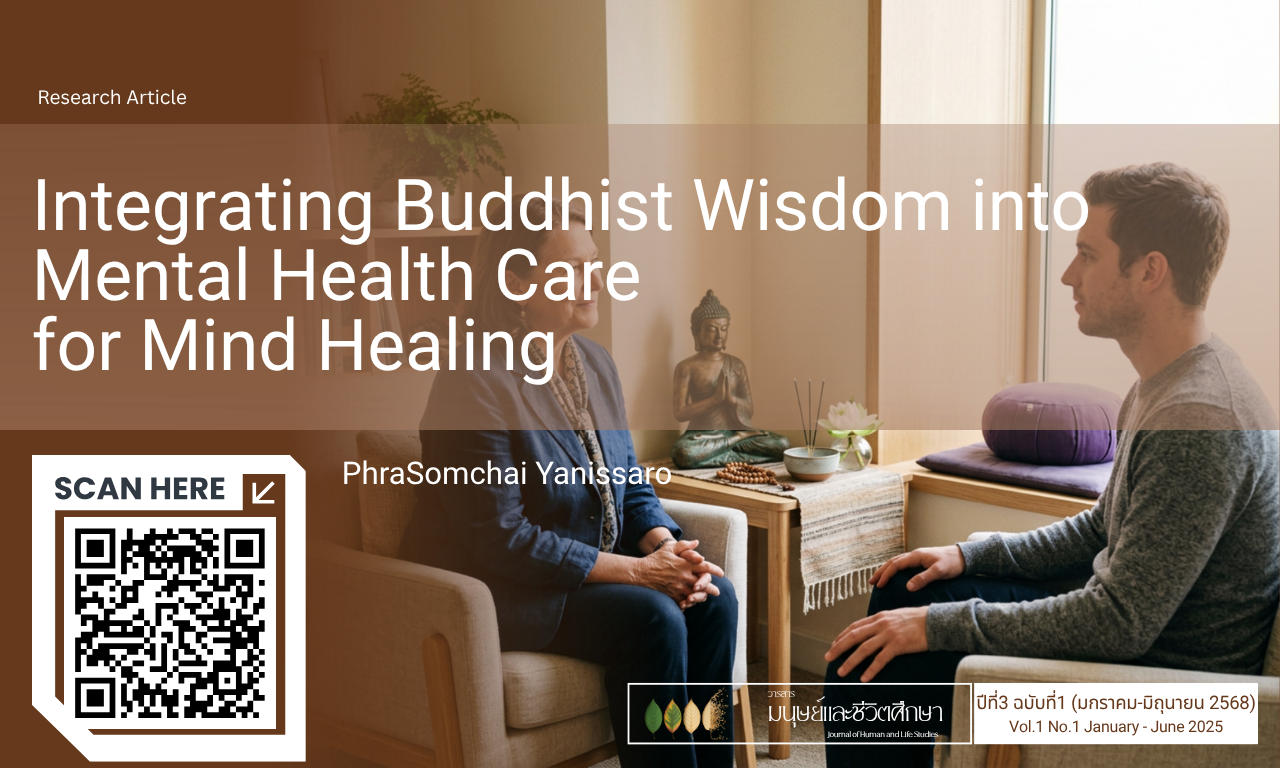
Integrating Buddhist Wisdom into Mental Health Care for Mind Healing
บทคัดย่อ
This article aimed to study: (1) the concept of mental healing from the Buddhist perspective, (2) the integration of Buddhist principles with contemporary mental health care, and (3) the synthesis of an integrative Buddhist model of mental healing for mental health care. The research employed a qualitative methodology, drawing on Buddhist philosophy and holistic healing theories as the research framework. The research area focused on documentary studies and related research on Buddhist approaches to mental healing. The target sources comprised 45 academic documents and research articles published between 2018 and 2023, selected through purposive sampling. The research instruments included: (1) a document analysis form, (2) an expert interview form, and (3) a credibility verification form. Data were analyzed using content analysis and conceptual synthesis, and findings were presented in descriptive narrative form.
The research results revealed the following. 1. Buddhist mental healing is grounded in the Four Noble Truths and the Noble Eightfold Path, emphasizing the understanding of the nature of suffering and the path to liberation. 2. The integration of Buddhist principles with mental health care enhances the effectiveness of healing through mindfulness practice, the cultivation of wisdom, and the reframing of perspectives. 3. The integrative Buddhist mental healing model consists of five key components: mindfulness (sati), wisdom (paññā), loving-kindness (mettā), concentration (samādhi), and perseverance (viriya). The study proposes an integrative Buddhist mental healing model that can be applied to holistic mental health care and serves as a guideline for developing healing innovations aligned with the Thai socio-cultural context
เอกสารอ้างอิง
Attarung, T. (2023). Mind healing: A Buddhist perspective in mental health care. Journal of Life Studies, 1(1), 12–24. https://so16.tci-thaijo.org/index.php/LS/article/view/2391
Buddhadasa Bhikkhu. (2021). Mindfulness with breathing: A manual for serious beginners. Wisdom Publications.
Department of Mental Health, Ministry of Public Health. (2023). Report on the mental health situation of the Thai population 2023. Cooperative Agricultural Printing House of Thailand.
Dhammapitaka (P. A. Payutto). (2023). Buddhadhamma: Expanded and revised edition. Sahadhammika Publishing.
Goleman, D., & Davidson, R. J. (2020). Altered traits: Science reveals how meditation changes your mind, brain, and body. Avery.
Harris, R. (2023). ACT made simple: An easy-to-read primer on acceptance and commitment therapy (3rd ed.). New Harbinger Publications.
Hayes, S. C., Hofmann, S. G., & Ciarrochi, J. (2022). A process-based approach to psychological flexibility. American Psychologist, 77(2), 285–300.
Kabat-Zinn, J. (2019). Mindfulness for beginners: Reclaiming the present moment—and your life. Sounds True.
Kittinannik, K. (2023). Application of vipassana meditation in treating patients with depression. Journal of Psychiatry of Thailand, 48(2), 123–138.
Mongkolsuk, S. (2023). The use of right view (sammā-diṭṭhi) in managing occupational stress. Journal of Community Mental Health, 11(1), 78–95.
Phra Dhammakittiwoong (Thongdee Suratecho). (2023). Wisdom in Buddhism and mental development. Journal of Buddhism, 61(4), 112–127.
Saipetch, V. (2023). Buddhist mental health: Integration of Buddhist principles with contemporary mental health care. Journal of Applied Humanities Studies, 1(1), 1–19. https://so09.tci-thaijo.org/index.php/J_AHS/article/view/6639
Santorelli, S. F., Kabat-Zinn, J., Blacker, M., Schweizer, S., & Meleo-Meyer, F. (2023). Mindfulness-based stress reduction (MBSR) authorized curriculum guide. University of Massachusetts Medical School.
Somdej Phra Nyanasamvara (Somdej Phra Sangharaja). (2022). Dhamma for life: Mindfulness practice in the modern age. Mahamakut Rajavidyalaya Printing.
Sophaborn, P. (2022). The Four Noble Truths and mental healing. Mahachulalongkornrajavidyalaya University Press.
Srisuk, S. (2022). The effectiveness of loving-kindness practice in reducing anger. Journal of Buddhist Studies, 17(3), 45–62.
Williams, J. M. G., Crane, C., Barnhofer, T., Brennan, K., Duggan, D. S., Fennell, M. J., ... Russell, I. T. (2022). Mindfulness-based cognitive therapy for preventing relapse in recurrent depression: A randomized dismantling trial. Journal of Consulting and Clinical Psychology, 90(1), 52–65.
World Health Organization. (2022). Mental disorders. https://www.who.int/news-room/fact-sheets/detail/mental-disorders
ดาวน์โหลด
เผยแพร่แล้ว
รูปแบบการอ้างอิง
ฉบับ
ประเภทบทความ
สัญญาอนุญาต
ลิขสิทธิ์ (c) 2025 Journal of Human and Life Studies

อนุญาตภายใต้เงื่อนไข Creative Commons Attribution-NonCommercial-NoDerivatives 4.0 International License.
บทความที่ได้รับการตีพิมพ์เป็นลิขสิทธิ์ของวารสารมนุษย์และชีวิตศึกษา
ข้อความที่ปรากฏในบทความแต่ละเรื่องในวารสารวิชาการเล่มนี้เป็นความคิดเห็นส่วนตัวของผู้เขียนแต่ละท่านไม่เกี่ยวข้องกับวารสารชีวิตศึกษา และกองบรรณาธิการท่านอื่นๆ ในสำนักพิมพ์ฯ แต่อย่างใด ความรับผิดชอบองค์ประกอบทั้งหมดของบทความแต่ละเรื่องเป็นของผู้เขียนแต่ละท่าน หากมีความผิดพลาดใดๆ ผู้เขียนแต่ละท่านจะรับผิดชอบบทความของตนเองแต่ผู้เดียว