Factors Influencing the Acceptance of Artificial Intelligence Technology Affecting Organizational Readiness for Support and Supervision: A Case Study of Provincial Offices for the Promotion of Local Administration in the Lower Northern Region
Article Sidebar
Main Article Content
Abstract
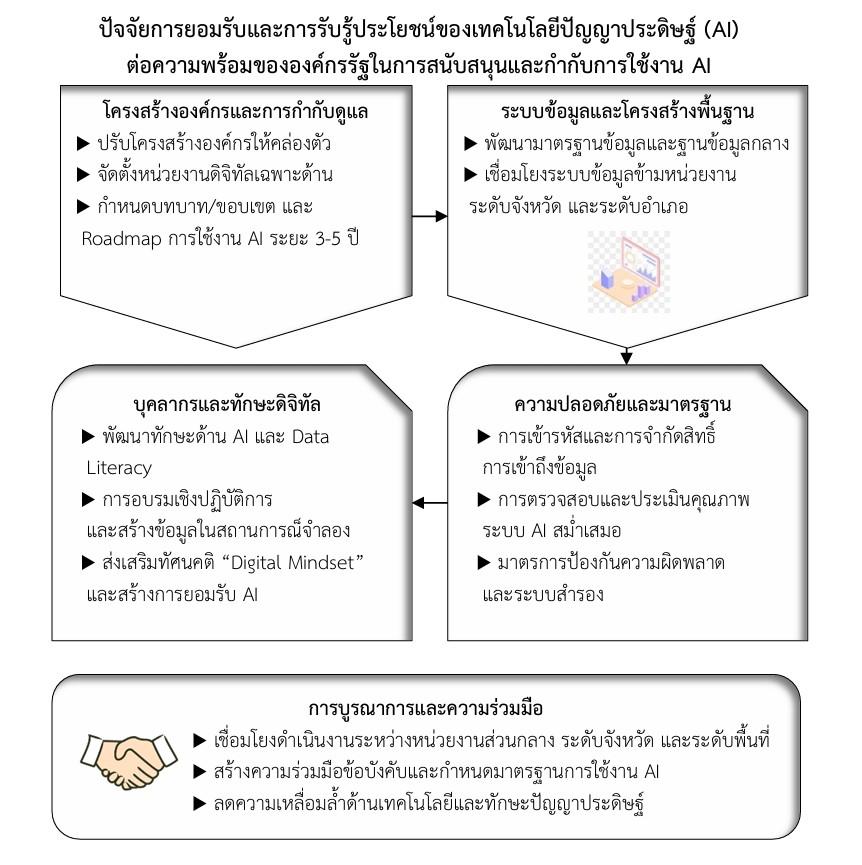
This research article aims to study (1) the level of acceptance and awareness of artificial intelligence technology among personnel in the Provincial Local Administration Promotion Offices in the lower northern region, (2) the level of organizational readiness to adopt artificial intelligence technology for support and oversight, (3) the influence of these factors on organizational readiness and (4) Guidelines for developing organizational readiness to enhance the efficiency of public services. A mixed-methods approach integrating quantitative and qualitative research was employed. Questionnaires and in-depth interviews served as the primary data collection tools. The quantitative sample consisted of 162 personnel selected through stratified and simple random sampling, while 17 key informants participated in the qualitative phase. Data analysis utilized descriptive statistics, multiple regression analysis, and content analysis. The research results found that (1) the factors of acceptance and awareness of artificial intelligence technology of personnel were at a high level, showing a positive attitude towards the application of AI in government work. (2) The organization's readiness to adopt artificial intelligence technology is at a high level, reflecting the preparation of infrastructure and operating systems to support new technology. (3) The influence of factors on acceptance and perception of artificial intelligence technology on organizational readiness had a predictive power of 67.80 percent and 94.70 percent. Hypothesis testing results indicate that perceived benefits, ease of use, and attitudes towards AI have a significant positive impact on organizations' readiness to adopt AI to enhance the efficiency of public services; and (4) Guidelines for developing organizational readiness include: defining data standards, information security, and AI quality control systems; developing a 3-5 year AI master plan; developing the skills and attitudes of personnel; establishing pilot areas to test the system before actual use; and strengthening cooperation between agencies. All of these are important factors that help organizations to use AI safely, transparently, and to the greatest benefit of the people in the lower northern region.
Article Details

This work is licensed under a Creative Commons Attribution-NonCommercial-NoDerivatives 4.0 International License.
References
กรมการปกครอง กระทรวงมหาดไทย. (2567). ข้อมูลจังหวัดภาคเหนือตอนล่าง. กรุงเทพฯ: กระทรวงมหาดไทย.
กรมส่งเสริมการปกครองท้องถิ่น. (2563). คู่มือการส่งเสริมการปกครองท้องถิ่นจังหวัด. กรุงเทพฯ: กระทรวงมหาดไทย.
กวิทธิ์ ศรีสัมฤทธิ์ และ วิทยาธร ท่อแก้ว. (2567). เทคโนโลยีปัญญาประดิษฐ์กับบทบาทการสื่อสารในงานการปกครองท้องถิ่น. วารสารสังคมศาสตร์และวัฒนธรรม, 8(8), 200-211.
กองยุทธศาสตร์และแผนงาน. (2563). แนวทางการส่งเสริมการมีส่วนร่วมของประชาชนในท้องถิ่น. กรุงเทพฯ: กระทรวงมหาดไทย.
กัญญกาญจน์ ซื่อสัตย์, มลพร กัลยาณมิตร, สถิต นิยมญาติ และ ทัศนีย์ ลักขณาภิชนชัช. (2568). ภาวะผู้นำท้องถิ่นต่อการนำเทคโนโลยีมาใช้ในการบริหารงานของ กลุ่มเทศบาลเมือง ในพื้นที่จังหวัดปทุมธานี. วารสารวิทยาลัยสงฆ์นครลำปาง, 14(3), 252-267.
จิรัตติกาล สุขสิงห์, สิปป์ณรงค์ กาญจนาวงศ์ไพศาล และ ภูริ จิตลดาพร. (2567). ปัจจัยที่ส่งผลต่อการยอมรับและการเรียนรู้เทคโนโลยีของบุคลากรในยุคดิจิทัล: กรณีศึกษาสำนักงานชลประทานที่ 11 กรมชลประทาน. วารสารวิชาการบัณฑิตวิทยาลัย มหาวิทยาลัยสวนดุสิต, 20(3), 137-149.
ณัฏฐพันธ์ เขจรนันทน์. (2561). การจัดการเทคโนโลยีสารสนเทศและระบบสารสนเทศเพื่อการจัดการ. (พิมพ์ครั้งที่ 6). กรุงเทพฯ: ซีเอ็ดยูเคชั่น.
ธนบดี ฐานะชาลา และ ภูริวัจน์ รักษ์ธนอนันต์. (2564). ความพร้อมในการบริหารจัดการองค์การตามหลักการบริหารจัดการ และการให้บริการสาธารณะของเทศบาลตำบลในจังหวัดฉะเชิงเทรา. วารสารราชนครินทร์, 18(1), 29-37.
นิสรา ใจซื่อ. (2568). การพัฒนาเทคโนโลยีดิจิทัลของเทศบาลเมืองบางบัวทอง จังหวัดนนทบุรี. วารสารวิทยาการจัดการ มหาวิทยาลัยราชภัฏสกลนคร, 5(3), 1022–1036.
บุหงา ชัยสุวรรณ และ มาริสา จันทมาศ. (2567). การจัดกลุ่มบุคลากรวัยทำงานตามระดับการยอมรับเทคโนโลยีปัญญาประดิษฐ์. วารสารนิเทศศาสตร์, 42(1), 99-117.
พรทิพย์ คำฟัก และ อรนันท์ กลันทปุระ. (2567). ความพร้อมสู่การเป็นรัฐบาลดิจิทัลของเทศบาลเมืองบางศรีเมือง อำเภอเมืองนนทบุรี จังหวัดนนทบุรี. วารสารสังคมศาสตร์ปัญญาพัฒน์, 6(3), 219-230.
ภคอร จตุพรธนภัทร. (2567). นโยบายการใช้นวัตกรรมปัญญาประดิษฐ์เพื่อเพิ่มขีดความสามารถในการแข่งขันของประเทศ. วารสารการบริหาร การจัดการ และการพัฒนาที่ยั่งยืน, 2(2), 330-340.
มานน เซียวประจวบ, ปิญะธิดา อมรภิญโญ และ นิษา ศักดิ์ชูวงษ์. (2567). โมเดลการใช้งานเทคโนโลยีปัญญาประดิษฐ์เชิงสร้างสรรค์ของผู้ปฏิบัติงานฐานความรู้. วารสารวิทยาการจัดการ มหาวิทยาลัยราชภัฏอุดรธานี, 6(4), 1-16.
สถาบันส่งเสริมการสอนวิทยาศาสตร์และเทคโนโลยี. (2562). การบริหารจัดการองค์กรปกครองส่วนท้องถิ่น. กรุงเทพฯ: สำนักพิมพ์วิทยาศาสตร์และเทคโนโลยี.
สำนักงานคณะกรรมการพัฒนาระบบราชการ. (2564). แผนพัฒนาระบบราชการไทย (พ.ศ. 2566–2570). กรุงเทพฯ: สำนักงานคณะกรรมการพัฒนาระบบราชการ.
สำนักงานพัฒนารัฐบาลดิจิทัล (องค์การมหาชน). (2566). ยุทธศาสตร์ดิจิทัลภาครัฐ พ.ศ. 2566–2570. กรุงเทพฯ: สำนักงานพัฒนารัฐบาลดิจิทัล (องค์การมหาชน).
สำนักงานส่งเสริมการปกครองท้องถิ่นจังหวัดกำแพงเพชร. (2564). รายงานการดำเนินงานส่งเสริมการวางแผนพัฒนาท้องถิ่น. กำแพงเพชร: สำนักงานส่งเสริมการปกครองท้องถิ่นจังหวัด.
Brynjolfsson, E., & McAfee, A. (2014). The Second Machine Age: Work, Progress, and Prosperity in a Time of Brilliant Technologies. New York: W. W. Norton & Company.
Cronbach, L.J. (1990). Essentials of psychological testing. (5th ed.). New York: Harper & Row.
Davis, F. D. (1989). Perceived usefulness, perceived ease of use, and user acceptance of information technology. MIS quarterly, 13(3), 319-340.
Gao, B., Liu, R., & Chu, J. (2025, May). Exploring Trends of Acceptance of Artificial Intelligence in Education: A Systematic Literature Review. In International Conference on Human-Computer Interaction (pp. 196-213). Cham: Springer Nature Switzerland.
Krejcie, R. V. & Morgan, D. W. (1970). Determining Sample Size for Research Activities. Educational and Psychological Measurement, 30(3), 607-610.
Organisation for Economic Co-operation and Development. (2021). The OECD digital government policy framework. Paris: Organization for Economic Co-operation and Development.
UN DESA. (2022). E-Government survey 2022: The future of digital government. New York: United Nations Department of Economic and Social Affairs.
Weiner, B. J. (2009). A theory of organizational readiness for change. Implementation Science, 4(1), 67.
