Knowledge and Understanding of the Learning Organization of the Budget Bureau
Article Sidebar
Main Article Content
Abstract
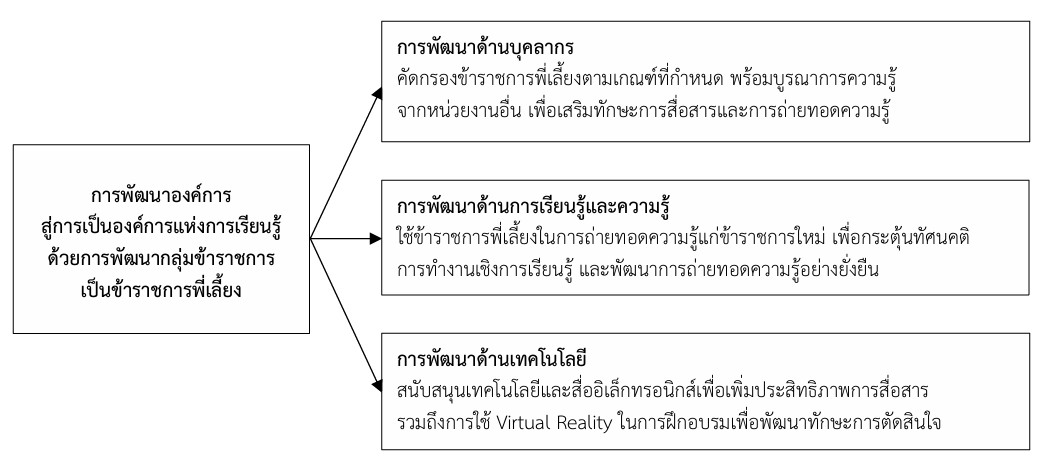
The objectives of this research are: (1) to study the level of knowledge and understanding of Learning Organizations among public servants in the Budget Bureau; (2) to compare the demographic factors with the knowledge and understanding of Learning Organizations among public servants in the Budget Bureau. This study employed a quantitative method. The population for the study consisted of 827 public servants in the Budget Bureau, and the sample included 270 public servants selected through non-probability sampling. The primary data collection instrument was a questionnaire. For data analysis, means and standard deviations were calculated. Inferential statistics used included One-Way Analysis of Variance (One-way ANOVA), t-tests, and Fisher’s Least Significant Difference (LSD) post-hoc test for pairwise comparison. The results indicated that: (1) the level of knowledge and understanding of Learning Organizations among public servants in the Budget Bureau was high, with both Learning and Organization at the highest level, followed by Employees, Knowledge, and Technology; (2) there were significant differences in knowledge and understanding of Learning Organizations based on gender and education at the .05 level of significance. The results suggest that the Budget Bureau might consider conducting surveys to identify the information or knowledge support required by its officials. This is necessary to align with the diverse expertise needed for their responsibilities. It is recommended to propose training sessions with suitable formats, including hands-on training and the use of presentation technology or video media to improve communication and stimulate learning behavior. Additionally, developing approaches to support the potential of new public servants by implementing a mentorship system is advisable. This should be accompanied by regular training designed to enhance and develop the mentors’ skills to ensure effective assistance and operational performance. The Budget Bureau may also consider integrating technology to facilitate learning participation, including the use of Virtual Reality (VR) in training or practice sessions, to gain experience and provide consultation for executing the Budget Bureau’s operations.
Article Details

This work is licensed under a Creative Commons Attribution-NonCommercial-NoDerivatives 4.0 International License.
References
ชาญยศ ปลื้มปิติวิริยะเวช. (2565). การเปรียบเทียบผลสัมฤทธิ์ทางการเรียนวิชาการออกแบบฐานข้อมูลระหว่างการเรียนแบบออนไลน์และแบบออนไซต์. Journal of Information and Learning, 33(2), 45-56.
นภาพร หัสไทรทอง. (2563). แนวทางการพัฒนาองค์การแห่งการเรียนรู้ของสำนักงานปลัดกระทรวงศึกษาธิการ. Journal of Management Science Nakhon Pathom Rajabhat University, 7(2), 67-80.
พิไลศรี สัมพันธ์สันติกูล. (2560). การเปรียบเทียบการปฏิบัติของบุคลากรตามแนวทางการพัฒนาองค์กรแห่งการเรียนรู้ระหว่างศูนย์บริการสาธารณสุขที่ได้รับและยังไม่ได้รับ การรับรองมาตรฐานศูนย์บริการสาธารณสุขในศูนย์ประสานงานที่ 5 สำนักอนามัย กรุงเทพมหานคร. (สาธารณสุขศาสตรมหาบัณฑิต, มหาวิทยาลัยสุโขทัยธรรมาธิราช).
ภาวิทย์ ชินะโชติ, ชมสุภัค ครุฑกะ และ ดวงเดือน จันทร์เจริญ. (2564). รูปแบบการพัฒนานักทรัพยากรบุคคล โดยใช้ทีมข้ามสายงาน กลุ่มธุรกิจธนาคาร. วารสารดุษฎีบัณฑิตทางสังคมศาสตร์, 11(1), 118-132.
สำนักงบประมาณ. (2564). แผนพัฒนาบุคลากรของสำนักงบประมาณ ระยะ 3 ปี (พ.ศ. 2564 - 2566). กรุงเทพฯ: สถาบันพัฒนาบุคลากรด้านการงบประมาณ สำนักงบประมาณ.
สำนักงบประมาณ. (2566). วิสัยทัศน์-พันธกิจ-สำนักงบประมาณ. สืบค้นจาก https://www.bb.go.th/index.php.
อภิเชษฐ์ บุญศรี. (2562). การเป็นองค์การแห่งการเรียนรู้ของโรงเรียนทีปังกรวิทยาพัฒน์ (ทวีวัฒนา) ในพระราชูปถัมภ์ฯ. (ศึกษาศาสตรมหาบัณฑิต, มหาวิทยาลัยศิลปากร).
Anderson, L. W., & Krathwohl, D. R. (2001). A Taxonomy for Learning, Teaching and Assessing: A Revision of Bloom’s Taxonomy of Educational Objectives: Complete Edition. New York: Longman.
Bloom, B.S. (1956). Taxonomy of Educational Objectives, Handbook: The Cognitive Domain. New York: David McKay.
Marquardt, M. J. (1996). Building the Learning Organization: A Systems Approach to Quantum Improvement and Global Success. New York: McGraw-Hill.
Yamane, T. (1973). Statistics: An Introductory Analysis. (3rd Edition). New York: Harper and Row.
