A Study of Collaborative Leadership Components of School Administrators
Article Sidebar
Main Article Content
Abstract
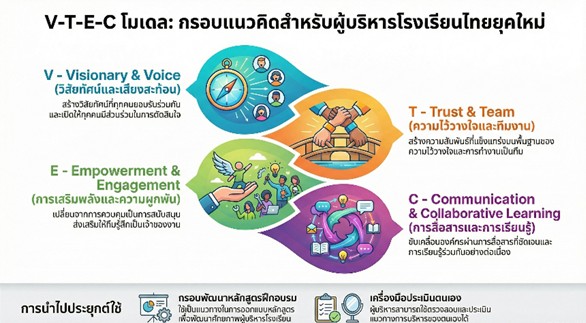
This research aimed to (1) synthesize the components of collaborative leadership, (2) develop operational definitions and behavioral indicators, and (3) examine their appropriateness and feasibility for school administrators. A mixed-methods research design was conducted in three phases: documentary research, development of definitions and indicators, and expert validation by seven specialists in educational administration and human resource development. Research instruments included a document analysis form and a 5-point Likert scale questionnaire. Data were analyzed using content analysis and descriptive statistics (mean and standard deviation). The results of the study revealed that seven components of collaborative leadership were identified: shared vision building, effective communication, participatory decision-making, trust building, teamwork, empowerment of human resources, and collaborative learning and professional development. The operational definitions emphasized participatory and horizontal leadership across academic, human resource, budget, and general administration. The evaluation results from experts indicated that the components reached the highest level of appropriateness, with an average score of 4.84, and the highest level of feasibility for implementation, with an average score of 4.86. These findings reflect the consistency between theoretical concepts and practical applications. Furthermore, the synthesis of new knowledge has led to the development of the V-T-E-C Model, which serves as a framework for the future development of school administrators.
Article Details

This work is licensed under a Creative Commons Attribution-NonCommercial-NoDerivatives 4.0 International License.
References
เกรียงศักดิ์ เจริญวงศ์ศักดิ์. (2558). การคิดเชิงวิพากษ์. กรุงเทพฯ: ซัคเซส มีเดีย.
โกศล เย็นสุขใจชน. (2565). การบริหารแบบมีส่วนร่วมของผู้บริหารที่ส่งผลต่อการทำงานเป็นทีมของครู ในสถานศึกษา สังกัดสำนักงานเขตพื้นที่การศึกษามัธยมศึกษา เขต 10. วารสารวิชาการ ครุศาสตร์สวนสุนันทา, 6(2), 62–70.
จิตติรัตน์ แสงเลิศอุทัย. (2564). ระเบียบวิธีวิจัยทางการศึกษา. นครปฐม: คณะครุศาสตร์ มหาวิทยาลัยราชภัฏนครปฐม.
ทรงพล นันทพล, บุญฤทธิ์ เพ็ชรวิศิษฐ์ และ วัลลภา อารีรัตน์. (2568). ภาวะผู้นำแบบร่วมพลังของผู้บริหารสถานศึกษาที่ส่งผลต่อประสิทธิผลการปฏิบัติงานของครู. วารสารครุศาสตร์ปัญญา, 4(4), 332–345
ธัญวรัตม์ สิงห์จู. (2563). แนวทางการพัฒนาการเป็นโรงเรียนนวัตกรรม: การบูรณาการการวิเคราะห์ข้ามกรณีและการย้อนรอยกระบวนการ. (ครุศาสตรมหาบัณฑิต, จุฬาลงกรณ์มหาวิทยาลัย).
ธีระ รุญเจริญ. (2557). ความเป็นมืออาชีพในการจัดและบริหารการศึกษายุคปฏิรูปการศึกษา. กรุงเทพฯ: ข้าวฟ่าง.
ธีระนันต์ โมธรรม, วาโร เพ็งสวัสดิ์ และ เอกลักษณ์ เพียสา. (2566). องค์ประกอบภาวะผู้นำแบบยั่งยืนของผู้บริหารโรงเรียนสังกัดสำนักงานเขตพื้นที่การศึกษามัธยมศึกษานครพนม. วารสารวิจยวิชาการ, 6(3), 77–92.
นิลาวัลย์ หนูน้ำคำ, กัลยารัตน์ เมธีวีรวงศ์ และ ปริยาภรณ์ ตั้งคุณานันต์. (2566). ปัจจัยการบริหารการเปลี่ยนแปลงที่ส่งผลต่อประสิทธิผลของสถานศึกษา สังกัดสำนักงานเขตพื้นที่การศึกษามัธยมศึกษากรุงเทพมหานคร เขต 2. วารสารศึกษาศาสตร์ มหาวิทยาลัยมหาสารคาม, 17(1), 81–96.
ไพฑูรย์ สินลารัตน์ และคณะ. (2552). ผู้นำทางวิชาการ: แนวคิด หลักการ และแนวทางปฏิบัติ. กรุงเทพฯ: จุฬาลงกรณ์มหาวิทยาลัย.
รณกฤต ผลแม่น และ มาลีรัตน์ ขจิตเนติธรรม. (2567). จากมาตรประมาณค่าของลิเคิร์ทสู่การพัฒนามาตรประมาณค่าแนวใหม่. วารสารการวัด ประเมินผล สถิติ และการวิจัยทางสังคมศาสตร์, 5(1), 1–15.
รัตนา ดวงแก้ว. (2562). นวัตกรรมการบริหารการศึกษาและภาวะผู้นำ. นนทบุรี: มหาวิทยาลัยสุโขทัยธรรมาธิราช.
วิโรจน์ สารรัตนะ. (2544). โรงเรียน: องค์การแห่งการเรียนรู้. กรุงเทพฯ: ทิพยวิสุทธิ์.
สถาบันพัฒนาครู คณาจารย์ และบุคลากรทางการศึกษา. (2565). รูปแบบการพัฒนาสมรรถนะผู้บริหารสถานศึกษา. กรุงเทพฯ: สำนักงานปลัดกระทรวงศึกษาธิการ.
สำนักงานคณะกรรมการการศึกษาขั้นพื้นฐาน. (2564). แนวทางการพัฒนาผู้บริหารสถานศึกษาในศตวรรษที่ 21. กรุงเทพฯ:กระทรวงศึกษาธิการ.
สำนักงานคณะกรรมการพัฒนาการเศรษฐกิจและสังคมแห่งชาติ. (2561). ยุทธศาสตร์ชาติ พ.ศ. 2561–2580. กรุงเทพฯ: สำนักงานคณะกรรมการพัฒนาการเศรษฐกิจและสังคมแห่งชาติ.
สำนักงานเลขาธิการสภาการศึกษา. (2542). พระราชบัญญัติการศึกษาแห่งชาติ พ.ศ. 2542 และที่แก้ไขเพิ่มเติม. กรุงเทพฯ: กระทรวงศึกษาธิการ.
สำนักงานเลขาธิการสภาการศึกษา. (2563). แนวทางการบริหารสถานศึกษาเพื่อการพัฒนาคุณภาพการศึกษา.กรุงเทพฯ: กระทรวงศึกษาธิการ.
สุวิทย์ เมษินทรีย์. (2559). โลกเปลี่ยน ไทยปรับ. กรุงเทพฯ: กรุงเทพธุรกิจ.
Bennett, N., & Lemoine, G. J. (2014). What VUCA really means for you. Harvard Business Review, 92(1/2), 27.
Bush, T. (2020). Theories of educational leadership and management. (5th ed.). London: Sage Publications.
Deci, E. L., & Ryan, R. M. (2000). The" what" and" why" of goal pursuits: Human needs and the self-determination of behavior. Psychological inquiry, 11(4), 227-268.
Fullan, M. (2016). The new meaning of educational change. (5th ed.). New York: Teachers College Press.
Hallinger, P., & Heck, R. H. (2010). Collaborative leadership and school improvement: Understanding the impact on school capacity and student learning. School leadership and management, 30(2), 95-110.
Harris, A. (2014). Distributed leadership matters: Perspectives, practicalities, and potential. Thousand Oaks, California: Corwin press.
Harris, A. (2021). Distributed leadership and school improvement. Oxfordshire: Routledge.
Harris, A., & Jones, M. (2018). Leading schools as learning organizations. School Leadership & Management, 38(4), 351-354.
Harris, A., & Jones, M. (2022). Leading schools as learning organizations. School Leadership & Management, 42(2), 101–117.
Leithwood, K., Harris, A., & Hopkins, D. (2008). Seven strong claims about successful school leadership. School leadership and management, 28(1), 27-42.
OECD. (2019). Education policy outlook 2019: Working together to help students achieve their potential. Paris: OECD Publishing.
OECD. (2021). Teachers and school leaders as valued professionals. Paris: OECD Publishing.
OECD. (2023). Education policy outlook 2023. Paris: OECD Publishing.
Ryan, R. M., & Deci, E. L. (2017). Self-determination theory: Basic psychological needs in motivation, development, and wellness. New York: Guilford Press.
Spillane, J. P. (2006). Distributed leadership. California: Jossey-Bass.
Tschannen-Moran, M. (2014). Trust matters: Leadership for successful schools. California: Jossey-Bass.
Woods, P. A. (2005). Democratic leadership in education. London: Sage.
World Economic Forum. (2020). Schools of the future: Defining new models of education for the Fourth Industrial Revolution. Retrieved from https://www.weforum.org/publications/schools-of-the-future-defining-new-models-of-education-for-the-fourth-industrial-revolution/.
