Cultural Integration and Synergy Theory in Cross-Cultural Teaching Management in Guangxi Universities, China: A Theoretical Framework and Hypothetical Model
Article Sidebar
Main Article Content
บทคัดย่อ
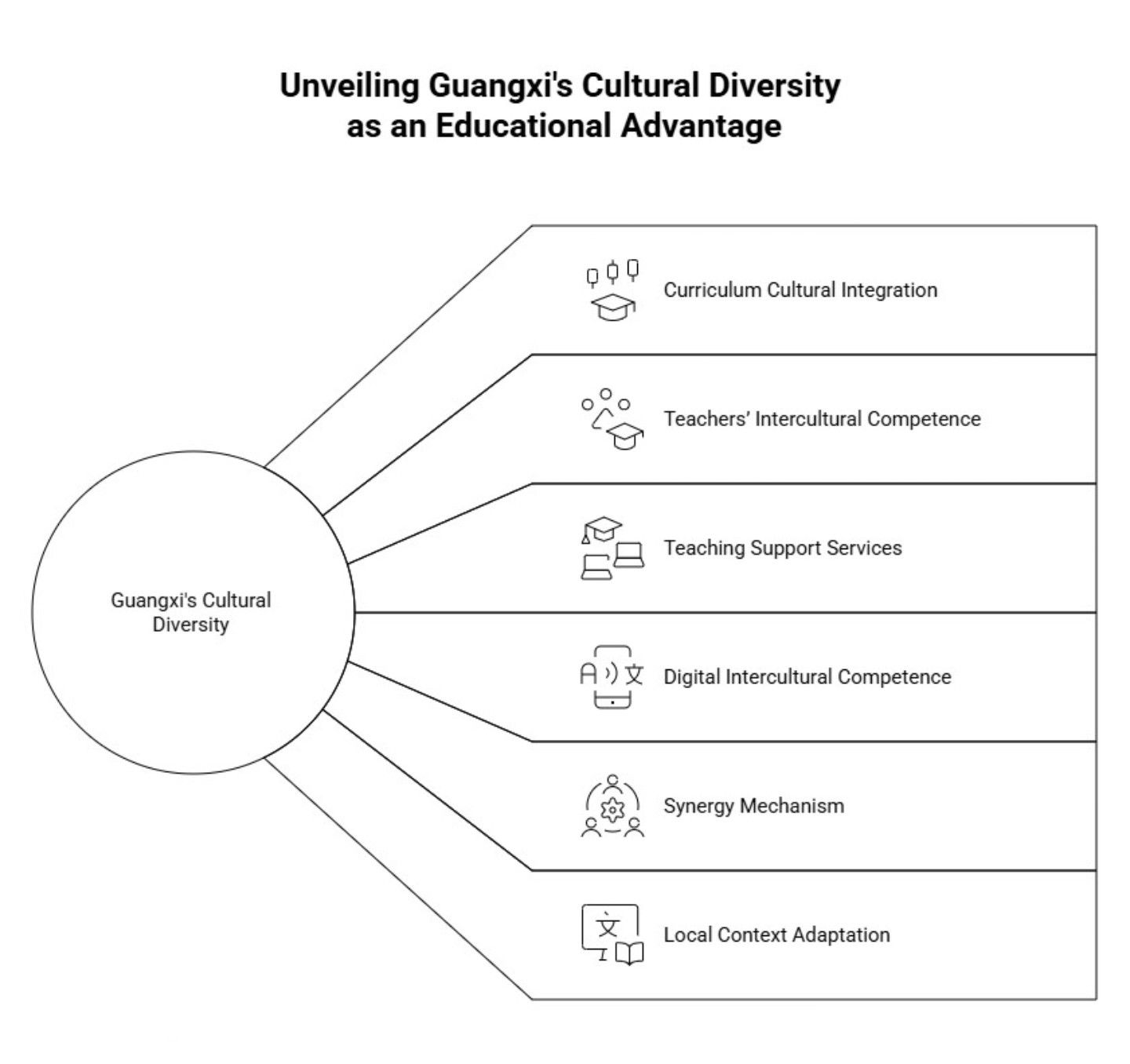
As a conceptual study, this research aimed to: (1) Construct a systematic theoretical framework for cross-cultural teaching management in Guangxi universities aligned with China-ASEAN educational cooperation; (2) Clarify core dimensions and variable relationships centered on Cultural Integration and Synergy Theory; (3) Propose testable hypotheses for subsequent empirical research. Through a four-step process—theoretical anchoring, conceptual deconstruction and synthesis, model deduction, and situational verification—the model integrated one core and five associated theories with local practical features. Results showed: (1) The model included six core dimensions, with Synergy Mechanism as the mediating variable and Inclusive Leadership as the moderating variable; (2) It overcame fragmented research limitations, with 13 hypotheses delineated direct, mediating, and moderating effects. Practically, it provided actionable guidelines for cross-cultural cooperation. Future empirical testing will employ survey data collected from more than 200 teachers across three representative universities in Guangxi, selected to reflect institutional diversity and China–ASEAN cooperation involvement. Overall, the model offered a standardized analytical framework with theoretical innovation and practical value.
Article Details

อนุญาตภายใต้เงื่อนไข Creative Commons Attribution-NonCommercial-NoDerivatives 4.0 International License.
เอกสารอ้างอิง
Adler, N. J. (1980). Cultural Synergy: The Management of Cross-cultural Organizations. Montreal: Faculty of Management, McGill University.
Adler, N. J. (1991). International dimensions of organizational behavior. (2nd ed.). Massachusetts: PWS-Kent Publishing Co.
Arndt, S., Madrid Akpovo, S., Tesar, M., Han, T., Huang, F., & Halladay, M. (2021). Collaborative online learning across borders (COLAB): Examining intercultural understandings of preservice teachers in a virtual cross-cultural university-based program. Journal of Research in Childhood Education, 35(2), 281-296.
Bantimaroudis, P. (2017). Bantimaroudis, P. (2017). Victor Roudometof, Glocalization: A Critical Introduction. International Journal of Communication 11, 728–730
Brooks, R., & Waters, J. (2009). International higher education and the mobility of UK students. Journal of Research in International Education, 8(2), 191-209.
Byram, M. (2020). Teaching and assessing intercultural communicative competence: Revisited. Bristol: Multilingual matters.
Cordeiro, C. M. (2018). Using systemic functional linguistics as method in identifying semogenic strategies in intercultural communication: A study of the collocation of “time” and “different” by Swedish managers with international management experiences. Journal of Intercultural Communication Research, 47(3), 207-225.
Czerniewicz, L., Agherdien, N., Badenhorst, J., Belluigi, D., Chambers, T., Chili, M., de Villiers, M., Felix, A., Gachago, D., Gokhale, C., Ivala, E., Kramm, N., Madiba, M., Mistri, G., Mgqwashu, E., Pallitt, N., Prinsloo, P., Solomon, K., Strydom, S., Swanepoel, M., Waghid, F., &Wissing, G. (2020). A wake-up call: Equity, inequality and Covid-19 emergency remote teaching and learning. Postdigital science and education, 2(3), 946-967.
De Wit, H., & Altbach, P. G. (2021). Internationalization in higher education: Global trends and recommendations for its future. Policy reviews in higher education, 5(1), 28-46.
Guo, J. (2024). Research on digital narratives of Chinese cultural communication from a cross-cultural perspective. In Proceedings of the 2024 3rd International Conference on Comprehensive Art and Cultural Communication (CACC 2024) (pp. 45–51). Dordrecht, Netherlands: Springer Nature.
Hofstede, G. (1999). Culture's consequences: International differences in work-related values. Beverly Hills, CA: Sage.
Islam, M. A., Hack-Polay, D., Rahman, M., Jantan, A. H., Dal Mas, F., & Kordowicz, M. (2023). Gender and leadership in public higher education in South Asia: examining the individual, socio-cultural and organizational barriers to female inclusion. Studies in Higher Education, 48(8), 1197-1215.
Kirkpatrick, D. L. (1959). Techniques for evaluation training programs. Journal of the american society of training directors, 13, 21-26.
Liu, Y. Y. (2022). Ten years of forging ahead: Guangxi education writes a new chapter. Beijing: China Education Daily.
Malinowski, B. (2013). Argonauts of the western Pacific: An account of native enterprise and adventure in the archipelagoes of Melanesian New Guinea [1922/1994]. Oxfordshire: Routledge.
Marginson, S. (2022). Research on international and global higher education: Six different perspectives. Oxford Review of Education, 48(4), 421-438.
Parsons, T. (1951). The social system. Washington, DC: Free Press.
Patel, F., & Lynch, H. (2013). Glocalization as an alternative to internationalization in higher education: Embedding positive glocal learning perspectives. International Journal of Teaching and Learning in Higher Education, 25(2), 223-230.
Patel, J. (2026). Universities and the Purpose of Higher Education: Expansion and Development in Post-War Britain. Oxfordshire: Taylor & Francis.
Randel, A. E., Galvin, B. M., Shore, L. M., Ehrhart, K. H., Chung, B. G., Dean, M. A., & Kedharnath, U. (2018). Inclusive leadership: Realizing positive outcomes through belongingness and being valued for uniqueness. Human resource management review, 28(2), 190-203.
Robertson, R. (1995). Glocalization: Time-space and homogeneity-heterogeneity. Global modernities, 2(1), 25-44.
Scott, C. (2020). Managing and regulating commitments to equality, diversity and inclusion in higher education. Irish Educational Studies, 39(2), 175-191.
Shen, T., & Croucher, S. M. (2018). A cross-cultural analysis of teacher confirmation and student motivation in China, Korea, and Japan. Journal of Intercultural Communication, 18(2), 1-12.
Shore, L. M., & Chung, B. G. (2022). Inclusive leadership: How leaders sustain or discourage work group inclusion. Group & organization management, 47(4), 723-754.
Trompenaars, F., & Hampden-Turner, C. (1997). Riding the Waves of Culture. (2nd ed.). London: Nicholas Brealey.
Vertovec, S. (2019). Talking around super-diversity. Ethnic and racial studies, 42(1), 125-139.
Votava, J. (2024). Multiclass: Multicultural Classrooms: Inclusive Learning and Teaching in Higher Education. Prague: Czech University of Life Sciences.
Yang, Z. (2025). Cultivating intercultural communicative competence among higher education students at a general university in China by using triad-layers ICC model. (Doctoral dissertation, Mae Fah Luang University).
Zhenling, S. U. (2024). A Study on the Impact of International Education Programs on the Global Competence of Teachers in Private Universities in Guangxi. US-China Education Review, 14(10), 687-696.
