
A Comparison of "le" in Mandarin Chinese and "lɛɛw" in Thai
Abstract
The purpose of this study is to compare the grammatical meaning and syntactic structure of "le1" and "le2" in Mandarin Chinese, and those of "le" in Mandarin Chinese and "lɛɛw" in Thai. The study shows that "le1" is an aspect marker indicating either completion of action or change, depending on the types of co-occurring indicates the occurrences of a new situation or a new state. Comparing "le1" and "le2" in Mandarin Chinese with "lɛɛw" in Thai, we find that "lɛɛw" in Thai shares similar grammatical meanings with "le1" and "le2" in Mandarin Chinese.
Downloads
Published
2007-08-01
How to Cite
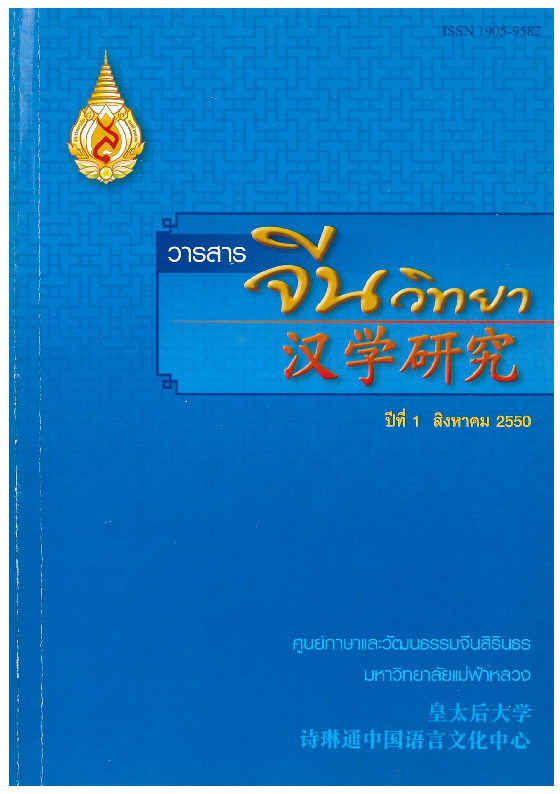
Amporndanai, S. (2007). A Comparison of "le" in Mandarin Chinese and "lɛɛw" in Thai . Journal of Sinology (วารสารจีนวิทยา), 1, 40–100. retrieved from https://so16.tci-thaijo.org/index.php/JSINO/article/view/2682
License

This work is licensed under a Creative Commons Attribution-NonCommercial-NoDerivatives 4.0 International License.
Articles in this journal are copyrighted by the x may be read and used for academic purposes, such as teaching, research, or citation, with proper credit given to the author and the journal.use or modification of the articles is prohibited without permission.
statements expressed in the articles are solely the opinions of the authors.
authors are fully responsible for the content and accuracy of their articles.
other reuse or republication requires permission from the journal."

