Factors Influencing the Demand for Retirement Financial Products Among the Working-Age Population in Bangkok
Article Sidebar
Main Article Content
Abstract
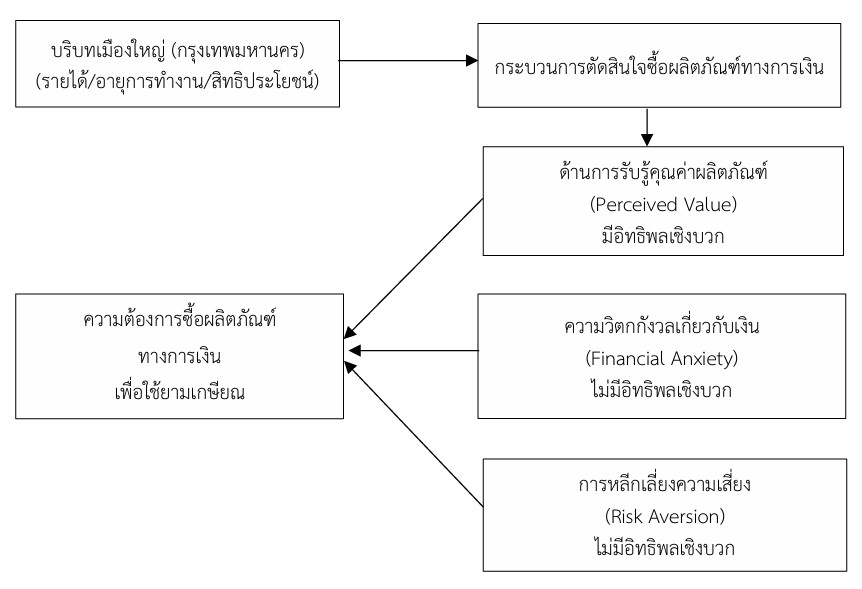
This study aimed to examine: (1) the relationship between the perceived value of retirement products and the desire to purchase retirement products; (2) the relationship between financial anxiety and the desire to purchase retirement products; and (3) the relationship between risk aversion and the desire to purchase retirement products. This quantitative research collected data using questionnaires from 385 working professionals aged 25–59 years in Bangkok. The data were analyzed using frequency distribution, percentages, means, and standard deviations, along with multiple regression analysis to test the hypotheses, with statistical significance set at the 0.05 level. The results showed that: (1) The perceived value of retirement products had a positive correlation with the desire to purchase retirement products, with statistical significance at the 0.05 level. Consumers who perceived the products as valuable, providing financial security, and offering appropriate returns had a higher intention and desire to purchase them. (2) Financial anxiety had no positive correlation with the desire to purchase retirement products. Although consumers were concerned about future expenses, uncertain income, and economic volatility, these concerns did not increase their intention to purchase retirement products. Conversely, they may lead to further delays in decision-making. (3) Risk aversion showed no positive correlation with the demand for retirement products. Even though consumers prioritize principal safety, high levels of risk aversion do not necessarily lead to increased demand. Consumers desire more information, transparency, and assurance before making a decision.
Article Details

This work is licensed under a Creative Commons Attribution-NonCommercial-NoDerivatives 4.0 International License.
References
เกื้อกูล ตรีพูนผล, สยา ทันตะเวช และ ดนีญา อุทัยสุข. (2566). ทักษะทางการเงินและความวิตกกังวลทางการเงินของครูดนตรีอิสระ ในโรงเรียนเอกชนนอกระบบ จังหวัดกรุงเทพมหานคร. วารสารดนตรีบ้านสมเด็จฯ, 5(2), 65–82.
ชเนรินทร์ ตาสา, สุกฤษฎิ์ ลิมโพธิ์ทอง และ พงศ์ศิริ คำขันแก้ว. (2565). อิทธิพลของการรับรู้คุณค่า การรับรู้ความเสี่ยง และการรับรู้ความน่าเชื่อถือที่ส่งผลต่อความตั้งใจซื้อประกันภัยผ่านระบบออนไลน์ของผู้บริโภค ในจังหวัดเชียงใหม่. วารสารวิชาการการตลาดและการจัดการ มหาวิทยาลัยเทคโนโลยีราชมงคลธัญบุรี, 9(1), 96-120
พรเพ็ญ สดศรีชัย. (2568). “สตางค์ Story” แบงก์ชาติใส่ใจการให้ความรู้ทางการเงิน. สืบค้นจาก https://www.bot.or.th/content/dam/bot/documents/th/research-and-publications-pdf/articles-and-publications/articles/download/2025/article-20250218.pdf.
มนต์ทนา คงแก้ว, นัดพลพิชัย ดุลยวาทิต และ ธันยาภรณ์ ดำจุติ. (2564). การลงทุนในผลิตภัณฑ์ทางการเงินของผู้สูงอายุยุคดิจิทัล. วารสารบริหารศาสตร์ มหาวิทยาลัยอุบลราชธานี, 10(2), 118-140.
วนิดา สมศรี และ ลดาวัลย์ ยมจินดา. (2566). ปัจจัยที่ส่งผลต่อการวางแผนทางการเงินเพื่อวัยเกษียณของบุคลากรสำนักงานผู้ตรวจการแผ่นดิน. วารสารปรัชญาดุษฎีบัณฑิตทางสังคมศาสตร์, 2(1), 50–64
สำนักงานสถิติแห่งชาติ. (2566). รายงานสถิติสังคมและเศรษฐกิจของประเทศไทย พ.ศ. 2566. กรุงเทพฯ: สำนักงานสถิติแห่งชาติ.
อัจฉราพรรณ ลีฬพันธ์, เสาวนิตย์ จันทนโรจน์, วิษณุ เหลืองลออ และ สวรส ศรีสุดโต. (2568). อิทธิพลของการรับรู้ความเสี่ยงและทัศนคติที่มีผลต่อการตัดสินใจลงทุนในผลิตภัณฑ์ทางการเงินของประชาชนในจังหวัดชายแดนภาคใต้. พัฒนาเทคนิคศึกษา, 37(134), 38-49.
อับบ๊าส พาลีเขตต์ และ มูฮัมหมัด ปุ. (2565). ปัจจัยที่มีผลต่อการวางแผนการเงินส่วนบุคคลของประชาชนในพื้นที่ 3 จังหวัดชายแดนภาคใต้. วารสารมหาวิทยาลัยราชภัฏยะลา, 17(3), 118-126.
Ahmed, M. A., Khattak, M. S., & Anwar, M. (2022). Personality traits and entrepreneurial intention: The mediating role of risk aversion. Journal of Public Affairs, 22(1), e2275.
Cochran, W. G. (1997). Sampling techniques. (3rd ed.). New York: John Wiley & Sons.
Elminejad, A., Havranek, T., & Irsova, Z. (2022). Relative risk aversion: A meta-analysis. Journal of Economic Surveys, 39(6), 2315–2333
Lee, Y. G., Kelley, H. H., & Lee, J. M. (2023). Untying financial stress and financial anxiety: Implications for research and financial practitioners. Journal of Financial Therapy, 14(1), 4.
Nunnally, J. C. (1978). An overview of psychological measurement. In Wohnan, B. B. (Ed.), Clinical diagnosis of mental disorders: A handbook (pp. 97-146). Boston: Springer.
Sheth, J. N., Newman, B. I., & Gross, B. L. (1991). Consumption values and market choices. Nashville, Tennessee: South-Western Publishing.
Sweeney, J. C., & Soutar, G. N. (2001). Consumer perceived value: The development of a multiple item scale. Journal of Retailing, 77(2), 203–220.
Tran, V.-T., Tran-Chi, V.-L., Nguyen-Thi, K.-S., & Nguyen, T. K. X. (2021). The relationship between financial anxiety and sugar dating among students at pedagogical universities in Vietnam. International Transaction Journal of Engineering, Management, & Applied Sciences & Technologies, 12(10), 1–8.
