อิทธิพลของการรับรู้ความรู้ด้านการเงินดิจิทัลต่อพฤติกรรมการลงทุนในคริปโทเคอร์เรนซีของนักลงทุนในเขตพื้นที่กรุงเทพมหานครและปริมณฑล
Article Sidebar
Main Article Content
บทคัดย่อ
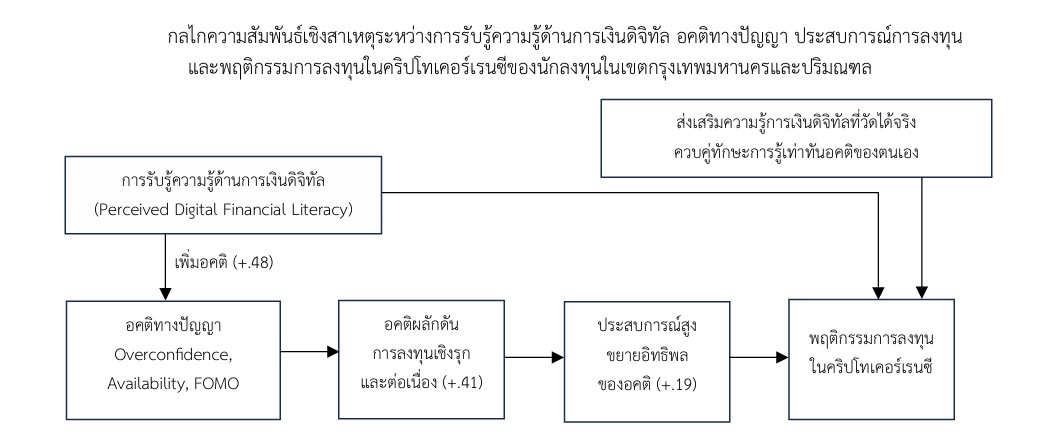
บทความวิจัยนี้มีวัตถุประสงค์เพื่อพัฒนาและตรวจสอบความสอดคล้องของโมเดลความสัมพันธ์เชิงสาเหตุ นอกจากนี้ยังศึกษาอิทธิพลทางตรง อิทธิพลทางอ้อมผ่านอคติทางปัญญาในฐานะตัวแปรส่งผ่าน และอิทธิพลกำกับของประสบการณ์การลงทุน ที่มีต่อพฤติกรรมการลงทุนในคริปโทเคอร์เรนซีของนักลงทุนในเขตกรุงเทพมหานครและปริมณฑล การวิจัยครั้งนี้เป็นการวิจัยเชิงปริมาณ กลุ่มตัวอย่าง ได้แก่ นักลงทุนที่เคยลงทุนในคริปโทเคอร์เรนซีและพำนักอยู่ในเขตกรุงเทพมหานครและปริมณฑล จำนวน 421 คน ได้มาโดยการเลือกตัวอย่างแบบสะดวก เก็บข้อมูลด้วยแบบสอบถามออนไลน์ และสถิติที่ใช้ในการวิเคราะห์ข้อมูล ได้แก่ สถิติเชิงบรรยาย ค่าความถี่และร้อยละ การวิเคราะห์องค์ประกอบเชิงยืนยัน และการวิเคราะห์โมเดลสมการโครงสร้าง ผลการศึกษาพบว่า 1) โมเดลความสัมพันธ์เชิงสาเหตุพฤติกรรมการลงทุนในคริปโทเคอร์เรนซีที่พัฒนาขึ้นมีความสอดคล้องกลมกลืนกับข้อมูลเชิงประจักษ์อยู่ในระดับดีทุกค่าดัชนี โดยตัวแปรแฝงทุกตัวมีความเชื่อมั่น ความต รงเชิงสอดคล้อง และความตรงเชิงจำแนกอยู่ในระดับที่ยอมรับได้ 2) สมมติฐานที่ 1, 3, 4 และ 5 ได้รับการสนับสนุนอย่างมีนัยสำคัญทางสถิติที่ระดับ .01 ส่วนสมมติฐานที่ 2 ไม่ได้รับการสนับสนุน โดยการรับรู้ความรู้ด้านการเงินดิจิทัลมีอิทธิพลทางตรงเชิงบวกต่อพฤติกรรมการลงทุนในคริปโทเคอร์เรนซี และมีอิทธิพลทางตรงเชิงบวกต่ออคติทางปัญญา ซึ่งตรงข้ามกับทิศทางที่ตั้งสมมติฐานไว้ อคติทางปัญญามีอิทธิพลทางตรงเชิงบวกต่อพฤติกรรมการลงทุนในคริปโทเคอร์เรนซี และทำหน้าที่เป็นตัวแปรส่งผ่านบางส่วนแบบเสริมกันระหว่างการรับรู้ความรู้ด้านการเงินดิจิทัลกับพฤติกรรมการลงทุนในคริปโทเคอร์เรนซี และประสบการณ์การลงทุนมีบทบาทกำกับความสัมพันธ์ระหว่างอคติทางปัญญากับพฤติกรรมการลงทุนในคริปโทเคอร์เรนซีอย่างมีนัยสำคัญ กล่าวคือ อิทธิพลเชิงบวกของอคติทางปัญญาต่อพฤติกรรมการลงทุนแรงขึ้นในกลุ่มนักลงทุนที่มีประสบการณ์สูงกว่า
Article Details

อนุญาตภายใต้เงื่อนไข Creative Commons Attribution-NonCommercial-NoDerivatives 4.0 International License.
เอกสารอ้างอิง
บริษัท หลักทรัพย์จัดการกองทุน ไทยพาณิชย์ จำกัด. (2568). รายงานประจำปี กองทุนรวมโครงสร้างพื้นฐานโทรคมนาคมดิจิทัล ปี 2568. สืบค้นจาก https://www.scbam.com/medias/fund-doc/annual/DIF_ANN_TH.pdf.
ศิริลักษณ์ ทัดเทียม และ นนทร์ วรพาณิชช์. (2565). ปัจจัยที่ส่งผลต่อการใช้คริปโทเคอร์เรนซี การวิเคราะห์โดยใช้แบบจำลองสมการโครงสร้างและการวิเคราะห์เส้นทาง. วารสารสังคมศาสตร์ปัญญาพัฒน์, 4(3), 31–44.
ศุขจิภา ศรีภิรมย์, พัชรา ตันติประภา และ อรชร มณีสงฆ์. (2568). การเปรียบเทียบพฤติกรรมการเลือกลงทุนในคริปโทเคอร์เรนซีของเจเนอเรชันซีเพศชายและหญิง. วารสารปัญญาภิวัฒน์, 17(2), 143–158.
สำนักงานคณะกรรมการกำกับหลักทรัพย์และตลาดหลักทรัพย์. (2569). รายงานสรุปภาวะตลาดสินทรัพย์ดิจิทัลรายเดือน. สืบค้นจาก https://www.sec.or.th/TH/Pages/DAMonthlyReport.aspx.
Addo, J. O., Cúg, J., Keelson, S. A., Amoah, J., & Petráková, Z. (2025). Behavioral risk management in investment strategies: Analyzing investor psychology. International Journal of Financial Studies, 13(2), 53.
Aftab, R., Fazal, A., & Andleeb, R. (2025). Behavioral biases and Fintech adoption: Investigating the role of financial literacy. Acta psychologica, 257, 105065.
Ahmad, U., Van Keulen, M., Briassouli, A., & Saad, M. (2025). Cognitive biases, Robo advisor and investment decision psychology: An investor's perspective from New York stock exchange. Acta psychologica, 256, 105048.
Aiken, L. S., West, S. G., & Reno, R. R. (1991). Multiple Regression: Testing and Interpreting Interactions. Thousand Oaks, CA: Sage.
Anderson, J. C., & Gerbing, D. W. (1984). The effect of sampling error on convergence, improper solutions, and goodness-of-fit indices for maximum likelihood confirmatory factor analysis. Psychometrika, 49(2), 155-173.
Babu, D. R., Sreenivas, T., Kumar, N. H., Panda, H. K., & Reddy, B. R. (2025). Behavioural biases and the diversification puzzle: Why investors fail to build optimal portfolios. International Journal of Business and Management Sciences, 1(1), 23-26.
Baron, R. M., & Kenny, D. A. (1986). The moderator–mediator variable distinction in social psychological research: Conceptual, strategic, and statistical considerations. Journal of personality and social psychology, 51(6), 1173–1182.
Bentler, P. M. (2005). EQS 6 Structural Equations Program Manual. Encino, CA: Multivariate Software.
Bosch-Rosa, C., & Corgnet, B. (2022). Cognitive finance. In S. Füllbrunn & E. Haruvy (Eds.), Handbook of experimental finance (pp. 73-88). Cheltenham: Edward Elgar.
Chen, H., & Volpe, R. P. (1998). An analysis of personal financial literacy among college students. Financial services review, 7(2), 107-128.
Cohen, J. (1988). Statistical power analysis for the behavioral sciences. (2nd ed.). Hillsdale, NJ: Lawrence Erlbaum Associates.
Coingecko. (2026). 2026 Q1 crypto industry report. Retrieved from https://www.coingecko.com/research/publications/2026-q1-crypto-industry-report.
Fornell, C., & Larcker, D. F. (1981). Evaluating structural equation models with unobservable variables and measurement error. Journal of marketing research, 18(1), 39-50.
Hadiwidjaja, R. D., Trisnowati, Y., & Kahar, M. R. (2026). The digital financial literacy and current financial behavior in Indonesia small medium enterprise. Jurnal Akuntansi, Keuangan, Pajak dan Informasi, 6(1), 47-58.
Hair, J. F., Black, W. C., Babin, B. J., & Anderson, R. E. (2010). Multivariate data analysis: A global perspective. (7th ed.). Upper Saddle River, NJ: Pearson Education.
Henseler, J., Ringle, C. M., & Sarstedt, M. (2015). A new criterion for assessing discriminant validity in variance-based structural equation modeling. Journal of the academy of marketing science, 43(1), 115-135.
Hoelter, J. W. (1983). The effects of role evaluation and commitment on identity salience. Social Psychology Quarterly, 46(2), 140–147.
Iamin, G. (2025). Are crypto-investors overconfident? The role of risk propensity and demographics. Evidence from Brazil and Portugal. The Journal of Risk Finance, 26(1), 147-173.
Katenova, M., Frolova, Y., & Schmunkamp, P. (2025). Behavioral Finance in the sphere of investment: Systematic Review of Literature between 2020 and 2025. F1000Research, 14, 949.
Kline, R. B. (2011). Principles and practice of structural equation modeling. (3rd ed.). New York: Guilford Press.
Kolb, D. A. (1984). Experiential learning: Experience as the source of learning and development. Englewood Cliffs, NJ: Prentice-Hall.
Koskelainen, T., Kalmi, P., Scornavacca, E., & Vartiainen, T. (2023). Financial literacy in the digital age-A research agenda. Journal of Consumer Affairs, 57(1), 507-528.
Likert, R. (1967). The method of constructing an attitude scale. In M. Fishbein (Ed.), Readings in attitude theory and measurement (pp. 90–95). New York: Wiley.
Lipshits, R., Goldstein, K., Goldstein, A., Eichel, R., & Goldstein, A. (2025). Novel Approach to Modeling Investor Decision-Making Using the Dual-Process Theory: Synthesizing Experimental Methods from Within-Subjects to Between-Subjects Designs. Mathematics, 13(19), 3090.
Lusardi, A., & Mitchell, O. S. (2014). The economic importance of financial literacy: Theory and evidence. Journal of economic literature, 52(1), 5-44.
MacCallum, R. C., Browne, M. W., & Sugawara, H. M. (1996). Power analysis and determination of sample size for covariance structure modeling. Psychological Methods, 1(2), 130–149.
Maheshwari, H., & Samantaray, A. K. (2026). Navigating investment challenges: financial literacy and digital advisory services in countering behavioural biases. International Journal of Sociology and Social Policy, 46(3-4), 409-425.
Nofsinger, J. R. (2017). The psychology of investing. (6th ed.). New York: Routledge.
OECD. (2026). Digital financial literacy core competency framework for adults in ASEAN. Paris, France: OECD Publishing.
Ruiz-Dotras, E., & Llados-Masllorens, J. (2026). Investment Experience and Financial Vulnerability: The Role of Financial Literacy, Gender and Social Context. Journal of Risk and Financial Management, 19(5), 369.
van den Akker, M. M. L. H. (2025). The adaptive nudge framework: advancing ethical behavioural design in financial decision-making. Journal of Social Impact in Business Research, 1(2), 3-19.
Yadav, M. (2024). Behavioral biases of cryptocurrency investors: a prospect theory model to explain cryptocurrency returns. Review of Behavioral Finance, 16(4), 643-667.