Developing Learning Activities through a Creative Practice-Based Research Process to Promote Artistic Creativity Skills among Students in the Faculty of Fine and Applied Arts
Article Sidebar
Main Article Content
Abstract
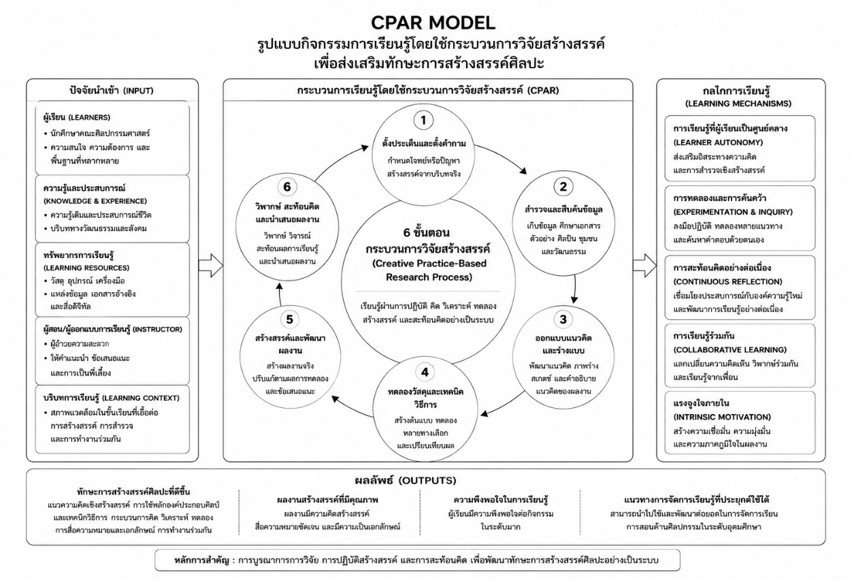
This research aimed to (1) develop learning activities based on a Creative Practice-Based Research Process, (2) examine changes in students’ artistic creativity skills before and after participating in the developed learning activities, and (3) examine students’ satisfaction with the learning activities. The sample consisted of 25 undergraduate students from the Faculty of Fine and Applied Arts, Rajamangala University of Technology Thanyaburi, who were enrolled in an art creation-related course. Participants were selected using purposive sampling. The research instruments included learning activities based on a Creative Practice-Based Research Process, an analytic rubric for assessing artistic creativity skills, and a student satisfaction questionnaire. Data were analyzed using the mean and standard deviation. The findings revealed that the developed learning activities supported the development of students’ artistic creativity skills. The mean score after the learning activities (x̄ = 4.30) was higher than the mean score before the learning activities (x̄ = 2.81), indicating positive changes in creative conceptual development, the application of artistic elements and techniques, analytical and experimental thinking, artistic communication and expression, and participation and collaborative work. In addition, students reported a high level of satisfaction across all five dimensions of the learning activities. These findings suggest that student-centered learning integrated with a Creative Practice-Based Research Process provides an appropriate instructional approach for promoting artistic creativity skills and can be applied to art education in higher education.
Article Details

This work is licensed under a Creative Commons Attribution-NonCommercial-NoDerivatives 4.0 International License.
References
ณิชกานต์ ไชยจักร. (2564). การปลูกฝังการเรียนรู้ของเด็กด้วยสายสัมพันธ์รังสรรค์ศิลปะ. วารสารมหาวิทยาลัยศิลปากร, 41(6), 53–65.
สุชาติ เถาทอง. (2553). การวิจัยสร้างสรรค์ทัศนศิลป์. ชลบุรี: คณะศิลปกรรมศาสตร์ มหาวิทยาลัยบูรพา.
อาทิตย์ กระจ่างศรี. (2565). การสร้างสรรค์ดนตรีพื้นเมืองอีสานเชิงวิชาการ. แก่นดนตรีและการแสดง มหาวิทยาลัยขอนแก่น, 4(1), 85–106.
Candy, L., & Edmonds, E. (2018). Practice-based research in the creative arts: Foundations and futures from the front line. Leonardo, 51(1), 63-69.
Catarino, P., Vasco, P., Lopes, J., Silva, H., & Morais, E. (2019). Cooperative learning on promoting creative thinking and mathematical creativity in higher education. REICE. Revista Iberoamericana Sobre Calidad, Eficacia y Cambio En Educacion, 17(3), 5-22.
Deci, E. L., & Ryan, R. M. (1985). Intrinsic motivation and self-determination in human behavior. New York: Plenum.
Guilford, J. P. (1967). The Nature of Human Intelligence. New York: McGraw-Hill.
Herzberg, F., Mausner, B., & Snyderman, B. (1959). The motivation to work. New York: Wiley.
Jones, E. K., Kittendorf, A. L., & Kumagai, A. K. (2017). Creative art and medical student development: a qualitative study. Medical education, 51(2), 174-183.
Karunarathne, W., & Calma, A. (2024). Assessing creative thinking skills in higher education: deficits and improvements. Studies in Higher Education, 49(1), 157-177.
Maslow, A. H. (1943). A theory of human motivation. Psychological Review, 50(4), 370–396.
Mingyu, S., & Ayob, A. (2025). Influence of visual art participation on creative thinking for art and design private college student in Guangzhou, China. ICCCM Journal of Social Sciences and Humanities, 4(1), 1-9.
Piaget, J. (1972). The psychology of the child. New York: Basic Books.
Smith, H., & Dean, R. T. (Eds.). (2009). Practice-led Research, Research-led Practice in the Creative Arts. Edinburgh: Edinburgh University Press.
Tam, C. O. (2023). Integrating creative thinking skills pedagogies into a higher education visual arts course. International Journal of Art & Design Education, 42(1), 16-32.
Ulger, K. (2016). The relationship between creative thinking and critical thinking skills of students. Hacettepe University Journal of Education, 31(4), 695-710.
Vygotsky, L. S. (1978). Mind in society: The development of higher psychological processes. Cambridge, Massachusetts: Harvard University Press.
Xia, T., Karanyathikul, A., & Kotchasit, S. (2023). Effect of learning management using interactive teaching mode on students’ learning achievement and creative ability of Chinese contemporary oil painting. International Journal of Sociologies and Anthropologies Science Reviews, 3(5), 139-148.
