Theoretical Paradoxes in Keith C. Barton's Inquiry-Based History Teaching Method: A Critical Analytic Study
Article Sidebar
Main Article Content
บทคัดย่อ
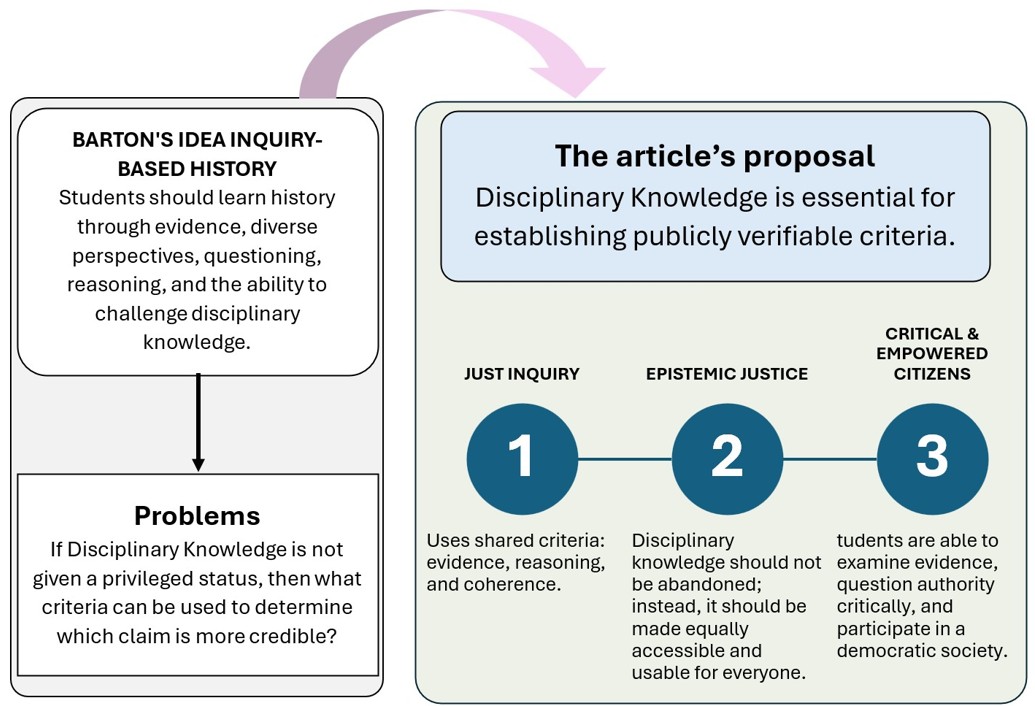
This article critically examines the claim that disciplinary knowledge functions as a tool of oppression, particularly within the context of history education. Through conceptual analysis, logical reconstruction of arguments, and critical examination of their epistemic assumptions, this article reassesses the role of disciplinary knowledge in shaping students’ understanding and its implications for epistemic justice. Drawing on Barton’s arguments and relevant theoretical perspectives, the study aims to reassess the role of disciplinary knowledge in shaping students’ understanding and its implications for epistemic justice. While existing critiques often emphasize the exclusionary and power-laden nature of knowledge systems, this article argues that such views risk oversimplifying the function of disciplinary knowledge by conflating its misuse with its intrinsic characteristics. The analysis demonstrates that disciplinary knowledge is distinguished by its reliance on systematic methods, conceptual clarity, and publicly verifiable criteria, which enable learners to engage in critical and reflective thinking. Rather than reinforcing domination, these epistemic structures provide students with the intellectual tools necessary to question dominant narratives and challenge existing inequalities. The article further argues that the true source of epistemic injustice lies not in the presence of disciplinary knowledge in the curriculum, but in the unequal distribution of access to it. By reframing the debate, the study highlights that denying students access to disciplinary knowledge may perpetuate deeper forms of marginalization, as it limits their ability to participate in informed critique and democratic processes. Ultimately, the article concludes that expanding equitable access to disciplinary knowledge is essential for fostering intellectual empowerment and promoting a more just and inclusive educational framework.
Article Details

อนุญาตภายใต้เงื่อนไข Creative Commons Attribution-NonCommercial-NoDerivatives 4.0 International License.
เอกสารอ้างอิง
Arnot, M., & Reay, D. (2004). The framing of pedagogic encounters: Regulating the social order in classroom learning. In J. Muller, B. Davies, & A. Morais (Eds.), Reading Bernstein, researching Bernstein (pp. 155–168). London: Routledge.
Atkinson, R. F. (1978). Knowledge and explanation in history: An introduction to the philosophy of history. Macmillan Education Ltd.
Banks, J. A. (1995). The historical reconstruction of knowledge about race: Implications for transformative teaching. Educational researcher, 24(2), 15-25.
Barber, B. R. (2003). Strong democracy: Participatory politics for a new age. University of California Press.
Barton, K. C. (2024). Knowledge without disciplines: A critique of social realism’s disciplinary fixation. Journal of Curriculum Studies, 56(3), 235-245.
Barton, K. C., & Ho, L.-C. (2022). Curriculum for justice and harmony: Deliberation, knowledge, and action in social and civic education. London: Routledge.
Barton, K. C., & Levstik, L. S. (2003). Why don't more history teachers engage students in interpretation?. Social Education, 67(6), 358-358.
Barton, K. C., & Levstik, L. S. (2004). Teaching history for the common good. London: Routledge.
Bernstein, B. (2000). Pedagogy, symbolic control, and identity. Bloomsbury: Bloomsbury Publishing PLC.
Bezgrebelna, M., & Teo, T. (2022). Epistemic violence. In L. R. Kurtz (Ed.), Encyclopedia of Violence, Peace, & Conflict (3rd ed., pp. 76–81). Academic Press.
Bhaskar, R. (1998). The Possibility of Naturalism: A Philosophical Critique of the Contemporary Human Sciences. (3rd ed.). London: Routledge.
Deng, Z. (2021). Powerful knowledge, transformations and Didaktik/curriculum thinking. British Educational Research Journal, 47(6), 1652-1674.
Donnelly, M., & Norton, C. (2020). Doing History. London: Routledge.
Eisner, E. W. (1984). Can the humanities be taught in American public schools? In B. Ladner (Ed.), The humanities in precollegiate education: Eighty-third yearbook of the National Society for the Study of Education, Part II (pp. 113–126). Chicago: University of Chicago Press.
Fraser, N. (1994). Rethinking the public sphere: A contribution to the critique of actually existing democracy. In H. A. Giroux & P. McLaren (Eds.), Between borders: Pedagogy and the politics of cultural studies (pp. 69–98). London: Routledge.
Fricker, M. (2007). Epistemic injustice: Power and the ethics of knowing. Oxford university press.
Gardner, H. (1991). The unschooled mind: How children think and how schools should teach. Basic Books.
Gardner, H., & Boix-Mansilla, V. (1994). Teaching for understanding in the disciplines-and beyond. Teachers College Record, 96(2), 198-218.
Gutmann, A. (1996). Democratic citizenship. In M. C. Nussbaum & J. Cohen (Eds.), For love of country: Debating the limits of patriotism (pp. 66–71). Beacon Press.
Heehs, P. (1994). Myth, history, and theory. History and Theory, 33(1), 1-19.
Martin, J. R. (1969). The disciplines and the curriculum. Educational Philosophy & Theory, 1(1), 23–40.
Maton, K., & Moore, R. (2010). Coalitions of the mind. In K. Maton & R. Moore (Eds.), Social realism, knowledge and the sociology of education: Coalitions of the mind (pp. 1–13). London: Routledge.
Newmann, F. M. (1975). Education for citizen action. London: McCutchan Publishing Corporation.
Putnam, R. D. (2000). Bowling alone: The collapse and revival of American community. New York: Simon and schuster.
Rata, E. (2014). The three stages of critical policy methodology: An example from curriculum analysis. Policy Futures in Education, 12(3), 347-358.
Roberts, J. J. (1976). Myth “versus” History. The Catholic Biblical Quarterly, 38(1), 1-13.
Rodríguez-Moneo, M., Carretero, M., & Gutiérrez-Cano, M. (2025). History Education: past, present, and challenges for the future. Current opinion in psychology, 67, 102188.
Seixas, P. (1993). The Community of Inquiry as a Basis for Knowledge and Learning: The Case of History. American Educational Research Journal, 30(2), 305–324.
Spivak, G. C. (1988). Can the subaltern speak? In C. Nelson & L. Grossberg (Eds.), Marxism and the interpretation of culture (pp. 271–313). Champaign: University of Illinois Press.
Teo, T. (2008). From speculation to epistemological violence in psychology: A critical-hermeneutic reconstruction. Theory & Psychology, 18(1), 47-67.
Teo, T. (2010). What is epistemological violence in the empirical social sciences?. Social and personality psychology compass, 4(5), 295-303.
Teo, T. (2011). Empirical race psychology and the hermeneutics of epistemological violence. Human Studies, 34(3), 237-255.
Wheelahan, L. (2012). Why knowledge matters in curriculum: A social realist argument. London: Routledge.
Willinsky, J. (1998). Learning to divide the world: Education at empire's end. New York: University of Minnesota Press.
Young, M. (2008a). Bringing knowledge back in: From social constructivism to social realism in the sociology of education. London: Routledge.
Young, M. (2008b). From constructivism to realism in the sociology of the curriculum. Review of research in education, 32(1), 1-28.
Young, M., & Muller, J. (2013). On the powers of powerful knowledge. Review of education, 1(3), 229-250.
