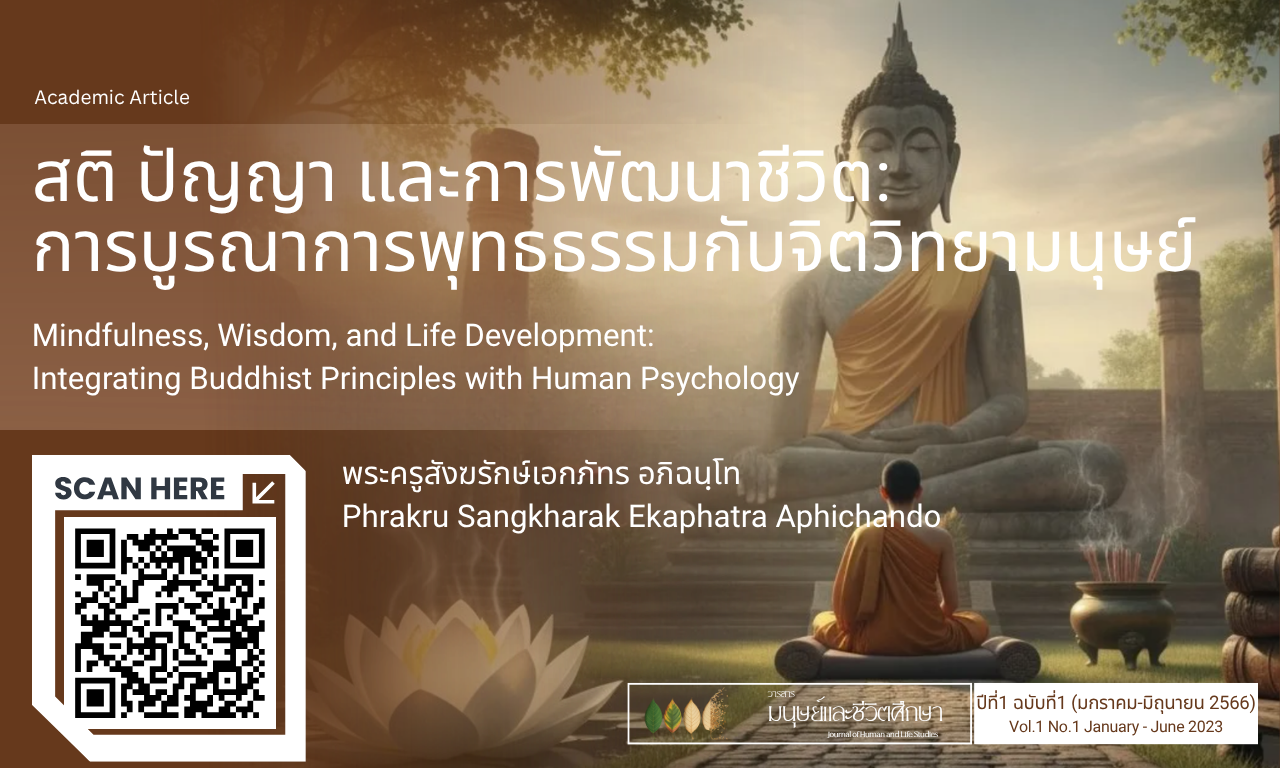
สติ ปัญญา และการพัฒนาชีวิต: การบูรณาการพุทธธรรมกับจิตวิทยามนุษย์
Mindfulness, Wisdom, and Life Development: Integrating Buddhist Principles with Human Psychology
คำสำคัญ:
สติ, ปัญญา, พุทธธรรม, จิตวิทยามนุษย์, การพัฒนาชีวิตบทคัดย่อ
บทความวิชาการนี้มีวัตถุประสงค์เพื่อศึกษาและวิเคราะห์การบูรณาการแนวคิดสติและปัญญาในพุทธธรรมกับจิตวิทยามนุษย์สมัยใหม่ โดยเน้นการประยุกต์ใช้เพื่อการพัฒนาชีวิตอย่างองค์รวม การศึกษาครั้งนี้ใช้วิธีการวิเคราะห์เชิงเอกสารและการสังเคราะห์แนวคิดจากแหล่งข้อมูลทางวิชาการ พบว่า สติ (Mindfulness) ในทางพุทธศาสนามีความหมายกว้างกว่าแนวคิดในจิตวิทยาสมัยใหม่ ครอบคลุมทั้งการระลึกรู้ในปัจจุบันขณะและการพิจารณาเห็นธรรมชาติที่แท้จริงของปรากฏการณ์ ขณะที่ปัญญา (Wisdom) เป็นความรู้แจ้งเห็นจริงที่เกิดจากการพัฒนาสติและสมาธิ สามารถนำไปสู่การเปลี่ยนแปลงเชิงพุทธิปัญญาและพฤติกรรม การบูรณาการทั้งสองมิตินี้กับจิตวิทยาสมัยใหม่ ทำให้เกิดกรอบแนวคิดที่สามารถประยุกต์ใช้ในการพัฒนาสุขภาวะทางจิต การจัดการอารมณ์ การสร้างความยืดหยุ่นทางจิตใจ และการพัฒนาศักยภาพของมนุษย์อย่างรอบด้าน ผลการศึกษาชี้ให้เห็นว่า การฝึกสติและการพัฒนาปัญญาในแนวพุทธศาสนามีหลักฐานเชิงประจักษ์สนับสนุนประสิทธิผลในการลดความเครียด เพิ่มความสามารถในการควบคุมตนเอง และส่งเสริมคุณภาพชีวิตที่ดีขึ้น ทั้งนี้ การบูรณาการดังกล่าวจำเป็นต้องคำนึงถึงบริบททางวัฒนธรรมและการปรับใช้ให้เหมาะสมกับสังคมร่วมสมัย
เอกสารอ้างอิง
Analayo, B. (2003). Satipatthana: The direct path to realization. Windhorse Publications.
Ardelt, M. (2003). Empirical assessment of a three-dimensional wisdom scale. Research on Aging, 25(3), 275–324. https://doi.org/10.1177/0164027503251764
Baer, R. A., Smith, G. T., Hopkins, J., Krietemeyer, J., & Toney, L. (2006). Using self-report assessment methods to explore facets of mindfulness. Assessment, 13(1), 27–45. https://doi.org/10.1177/1073191105283504
Baltes, P. B., & Staudinger, U. M. (2000). Wisdom: A metaheuristic (pragmatic) to orchestrate mind and virtue toward excellence. American Psychologist, 55(1), 122–136. https://doi.org/10.1037/0003-066X.55.1.122
Bodhi, B. (2000). The connected discourses of the Buddha: A new translation of the Samyutta Nikaya. Wisdom Publications.
Bodhi, B. (2005). In the Buddha’s words: An anthology of discourses from the Pali Canon. Wisdom Publications.
Bodhi, B. (2011). What does mindfulness really mean? A canonical perspective. Contemporary Buddhism, 12(1), 19–39. https://doi.org/10.1080/14639947.2011.564813
Brown, K. W., & Ryan, R. M. (2003). The benefits of being present: Mindfulness and its role in psychological well-being. Journal of Personality and Social Psychology, 84(4), 822–848. https://doi.org/10.1037/0022-3514.84.4.822
Carlson, L. E., Speca, M., Faris, P., & Patel, K. D. (2007). One-year pre–post intervention follow-up of psychological, immune, endocrine, and blood pressure outcomes of mindfulness-based stress reduction (MBSR) in breast and prostate cancer outpatients. Brain, Behavior, and Immunity, 21(8), 1038–1049. https://doi.org/10.1016/j.bbi.2007.04.002
Chambers, R., Gullone, E., & Allen, N. B. (2009). Mindful emotion regulation: An integrative review. Clinical Psychology Review, 29(6), 560–572. https://doi.org/10.1016/j.cpr.2009.06.005
Chmitorz, A., Kunzler, A., Helmreich, I., Tüscher, O., Kalisch, R., Kubiak, T., Wessa, M., & Lieb, K. (2018). Intervention studies to foster resilience: A systematic review and proposal for a resilience framework in future intervention studies. Clinical Psychology Review, 59, 78–100. https://doi.org/10.1016/j.cpr.2017.11.002
Cousins, L. S. (1984). Samatha-yāna and vipassanā-yāna. In G. Dhammapala, R. Gombrich, & K. Norman (Eds.), Buddhist studies in honour of Hammalava Saddhatissa (pp. 56–68). University of Sri Jayewardenepura.
Frankl, V. E. (1963). Man’s search for meaning: An introduction to logotherapy. Washington Square Press.
Fredrickson, B. L., Cohn, M. A., Coffey, K. A., Pek, J., & Finkel, S. M. (2008). Open hearts build lives: Positive emotions, induced through loving-kindness meditation, build consequential personal resources. Journal of Personality and Social Psychology, 95(5), 1045–1062. https://doi.org/10.1037/a0013262
Gethin, R. (1998). The foundations of Buddhism. Oxford University Press.
Gethin, R. (2001). The Buddhist path to awakening. Oneworld Publications.
Goldin, P. R., & Gross, J. J. (2010). Effects of mindfulness-based stress reduction (MBSR) on emotion regulation in social anxiety disorder. Emotion, 10(1), 83–91. https://doi.org/10.1037/a0018441
Goldstein, J. (2002). One Dharma: The emerging Western Buddhism. HarperCollins.
Gunaratana, B. (2002). Mindfulness in plain English. Wisdom Publications.
Harvey, P. (2000). An introduction to Buddhist ethics. Cambridge University Press.
Hayes, S. C., Luoma, J. B., Bond, F. W., Masuda, A., & Lillis, J. (2006). Acceptance and commitment therapy: Model, processes and outcomes. Behaviour Research and Therapy, 44(1), 1–25. https://doi.org/10.1016/j.brat.2005.06.006
Hölzel, B. K., Carmody, J., Vangel, M., Congleton, C., Yerramsetti, S. M., Gard, T., & Lazar, S. W. (2010). Mindfulness practice leads to increases in regional brain gray matter density. Psychiatry Research: Neuroimaging, 191(1), 36–43. https://doi.org/10.1016/j.pscychresns.2010.08.006
Hölzel, B. K., Lazar, S. W., Gard, T., Schuman-Olivier, Z., Vago, D. R., & Ott, U. (2011). How does mindfulness meditation work? Proposing mechanisms of action from a conceptual and neural perspective. Perspectives on Psychological Science, 6(6), 537–559. https://doi.org/10.1177/1745691611419671
Jain, S., Shapiro, S. L., Swanick, S., Roesch, S. C., Mills, P. J., Bell, I., & Schwartz, G. E. (2007). A randomized controlled trial of mindfulness meditation versus relaxation training. Annals of Behavioral Medicine, 33(1), 11–21. https://doi.org/10.1207/s15324796abm3301_2
Kabat-Zinn, J. (1994). Wherever you go, there you are: Mindfulness meditation in everyday life. Hyperion.
Kabat-Zinn, J. (2003). Mindfulness-based interventions in context: Past, present, and future. Clinical Psychology: Science and Practice, 10(2), 144–156. https://doi.org/10.1093/clipsy.bpg016
Kabat-Zinn, J. (2005). Coming to our senses: Healing ourselves and the world through mindfulness. Hyperion.
Kang, C., & Whittingham, K. (2010). Mindfulness: A dialogue between Buddhism and clinical psychology. Mindfulness, 1(3), 161–173. https://doi.org/10.1007/s12671-010-0018-1
Kashdan, T. B., & Rottenberg, J. (2010). Psychological flexibility as a fundamental aspect of health. Clinical Psychology Review, 30(7), 865–878. https://doi.org/10.1016/j.cpr.2010.03.001
Kemeny, M. E., et al. (2012). Contemplative/emotion training reduces negative emotional behavior and promotes prosocial responses. Emotion, 12(2), 338–350. https://doi.org/10.1037/a0026118
Khoury, B., et al. (2013). Mindfulness-based therapy: A comprehensive meta-analysis. Clinical Psychology Review, 33(6), 763–771. https://doi.org/10.1016/j.cpr.2013.05.005
Klimecki, O. M., et al. (2013). Functional neural plasticity and associated changes in positive affect after compassion training. Cerebral Cortex, 23(7), 1552–1561. https://doi.org/10.1093/cercor/bhs142
Kornfield, J. (1993). A path with heart: A guide through the perils and promises of spiritual life. Bantam Books.
Leiberg, S., Klimecki, O., & Singer, T. (2011). Short-term compassion training increases prosocial behavior. PLoS ONE, 6(3), e17798. https://doi.org/10.1371/journal.pone.0017798
Linehan, M. M. (1993). Cognitive-behavioral treatment of borderline personality disorder. Guilford Press.
Mahasi Sayadaw. (1990). Practical insight meditation: Basic and progressive stages. Buddhist Publication Society.
Monteiro, L. M., Musten, R. F., & Compson, J. (2015). Traditional and contemporary mindfulness. Mindfulness, 6(1), 1–13. https://doi.org/10.1007/s12671-014-0301-7
Neff, K. D., & Germer, C. K. (2013). Mindful self-compassion program. Journal of Clinical Psychology, 69(1), 28–44. https://doi.org/10.1002/jclp.21923
Nyanaponika, T. (1962). The heart of Buddhist meditation. Buddhist Publication Society.
Nyanaponika, T. (1998). Abhidhamma studies (4th ed.). Wisdom Publications.
Olendzki, A. (2010). Unlimiting mind. Wisdom Publications.
Salovey, P., & Mayer, J. D. (1990). Emotional intelligence. Imagination, Cognition and Personality, 9(3), 185–211. https://doi.org/10.2190/DUGG-P24E-52WK-6CDG
Segal, Z. V., Williams, J. M. G., & Teasdale, J. D. (2002). Mindfulness-based cognitive therapy for depression. Guilford Press.
Shapiro, S. L., Carlson, L. E., Astin, J. A., & Freedman, B. (2006). Mechanisms of mindfulness. Journal of Clinical Psychology, 62(3), 373–386. https://doi.org/10.1002/jclp.20237
Tang, Y. Y., Hölzel, B. K., & Posner, M. I. (2015). The neuroscience of mindfulness meditation. Nature Reviews Neuroscience, 16(4), 213–225. https://doi.org/10.1038/nrn3916
Teasdale, J. D., et al. (2000). Prevention of relapse in major depression. Journal of Consulting and Clinical Psychology, 68(4), 615–623. https://doi.org/10.1037/0022-006X.68.4.615
Thompson, R. W., Arnkoff, D. B., & Glass, C. R. (2011). Mindfulness and acceptance as resilience. Trauma, Violence, & Abuse, 12(4), 220–235. https://doi.org/10.1177/1524838011416375
Tugade, M. M., & Fredrickson, B. L. (2004). Positive emotions and resilience. Journal of Personality and Social Psychology, 86(2), 320–333. https://doi.org/10.1037/0022-3514.86.2.320
Walshe, M. (1995). The long discourses of the Buddha. Wisdom Publications.
Witkiewitz, K., et al. (2013). Mindfulness-based relapse prevention. Addictive Behaviors, 38(2), 1563–1571. https://doi.org/10.1016/j.addbeh.2012.04.001
ดาวน์โหลด
เผยแพร่แล้ว
รูปแบบการอ้างอิง
ฉบับ
ประเภทบทความ
สัญญาอนุญาต
ลิขสิทธิ์ (c) 2023 วารสารมนุษย์และชีวิตศึกษา

อนุญาตภายใต้เงื่อนไข Creative Commons Attribution-NonCommercial-NoDerivatives 4.0 International License.
บทความที่ได้รับการตีพิมพ์เป็นลิขสิทธิ์ของวารสารมนุษย์และชีวิตศึกษา
ข้อความที่ปรากฏในบทความแต่ละเรื่องในวารสารวิชาการเล่มนี้เป็นความคิดเห็นส่วนตัวของผู้เขียนแต่ละท่านไม่เกี่ยวข้องกับวารสารชีวิตศึกษา และกองบรรณาธิการท่านอื่นๆ ในสำนักพิมพ์ฯ แต่อย่างใด ความรับผิดชอบองค์ประกอบทั้งหมดของบทความแต่ละเรื่องเป็นของผู้เขียนแต่ละท่าน หากมีความผิดพลาดใดๆ ผู้เขียนแต่ละท่านจะรับผิดชอบบทความของตนเองแต่ผู้เดียว