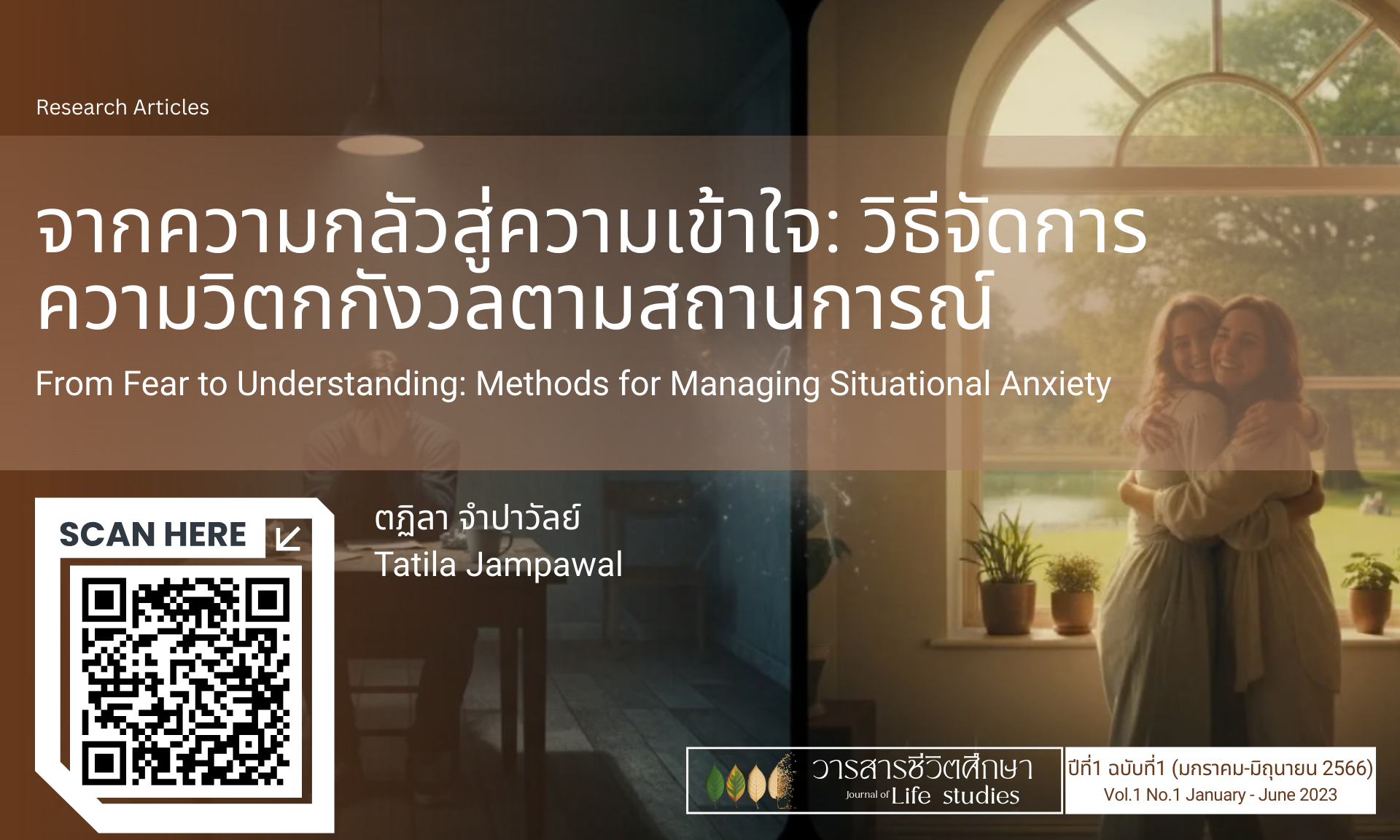
From Fear to Understanding: Methods for Managing Situational Anxiety
จากความกลัวสู่ความเข้าใจ: วิธีจัดการความวิตกกังวลตามสถานการณ์
Keywords:
Situational Anxiety, Emotion Regulation, Mental Health, PsychotherapyAbstract
The objectives of this study were: (1) to study concepts and theories related to situational anxiety, (2) to analyze effective strategies for managing situational anxiety, and (3) to synthesize new knowledge regarding the transition process from fear to understanding in anxiety management. The research employed a qualitative documentary study design, using holistic theoretical perspectives on anxiety and emotion regulation as its framework. The data were obtained from 45 academic sources, including scholarly articles and related research published between 2015 and 2023. Three instruments were used: (1) a document quality assessment form, (2) a content analysis record, and (3) a data synthesis form. Data were analyzed through inductive content analysis and narrative synthesis.
The research results revealed the following. 1) Situational anxiety is an emotional reaction that arises when individuals face unexpected or challenging circumstances, consisting of physical, emotional, and cognitive components. 2) Effective management strategies include self-awareness, relaxation techniques, cognitive restructuring, and building social support systems. 3) The transitional process from fear to understanding occurs in four stages: awareness, acceptance, learning, and adaptation. The knowledge generated from this study can be applied to the development of anxiety management training programs, psychological counseling, and the promotion of mental health within communities
References
American Psychological Association. (2023). Stress and anxiety trends in global population: Annual report 2023. APA Publishing.
Anderson, K., & Lee, S. (2020). Cognitive restructuring techniques for situational anxiety management: A systematic review. Journal of Cognitive Therapy, 15(3), 245-262.
Beck, A. T., & Clark, D. A. (2019). Anxiety and worry: Cognitive mechanisms and therapeutic approaches (3rd ed.). Guilford Press.
Brown, M., & Taylor, R. (2022). The transformation process from fear to understanding in anxiety management. Clinical Psychology Review, 98, 102-118.
Chen, L., Wang, H., & Zhang, Y. (2020). Understanding anxiety mechanisms and developing effective coping strategies: A meta-analysis. Psychological Medicine, 50(8), 1267-1280.
Johnson, P., & Smith, A. (2021). Psychological resilience and situational anxiety management in uncertain times. Journal of Applied Psychology, 106(4), 523-538.
Kumar, R., & Singh, M. (2023). Social support systems in anxiety management: Community-based interventions. Community Mental Health Journal, 59(2), 178-195.
Martinez, C., & Rodriguez, L. (2021). Holistic approach to situational anxiety: A comprehensive framework. Anxiety, Stress & Coping, 34(5), 587-603.
Nguyen, T., & Patel, S. (2021). Effectiveness of relaxation techniques in reducing situational anxiety: A randomized controlled trial. Behavior Therapy, 52(4), 812-826.
Thompson, J., Davis, K., & Wilson, B. (2020). Factors influencing situational anxiety development: A longitudinal study. Journal of Anxiety Disorders, 76, 102-115.
Williams, D., & Davis, P. (2022). Integrated coping strategies for anxiety management: Theory and practice. Clinical Psychology Science, 10(3), 456-472.
Wilson, G., & Garcia, E. (2021). Success factors in anxiety management transformation: A qualitative study. Qualitative Health Research, 31(7), 1289-1305.
World Health Organization. (2022). Mental health and climate change: Policy brief. WHO Press.
ต ฏิ ลา จำปา วัลย์. (2018). ความวิตกกังวลตามสถานการณ์. วารสารพุทธจิตวิทยา, 3(1), 13-20.
สุรศักดิ์ วิศาลาภรณ์, นิธิยา เจริญสุข, & อมรา สุขใส. (2022). ระดับความวิตกกังวลในประชากรไทยหลังสถานการณ์โควิด-19. วารสารสุขภาพจิตไทย, 30(2), 89-104.
Downloads
Published
How to Cite
Issue
Section
License
Copyright (c) 2023 Journal of Human and Life Studies

This work is licensed under a Creative Commons Attribution-NonCommercial-NoDerivatives 4.0 International License.
Published articles are copyrighted by the Journal of Human and Life Studies.
The contents of each article in this academic journal represent the personal opinions of the individual authors and are not affiliated with the Journal of Life Studies or any other editorial team within the publishing house. The responsibility for all content of each article rests with the individual authors. Any errors or omissions are solely the responsibility of each individual author.