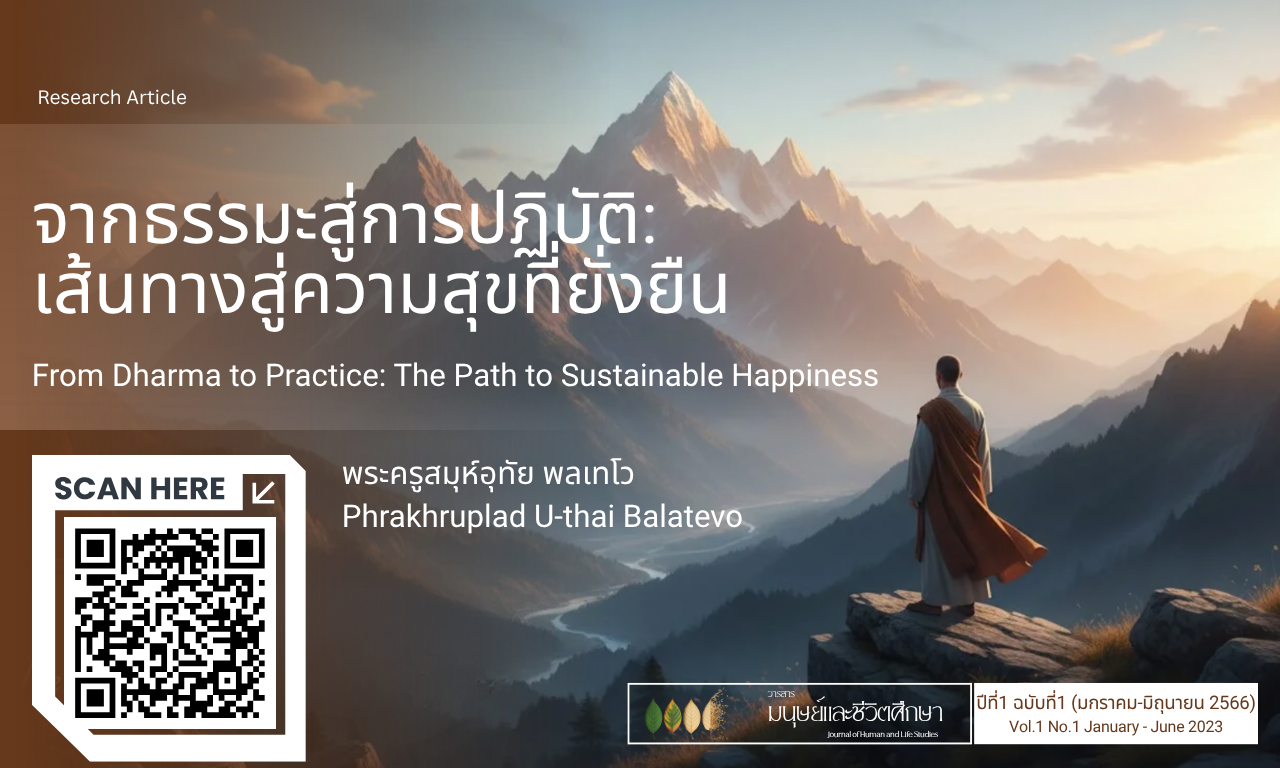
From Dharma to Practice: The Path to Sustainable Happiness
จากธรรมะสู่การปฏิบัติ: เส้นทางสู่ความสุขที่ยั่งยืน
Keywords:
ธรรมะ, ความสุขที่ยั่งยืน, การปฏิบัติธรรม, จิตวิญญาณเชิงพุทธ, สติปัฏฐานAbstract
The objectives of this research were: (1) to study Buddhist doctrines related to sustainable happiness, (2) to analyze the application of these doctrines in daily life, and (3) to develop a model of the path to sustainable happiness according to Buddhist principles. The research employed a qualitative approach, using the Tripitaka and the teachings of the Buddha as the research framework. The research area consisted of studying Buddhist scriptures and related research articles. The target group was 50 academic documents selected through purposive sampling. The research instruments comprised three types: (1) a documentary recording form, (2) a content analysis form, and (3) a knowledge synthesis form. Data were analyzed using content analysis and presented in descriptive narrative form.
The research findings revealed that: (1) the key Buddhist doctrines important to sustainable happiness include the Noble Eightfold Path, the Threefold Training, and the Four Foundations of Mindfulness; (2) the application of these doctrines in daily life can be practiced through meditation, mindfulness cultivation, and daily practice; and (3) the model of the path to sustainable happiness consists of four main components: knowledge of the Dhamma, practical training, mental development, and mindful living. The body of knowledge derived from this study will be useful for developing curricula and teaching programs, as well as for promoting mental health programs based on Buddhist principles for the general public
References
Attarung, T., & Jampawal, T. (2023). The Art of Happy Living in Buddhism. Journal of Mahapajapati Buddhist Review, 1(2), 26-35.
World Health Organization. (2023). Depression and other common mental disorders: Global health estimates. World Health Organization Press.
ธัชฑล อัตรัง, & ตฏิลา จำปาวัลย์. (2023). โรคจิตทางพระพุทธศาสนาและวิธีรักษาตามแนวพระพุทธศาสนา. วารสารพุทธจิตวิทยา, 8(2), 359-368.
ธัชฑล อัตรัง, พระมหาเผื่อนกิตฺติโสภโณ, ผศ. ดร., & ประยูร สุยะใจ. (2023). การพัฒนาตัวบ่งชี้และมาตรวัดความงอกงามทางจิตวิญญาณเชิงพุทธ. มจร การพัฒนาสังคม, 8(2), 129-142.
พระธรรมปิฎก (ป.อ. ปยุตฺโต). (2022). พจนานุกรมพุทธศาสตร์ ฉบับประมวลธรรม (พิมพ์ครั้งที่ 25). โรงพิมพ์มหาจุฬาลงกรณราชวิทยาลัย.
พระพรหมคุณาภรณ์ (ป.อ. ปยุตฺโต). (2021). ธรรมนูญชีวิต. สำนักพิมพ์อมรินทร์.
มหาจุฬาลงกรณราชวิทยาลัย. (2021). พระไตรปิฎกและอรรถกถา ฉบับมหาจุฬาลงกรณราชวิทยาลัย. โรงพิมพ์มหาจุฬาลงกรณราชวิทยาลัย.
ยุพาพันธ์ ศรีสุข. (2023). บทบาทของสมาธิในการลดความเครียดของพนักงานบริษัท. วารสารสันติศึกษาเพื่อการพัฒนา, 11(2), 78-91.
สมเด็จพระมหาสมณเจ้า กรมพระยาวชิรญาณวโรรส. (2020). พระธรรมวินัย (พิมพ์ครั้งที่ 15). โรงพิมพ์การศาสนา.
สมาคมจิตแพทย์แห่งประเทศไทย. (2022). แนวทางการดูแลสุขภาพจิตแบบองค์รวม. สำนักพิมพ์แห่งจุฬาลงกรณ์มหาวิทยาลัย.
อติชาติ สุทธิพิทักษ์. (2023). การประยุกต์ใช้หลักไตรสิกขาในการส่งเสริมสุขภาพจิต. วารสารวิทยาลัยพยาบาลพระปกเกล้า จันทบุรี, 34(1), 45-58.
เอกชัย กึ่งเจริญ. (2022). สติปัฏฐานสี่กับการพัฒนาคุณภาพชีวิต. สำนักพิมพ์ธรรมสภา.
Downloads
Published
How to Cite
Issue
Section
License
Copyright (c) 2023 Journal of Human and Life Studies

This work is licensed under a Creative Commons Attribution-NonCommercial-NoDerivatives 4.0 International License.
Published articles are copyrighted by the Journal of Human and Life Studies.
The contents of each article in this academic journal represent the personal opinions of the individual authors and are not affiliated with the Journal of Life Studies or any other editorial team within the publishing house. The responsibility for all content of each article rests with the individual authors. Any errors or omissions are solely the responsibility of each individual author.