Cultural Lag in the Social Studies Classroom: An Analysis of the Basic Education Core Curriculum B.E. 2551 (A.D. 2008) at the Upper Secondary Level in the Context of Global Citizenship
Article Sidebar
Main Article Content
Abstract
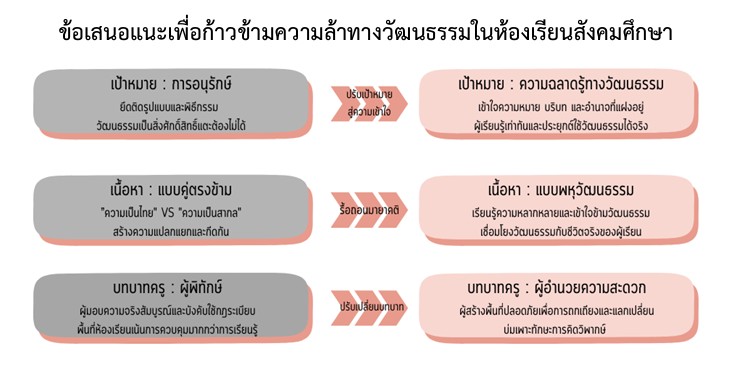
This article employs content analysis to examine the conflict between the structure of the Basic Education Core Curriculum B.E. 2551 (A.D. 2008), the context of cultural changes in the globalization era, and the concept of Global Citizenship. The study utilizes “Cultural Lag” as its primary analytical framework. The findings reveal that the Social Studies, Religion, and Culture learning area under this curriculum experiences a state of cultural lag. Most of the contents struggle to adapt to global dynamics, focusing primarily on producing “conventional citizens” who adhere to physical traditions, nationalist frameworks, and a binary mindset that contrasts virtuous Thainess with the perceived risks of global influences. Furthermore, history is utilized more as a tool for civic conformity than for promoting critical thinking. Consequently, this article proposes shifting the learning objectives towards cultivating “Cultural Literacy.” This can be achieved by de-emphasizing state-centricity, creating spaces for learning about diversity, and transforming the teacher's role into a facilitator of safe spaces for dialogue. Ultimately, these shifts aim to nurture learners into global citizens equipped with critical thinking skills, enabling them to coexist peacefully in a multicultural society.
Article Details

This work is licensed under a Creative Commons Attribution-NonCommercial-NoDerivatives 4.0 International License.
References
กระทรวงศึกษาธิการ. (2551). ตัวชี้วัดและสาระการเรียนรู้แกนกลาง กลุ่มสาระการเรียนรู้สังคมศึกษา ศาสนา และวัฒนธรรม ตามหลักสูตรแกนกลางการศึกษาขั้นพื้นฐาน พุทธศักราช 2551. กรุงเทพฯ: สำนักวิชาการและมาตรฐานการศึกษา สำนักงานคณะกรรมการการศึกษาขั้นพื้นฐาน.
พระครูปภัสสรกิตติคุณ ชุมโคตร และ วิทยา ทองดี. (2568). แนวทางการสอนศาสนาเพื่อเสริมสร้างความเป็นพลเมืองโลก: บทเรียนสำคัญของครูสังคมศึกษา. วารสารสังคมศาสตร์ปัญญาพัฒน์, 7(1), 535–546.
สำนักงานคณะกรรมการการศึกษาขั้นพื้นฐาน. (2553). หนังสือเรียนรายวิชาพื้นฐาน หน้าที่พลเมือง วัฒนธรรมและการดำเนินชีวิตในสังคม ชั้นมัธยมศึกษาปีที่ 4-6. กรุงเทพฯ: โรงพิมพ์ สกสค. ลาดพร้าว.
สำนักงานคณะกรรมการการศึกษาขั้นพื้นฐาน. (2567). หนังสือเรียนรายวิชาพื้นฐาน ประวัติศาสตร์ไทย ชั้นมัธยมศึกษาปีที่ 4-6. กรุงเทพฯ: โรงพิมพ์ สกสค. ลาดพร้าว.
สำนักงานเลขาธิการสภาการศึกษา. (2561). แนวทางการส่งเสริมความเป็นพลเมืองโลก (Global Citizenship). กรุงเทพฯ: พริกหวานกราฟฟิค.
Apple, M., & Apple, M. W. (2004). Ideology and curriculum. (3rd ed.). New York: Routledge.
Banks, J. A. (2004). Diversity and citizenship education: Global perspectives. San Francisco, CA: Jossey-Bass.
Banks, J. A. (2007). Educating citizens in a multicultural society. New York: Teachers College Press
Giroux, H. A. (1983). Theory and resistance in education: A pedagogy for the opposition. South Hadley, MA: Bergin & Garvey.
Giroux, H. A. (1988). Teachers as intellectuals: Toward a critical pedagogy of learning. Massachusetts: Bergin & Garvey Publishers, Inc.
Hess, D. E. (2009). Controversy in the classroom: The democratic power of discussion. New York: Routledge.
Hirsch, E. D. (1987). Cultural literacy: What every American needs to know. Boston, MA: Houghton Mifflin.
Kymlicka, W. (1995). Multicultural citizenship: A liberal theory of minority rights. Oxford University Press.
McIntosh, P. (2005). Gender perspectives on educating for global citizenship. In Educating for global citizenship. New York: Routledge.
Nieto, S. (2004). Affirming diversity: The Sociopolitical Context of Multicultural Education (4th Edition). Boston: Pearson Education.
Ogburn, W. F. (1922). Social Change with Respect to Culture and Original Nature. New York: B. W. Huebsch.
Osler, A. & Vincent, K. (2002). Citizenship and the challenge of global education. London: Trentham Books.
Oxfam. (2006). Education for Global Citizenship: A Guide for Schools. Oxford: Oxfam Development Education Programme.
Oxley, L., & Morris, P. (2013). Global citizenship: A typology for distinguishing its multiple conceptions. British journal of educational studies, 61(3), 301-325.
Reysen, S., & Katzarska-Miller, I. (2013). A model of global citizenship: Antecedents and outcomes. International Journal of Psychology, 48(5), 858-870.
Sant, E., Davies, I., Shultz, L., & Pashby, K. (2018). Global Citizenship Education: A Critical Introduction to Key Concepts and Debates. London: Bloomsbury Academic.
Sinpeng, A. (2021). Opposing Democracy in the Digital Age: The Yellow Shirts in Thailand. Michigan: University of Michigan Press.
UNESCO. (2014). Global Citizenship Education: Preparing learners for the challenges of the 21st century. Paris: UNESCO.
UNESCO. (2015). Global Citizenship Education: Topics and Learning Objectives. Paris: UNESCO.
