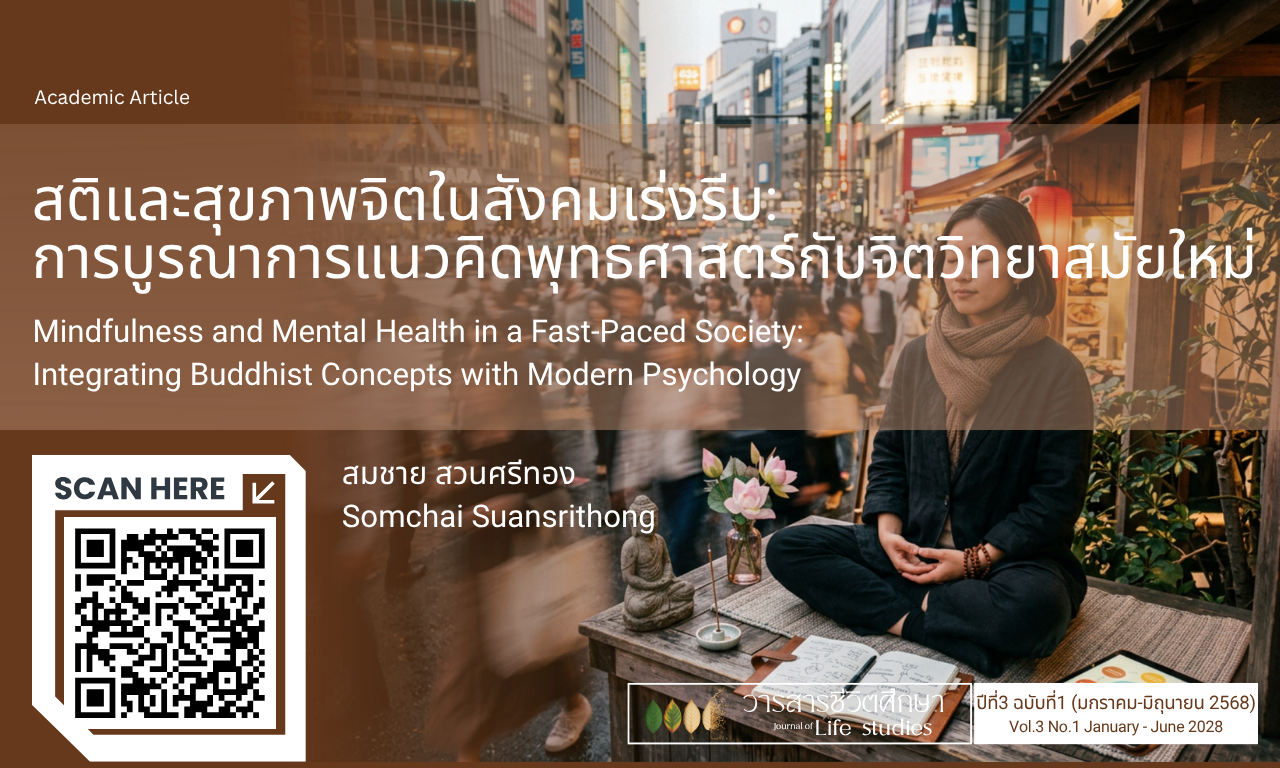
สติและสุขภาพจิตในสังคมเร่งรีบ: การบูรณาการแนวคิดพุทธศาสตร์ กับจิตวิทยาสมัยใหม่
Mindfulness and Mental Health in a Fast-Paced Society: Integrating Buddhist Concepts with Modern Psychology
คำสำคัญ:
สติ, สุขภาพจิต, พุทธศาสตร์, จิตวิทยาสมัยใหม่, การบูรณาการบทคัดย่อ
บทความวิชาการนี้มุ่งศึกษาความสัมพันธ์ระหว่างการปฏิบัติสติ (Mindfulness) ในแบบฉบับพุทธศาสนาเถรวาทกับแนวคิดและการประยุกต์ใช้ทางจิตวิทยาสมัยใหม่ เพื่อนำเสนอกรอบบูรณาการสำหรับการส่งเสริมสุขภาพจิตในบริบทสังคมที่เร่งรีบและเต็มไปด้วยความกดดันในศตวรรษที่ 21 บทความบูรณาการหลักธรรมสำคัญในพุทธศาสนาเถรวาท โดยเฉพาะสติปัฏฐาน 4 กับกรอบจิตวิทยาร่วมสมัยอย่าง Mindfulness-Based Stress Reduction ของ Kabat-Zinn, Mindfulness-Based Cognitive Therapy ของ Segal, Williams และ Teasdale, Acceptance and Commitment Therapy ของ Hayes และแนวคิด Self-Compassion ของ Neff ผลการวิเคราะห์พบว่าการบูรณาการภูมิปัญญาพุทธศาสตร์กับจิตวิทยาสมัยใหม่สร้างกรอบการดูแลสุขภาพจิตที่ครอบคลุมและเหมาะสมกับบริบทวัฒนธรรมไทยอย่างลึกซึ้ง บทความเสนอแนวทางปฏิบัติสำหรับบุคลากรด้านสุขภาพจิต นักการศึกษา และผู้สนใจในการนำสติมาใช้ส่งเสริมสุขภาวะของตนเองและผู้อื่น
เอกสารอ้างอิง
Bodhi, B. (2011). What does mindfulness really mean? A canonical perspective. Contemporary Buddhism, 12(1), 19–39.
Broderick, P. C., & Jennings, P. A. (2012). Mindfulness for adolescents: A promising approach to supporting emotion regulation and preventing risky behavior. New Directions for Youth Development, 2012(136), 111–126.
Germer, C. K., & Neff, K. D. (2019). Teaching the mindful self-compassion program: A guide for professionals. Guilford Press.
Hayes, S. C., Strosahl, K. D., & Wilson, K. G. (2012). Acceptance and commitment therapy: The process and practice of mindful change (2nd ed.). Guilford Press.
Kabat-Zinn, J. (2013). Full catastrophe living: Using the wisdom of your body and mind to face stress, pain, and illness (Rev. ed.). Bantam Books.
Lazar, S. W., Kerr, C. E., Wasserman, R. H., Gray, J. R., Greve, D. N., Treadway, M. T., & Fischl, B. (2005). Meditation experience is associated with increased cortical thickness. NeuroReport, 16(17), 1893–1897.
Neff, K. D. (2011). Self-compassion: The proven power of being kind to yourself. William Morrow.
Porges, S. W. (2011). The polyvagal theory: Neurophysiological foundations of emotions, attachment, communication, and self-regulation. W. W. Norton.
Segal, Z. V., Williams, J. M. G., & Teasdale, J. D. (2013). Mindfulness-based cognitive therapy for depression (2nd ed.). Guilford Press.
Treleaven, D. A. (2018). Trauma-sensitive mindfulness: Practices for safe and transformative healing. W. W. Norton.
Van Dam, N. T., van Vugt, M. K., Vago, D. R., Schmalzl, L., Saron, C. D., Olendzki, A., & Meyer, D. E. (2018). Mind the hype: A critical evaluation and prescriptive agenda for research on mindfulness and meditation. Perspectives on Psychological Science, 13(1), 36–61.
World Health Organization. (2023). World mental health report: Transforming mental health for all. WHO.
กรมสุขภาพจิต. (2566). รายงานประจำปีกรมสุขภาพจิต 2566. กระทรวงสาธารณสุข.
พระพรหมคุณาภรณ์ (ป. อ. ปยุตฺโต). (2558). พุทธธรรมฉบับปรับขยาย. มหาจุฬาลงกรณราชวิทยาลัย.
อภิชัย มงคล, สุวรรณา อรุณพงค์ไพศาล, และ ดวงรัตน์ วัฒนกิจไกรเลิศ. (2561). การทบทวนวรรณกรรมอย่างเป็นระบบเรื่องประสิทธิผลของโปรแกรมการฝึกสติในประเทศไทย. วารสารสุขภาพจิตแห่งประเทศไทย, 26(3), 145–162.
ดาวน์โหลด
เผยแพร่แล้ว
รูปแบบการอ้างอิง
ฉบับ
ประเภทบทความ
สัญญาอนุญาต
ลิขสิทธิ์ (c) 2025 วารสารมนุษย์และชีวิตศึกษา

อนุญาตภายใต้เงื่อนไข Creative Commons Attribution-NonCommercial-NoDerivatives 4.0 International License.
บทความที่ได้รับการตีพิมพ์เป็นลิขสิทธิ์ของวารสารมนุษย์และชีวิตศึกษา
ข้อความที่ปรากฏในบทความแต่ละเรื่องในวารสารวิชาการเล่มนี้เป็นความคิดเห็นส่วนตัวของผู้เขียนแต่ละท่านไม่เกี่ยวข้องกับวารสารชีวิตศึกษา และกองบรรณาธิการท่านอื่นๆ ในสำนักพิมพ์ฯ แต่อย่างใด ความรับผิดชอบองค์ประกอบทั้งหมดของบทความแต่ละเรื่องเป็นของผู้เขียนแต่ละท่าน หากมีความผิดพลาดใดๆ ผู้เขียนแต่ละท่านจะรับผิดชอบบทความของตนเองแต่ผู้เดียว