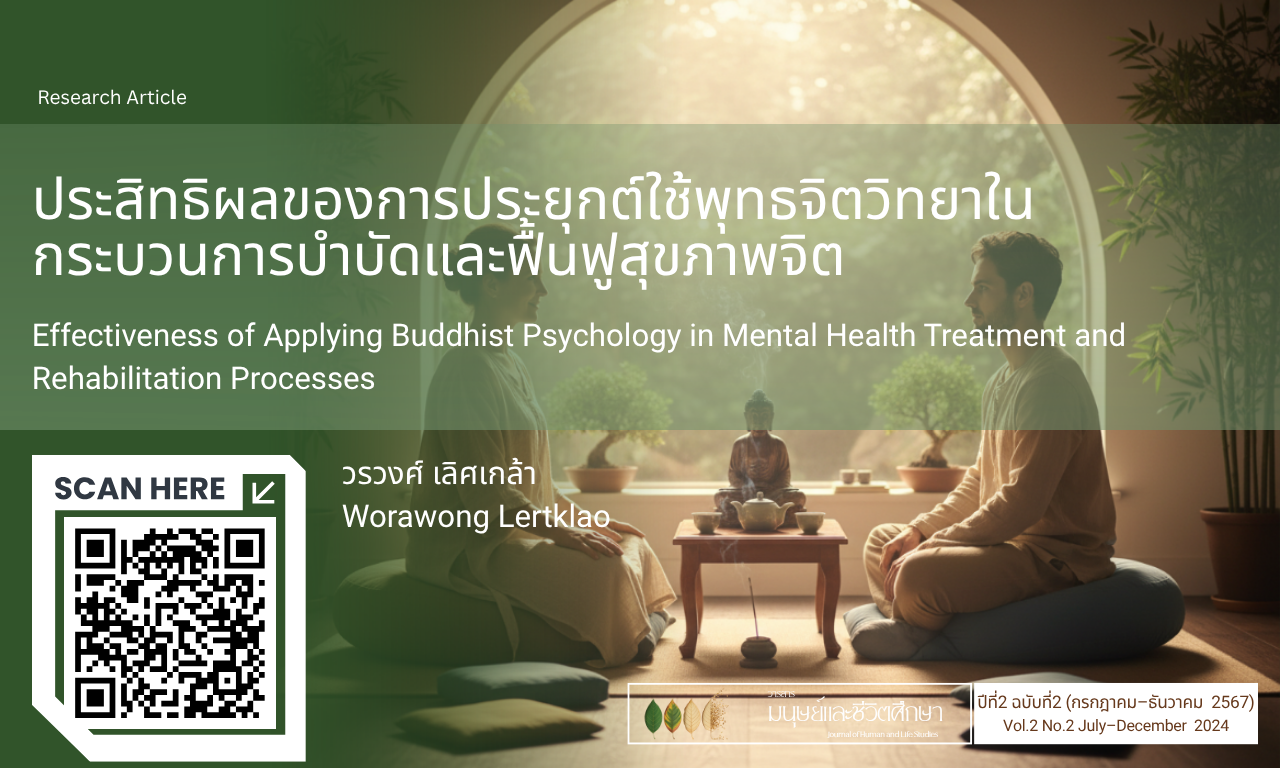
ประสิทธิผลของการประยุกต์ใช้พุทธจิตวิทยาในกระบวนการบำบัด และฟื้นฟูสุขภาพจิต
Effectiveness of Applying Buddhist Psychology in Mental Health Treatment and Rehabilitation Processes
คำสำคัญ:
พุทธบำบัด, ประสิทธิผลการบำบัด, สุขภาวะจิต, พุทธจิตวิทยา, การฟื้นฟูสุขภาพจิตบทคัดย่อ
บทความวิจัยนี้มีวัตถุประสงค์ 1) เพื่อศึกษาประสิทธิผลของการประยุกต์ใช้หลักพุทธจิตวิทยาในกระบวนการบำบัดและฟื้นฟูสุขภาพจิต 2) เพื่อวิเคราะห์กลไกและปัจจัยที่ส่งเสริมประสิทธิผลของพุทธบำบัดในกลุ่มผู้รับบริการสุขภาพจิตในบริบทสังคมไทย และ 3) เพื่อเสนอแนวทางพัฒนาโปรแกรมพุทธบำบัดที่มีประสิทธิผลสำหรับกลุ่มปัญหาสุขภาพจิตเฉพาะด้าน รูปแบบการวิจัยเป็นการวิจัยแบบผสานวิธี (Mixed Methods Research) ใช้แนวคิดพุทธจิตวิทยาและกรอบการบำบัดแบบองค์รวมเป็นกรอบการวิจัย กลุ่มตัวอย่างประกอบด้วยผู้รับบริการสุขภาพจิตที่เข้าร่วมโปรแกรมพุทธบำบัด จำนวน 60 คน คัดเลือกแบบสุ่มแบ่งชั้น เครื่องมือที่ใช้ในการวิจัยมี 3 ชนิด คือ 1) แบบวัดสุขภาวะจิตองค์รวม 2) แบบสัมภาษณ์เชิงลึก 3) แบบบันทึกการสังเกต วิเคราะห์ข้อมูลโดยใช้สถิติพื้นฐาน การทดสอบค่าที (t-test) และการวิเคราะห์เนื้อหา
ผลการวิจัยพบว่า 1. กลุ่มทดลองที่เข้าร่วมโปรแกรมพุทธบำบัด 8 สัปดาห์มีคะแนนสุขภาวะจิตสูงกว่ากลุ่มควบคุมอย่างมีนัยสำคัญทางสถิติ (p < .001) โดยมีขนาดผลลัพธ์ขนาดใหญ่ (Cohen's d = 0.82) 2. ปัจจัยสำคัญที่ส่งเสริมประสิทธิผลของพุทธบำบัด ได้แก่ การฝึกสติสม่ำเสมอ การสนับสนุนจากกลุ่ม และการมีทัศนคติเชิงพุทธที่เปิดกว้างต่อการเปลี่ยนแปลง 3. โปรแกรมพุทธบำบัดเฉพาะด้านสำหรับภาวะซึมเศร้า วิตกกังวล และการฟื้นฟูจากการเสพติด มีประสิทธิผลสูงเมื่อบูรณาการกับการดูแลทางการแพทย์มาตรฐาน องค์ความรู้จากงานวิจัยนี้จะเป็นประโยชน์ต่อการพัฒนาโปรแกรมพุทธบำบัดมาตรฐาน การฝึกอบรมบุคลากรสุขภาพจิต และการสร้างนโยบายที่ผสมผสานพุทธธรรมในระบบบริการสุขภาพจิตของประเทศไทย
เอกสารอ้างอิง
Bowen, S., Witkiewitz, K., Clifasefi, S. L., Grow, J., Chawla, N., Hsu, S. H., Carroll, H. A., Harrop, E., Lustyk, M. K., & Larimer, M. E. (2014). Relative efficacy of mindfulness-based relapse prevention, standard relapse prevention, and treatment as usual for substance use disorders: A randomized clinical trial. JAMA Psychiatry, 71(5), 547–556. https://doi.org/10.1001/jamapsychiatry.2013.4546
Davidson, R. J., Kabat-Zinn, J., Schumacher, J., Rosenkranz, M., Muller, D., Santorelli, S. F., Urbanowski, F., Harrington, A., Bonus, K., & Sheridan, J. F. (2003). Alterations in brain and immune function produced by mindfulness meditation. Psychosomatic Medicine, 65(4), 564–570. https://doi.org/10.1097/01.PSY.0000077505.67574.E3
Dhammapitaka, P. A. (Payutto). (2016). Buddhist dhamma: Expanded edition (45th ed.). Phalitham.
Hayes, S. C., Strosahl, K. D., & Wilson, K. G. (2011). Acceptance and commitment therapy: The process and practice of mindful change (2nd ed.). Guilford Press.
Hölzel, B. K., Carmody, J., Vangel, M., Congleton, C., Yerramsetti, S. M., Gard, T., & Lazar, S. W. (2011). Mindfulness practice leads to increases in regional brain gray matter density. Psychiatry Research: Neuroimaging, 191(1), 36–43. https://doi.org/10.1016/j.pscychresns.2010.08.006
Hutcherson, C. A., Seppala, E. M., & Gross, J. J. (2008). Loving-kindness meditation increases social connectedness. Emotion, 8(5), 720–724. https://doi.org/10.1037/a0013237
Kabat-Zinn, J. (2013). Full catastrophe living: Using the wisdom of your body and mind to face stress, pain, and illness (Rev. ed.). Bantam Books.
Linehan, M. M. (1993). Cognitive-behavioral treatment of borderline personality disorder. Guilford Press.
Piet, J., & Hougaard, E. (2011). The effect of mindfulness-based cognitive therapy for prevention of relapse in recurrent major depressive disorder: A systematic review and meta-analysis. Clinical Psychology Review, 31(6), 1032–1040. https://doi.org/10.1016/j.cpr.2011.05.002
Saipetch, V. (2023). Buddhist mental health: Integration of Buddhist principles with contemporary mental health care. Journal of Applied Humanities Studies, 1(1), 1–19. https://doi.org/10.65680/jahs.v1i1.6639
Segal, Z. V., Williams, J. M. G., & Teasdale, J. D. (2013). Mindfulness-based cognitive therapy for depression (2nd ed.). Guilford Press.
Shonin, E., Van Gordon, W., Compare, A., Zangeneh, M., & Griffiths, M. D. (2014). Buddhist-derived loving-kindness and compassion meditation for the treatment of psychopathology: A systematic review. Mindfulness, 5(4), 431–451. https://doi.org/10.1007/s12671-013-0368-1
World Health Organization. (2017). Depression and other common mental disorders: Global health estimates. World Health Organization. https://apps.who.int/iris/handle/10665/254610
Xiong, J., Lipsitz, O., Nasri, F., Lui, L. M., Gill, H., Phan, L., Chen-Li, D., Iacobucci, M., Ho, R., Majeed, A., & McIntyre, R. S. (2020). Impact of COVID-19 pandemic on mental health in the general population: A systematic review. Journal of Affective Disorders, 277, 55–64. https://doi.org/10.1016/j.jad.2020.08.001
ดาวน์โหลด
เผยแพร่แล้ว
รูปแบบการอ้างอิง
ฉบับ
ประเภทบทความ
สัญญาอนุญาต
ลิขสิทธิ์ (c) 2024 วารสารมนุษย์และชีวิตศึกษา

อนุญาตภายใต้เงื่อนไข Creative Commons Attribution-NonCommercial-NoDerivatives 4.0 International License.
บทความที่ได้รับการตีพิมพ์เป็นลิขสิทธิ์ของวารสารมนุษย์และชีวิตศึกษา
ข้อความที่ปรากฏในบทความแต่ละเรื่องในวารสารวิชาการเล่มนี้เป็นความคิดเห็นส่วนตัวของผู้เขียนแต่ละท่านไม่เกี่ยวข้องกับวารสารชีวิตศึกษา และกองบรรณาธิการท่านอื่นๆ ในสำนักพิมพ์ฯ แต่อย่างใด ความรับผิดชอบองค์ประกอบทั้งหมดของบทความแต่ละเรื่องเป็นของผู้เขียนแต่ละท่าน หากมีความผิดพลาดใดๆ ผู้เขียนแต่ละท่านจะรับผิดชอบบทความของตนเองแต่ผู้เดียว