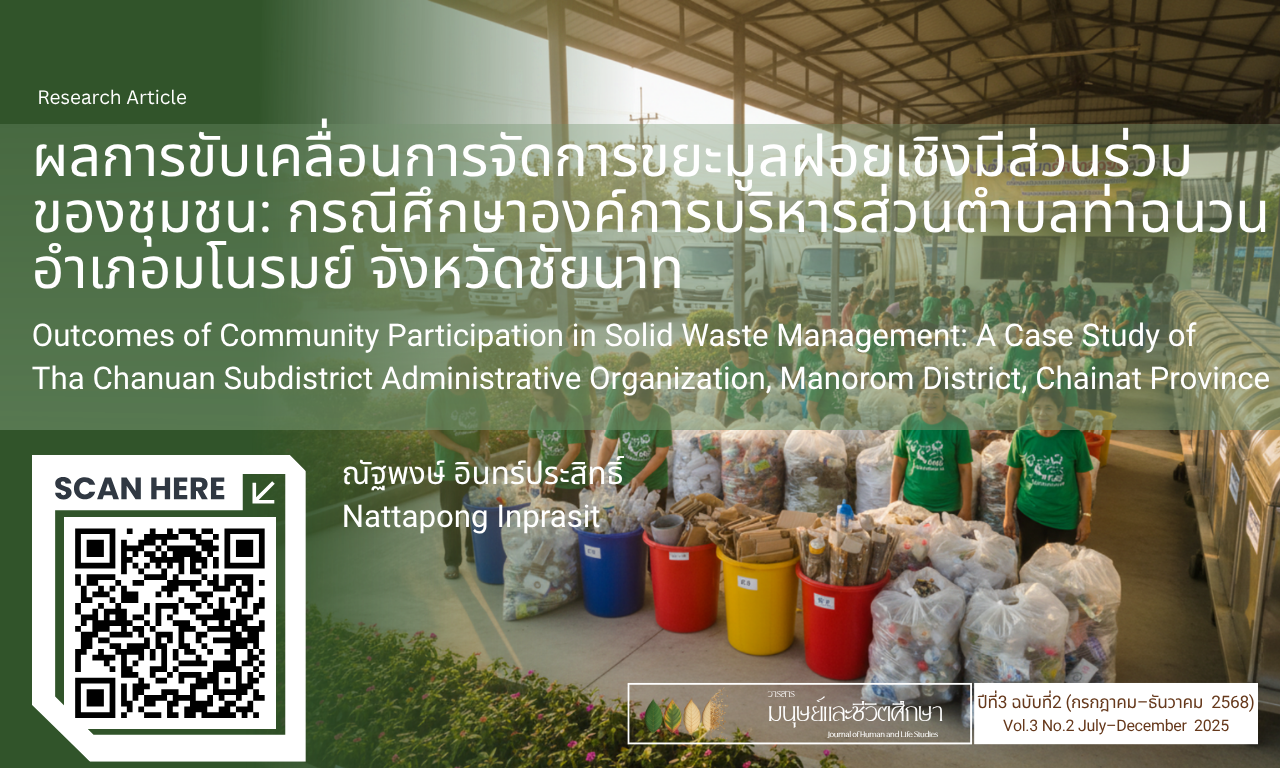
ผลการขับเคลื่อนการจัดการขยะมูลฝอยเชิงมีส่วนร่วมของชุมชน: กรณีศึกษาองค์การบริหารส่วนตำบลท่าฉนวน อำเภอมโนรมย์ จังหวัดชัยนาท
Outcomes of Community Participation in Solid Waste Management: A Case Study of Tha Chanuan Subdistrict Administrative Organization, Manorom District, Chainat Province
บทคัดย่อ
การวิจัยครั้งนี้มีวัตถุประสงค์คือ 1) เพื่อศึกษาระดับการมีส่วนร่วมของประชาชนในการจัดการขยะพื้นที่องค์การบริหารส่วนตำบลท่าฉนวน อำเภอมโนรมย์ จังหวัดชัยนาท 2) เพื่อศึกษาระดับประสิทธิผลในการบริหารจัดการขยะมูลฝอยขององค์การบริหารส่วนตำบลท่าฉนวน อำเภอมโนรมย์ จังหวัดชัยนาท 3) เพื่อศึกษาความสัมพันธ์ระหว่างการมีส่วนร่วมของประชาชนกับประสิทธิผลในการบริหารจัดการขยะมูลฝอยขององค์การบริหารส่วนตำบลท่าฉนวน อำเภอมโนรมย์ จังหวัดชัยนาท และ 4) เพื่อศึกษาการมีส่วนร่วมของประชาชนที่ส่งผลต่อประสิทธิผลในการบริหารจัดการขยะมูลฝอยขององค์การบริหารส่วนตำบลท่าฉนวน อำเภอมโนรมย์ จังหวัดชัยนาท การศึกษาในครั้งนี้เก็บข้อมูลโดยใช้แบบสอบถามกลุ่มตัวอย่างที่ใช้ในการวิจัยในครั้งนี้ คือประชาชนที่อาศัยอยู่ในชุมชนองค์การบริหารส่วนตำบลท่าฉนวน อำเภอมโนรมย์ จังหวัดชัยนาท 360 คน สถิติที่ใช้ในการวิเคราะห์ข้อมูล ได้แก่ การแจกแจงความถี่ ค่าร้อยละ ค่าเฉลี่ย ส่วนเบี่ยงเบนมาตรฐานค่าสัมประสิทธิ์สหสัมพันธ์ของเพียร์สัน และการวิเคราะห์สมการถดถอยเชิงพหุคูณ
ผลการวิจัยพบว่า 1) การมีส่วนร่วมของประชาชนในการบริหารจัดการขยะโดยรวม อยู่ในระดับมาก 2) ประสิทธิผลการบริหารจัดการขยะโดยรวมอยู่ในระดับปานกลาง 3) ความสัมพันธ์ของการมีส่วนร่วมของประชาชนกับประสิทธิผลในการบริหารจัดการขยะโดยภาพรวม พบว่า มีความสัมพันธ์ในระดับสูง พิจารณารายด้านโดยเรียงลำดับจากค่าความสัมพันธ์ได้ดังนี้ การมีส่วนร่วมในการดําเนินงาน รองลงมาคือ การมีส่วนร่วมตรวจสอบและการประเมินผล การมีส่วนร่วมในการรับผลประโยชน์ และการมีส่วนร่วมในการตัดสินใจ ตามลำดับ และ 4) การมีส่วนร่วมของประชาชนส่งผลต่อประสิทธิผลในการบริหารจัดการขยะมูลฝอย มี 3 องค์ประกอบ ซึ่งสามารถเรียงลำดับจากมากไปหาน้อยดังนี้ การมีส่วนร่วมในการดำเนินงานการมีส่วนร่วมในการติดตามประเมินผล และการมีส่วนร่วมในการรับผลประโยชน์
เอกสารอ้างอิง
Adeolu, A. T., Enesi, D. O., & Adeolu, M. O. (2020). Assessment of community participation in solid waste management in selected residential areas. Journal of Environmental Health Science & Engineering, 18(1), 43–52. https://doi.org/10.1007/s40201-020-00461-z
Adeolu, A. T., Enesi, D. O., & Adeolu, M. O. (2020). Assessment of community participation in solid waste management in selected residential areas. Journal of Environmental Health Science & Engineering, 18(1), 43–52. https://doi.org/10.1007/s40201-020-00461-z
Ajzen, I. (1991). The theory of planned behavior. Organizational Behavior and Human Decision Processes, 50(2), 179–211.
Almulhim, A. (2021). Citizen participation and municipal solid waste management: A case study in Saudi Arabia. Waste Management & Research, 39(2), 208–217. https://doi.org/10.1177/0734242X20980791
Cohen, J. M., & Uphoff, N. T. (1980). Participation’s Place in Rural Development: Seeking Clarity through Specificity. World Development, 8, 213-235.
Fahmi, F., Yuliana, M., & Rahman, A. (2022). Community behavior and waste recycling: A model of sustainable urban management. Environmental Management and Sustainable Development, 11(2), 45–58.
Fahmi, M., Aini, M. S., & Daud, N. M. (2022). Behavioral determinants of household waste recycling: Evidence from a community-based program. Sustainability, 14(7), 4132. https://doi.org/10.3390/su14074132
Krejcie, R. V., & Morgan, D. W. (1970). Determining sample size for research activities. Educational and Psychological Measurement, 30(3), 607–610.
Zambrano-Monserrate, M. A., Ruano, M. A., & Sanchez-Alcalde, L. (2020). Citizen behavior and solid waste management: Toward sustainable cities. Science of The Total Environment, 728, 138870. https://doi.org/10.1016/j.scitotenv.2020.138870
Zambrano-Monserrate, M. A., Ruano, M. A., & Sanchez-Alcalde, L. (2020). Indirect effects of COVID-19 on the environment. Science of the Total Environment, 728, 138813.
กรมควบคุมมลพิษ. (2023). แผนปฏิบัติการด้านการจัดการขยะของประเทศ ฉบับที่ 2 (พ.ศ. 2565–2570). https://env.anamai.moph.go.th/th/wastemanagement-action-plan/download?id=98732&mid=37662&mkey=m_document&lang=th&did=30304
กรมส่งเสริมการปกครองท้องถิ่น และกรมควบคุมมลพิษ. (2024). การจัดการขยะมูลฝอยชุมชน. https://www.pcd.go.th/publication/28745/
ธนพล สมควร. (2022). ปัจจัยที่ส่งผลต่อความสำเร็จในการจัดการขยะมูลฝอยแบบมีส่วนร่วมของชุมชน: กรณีศึกษาเทศบาลตำบลท่าน้ำอ้อยม่วงหัก. วารสารการบริหารท้องถิ่น, 15(3), 45–62.
นภาพร สิงห์ทอง. (2022). การศึกษาแนวทางการจัดการขยะมูลฝอยแบบมีส่วนร่วมของชุมชนในเขตเทศบาลนครขอนแก่น. วารสารวิทยาการจัดการ, 12(1), 89–108.
นฤนาท ยืนยง, & พิชชานาถ เงินดีเจริญ. (2022). การมีส่วนร่วมของประชาชนในการจัดการขยะมูลของตำบลสำพะเนียง อำเภอโนนแดง จังหวัดนครราชสีมา. วารสารวิชาการและวิจัย มหาวิทยาลัยภาคตะวันออกเฉียงเหนือ, 12(2), 279–297.
นิสาวรรณ พรมเมตตา. (2022). การศึกษาแนวทางการพัฒนาระบบบริหารจัดการขยะของเขตบางบอนสู่การเป็นสังคม zero waste [วิทยานิพนธ์ปริญญามหาบัณฑิต]. มหาวิทยาลัยธรรมศาสตร์.
พรทิพย์ ศรีสุดใจ. (2021). ประสิทธิผลของโครงการลดการใช้พลาสติกแบบใช้ครั้งเดียวในเขตกรุงเทพมหานคร. วารสารสิ่งแวดล้อม, 25(3), 78–92.
พิณะเวช คงยั่งยืน, รุ่งรดิศ คงยั่งยืน, & ฐากร สวัสดิกำธร. (2024). การมีส่วนร่วมของชุมชนในการจัดการขยะกรณีศึกษา ชุมชนตำบลบางรักน้อยอำเภอเมือง จังหวัดนนทบุรี. Journal of Dhamma for Life, 30(2), 408–417.
มานิตา วงศ์สุวรรณ. (2022). การติดตามและประเมินผลการจัดการขยะมูลฝอยแบบมีส่วนร่วมของชุมชนในเขตเทศบาลเมืองลำพูน. วารสารการจัดการสิ่งแวดล้อม, 17(1), 123–142.
มานิตา วงศ์สุวรรณ. (2565). การมีส่วนร่วมของประชาชนในการติดตามและประเมินผลการจัดการขยะมูลฝอยขององค์กรปกครองส่วนท้องถิ่น. วารสารการพัฒนาชุมชน, 14(3), 91–108.
รุ่งรดิศ คงยั่งยืน, พิณะเวช คงยั่งยืน, & ฐากร สวัสดิกำธร. (2024). ปัจจัยที่มีอิทธิพลต่อการตระหนักรู้และการมีส่วนร่วมของชุมชนในการจัดการขยะกรณีศึกษา ชุมชนตำบลบางรักน้อย อำเภอเมือง จังหวัดนนทบุรี. วารสารครุศาสตร์ปริทรรศน์, 11(2), 144–157.
วรรณา จันทร์สว่าง. (2022). ปัจจัยความสำเร็จในการจัดการขยะชุมชน: กรณีศึกษาชุมชนปลอดขยะในภาคตะวันออก. วารสารสิ่งแวดล้อมศึกษา, 13(2), 67–85.
ศิริวรรณ บุญประเสริฐ. (2021). ผลตอบแทนทางเศรษฐกิจและสังคมจากการจัดการขยะมูลฝอยแบบครบวงจร: กรณีศึกษาชุมชนเมืองในจังหวัดเชียงใหม่. วารสารเศรษฐศาสตร์และการจัดการ, 10(2), 112–131.
ศิริวรรณ บุญประเสริฐ. (2564). ปัจจัยที่มีอิทธิพลต่อการมีส่วนร่วมของประชาชนในการบริหารจัดการขยะมูลฝอย. วารสารการบริหารปกครองท้องถิ่น, 7(1), 85–102.
สนธยา บัวสงค์. (2018). ปัจจัยการมีส่วนร่วมในการจัดการขยะของประชาชนขององค์การบริหารส่วนตำบลเขาทะลุ อำเภอสวี จังหวัดชุมพร [วิทยานิพนธ์ปริญญามหาบัณฑิต]. มหาวิทยาลัยราชภัฏมหาสารคาม.
สมศักดิ์ วงศ์เสงี่ยม. (2022). ประสิทธิผลการจัดการขยะมูลฝอยขององค์กรปกครองส่วนท้องถิ่นในจังหวัดสมุทรปราการ. วารสารการบริหารท้องถิ่น, 15(1), 78–96.
สุภาวดี ศรีสวัสดิ์. (2564). ผลของน้ำหมักชีวภาพต่อการลดระยะเวลาการผลิตปุ๋ยหมักจากมูลฝอยอินทรีย์ในเขตเทศบาลเมืองยโสธร. วารสารสาธารณสุขและการพัฒนา, 19(2), 45–54.
สุนิสา แก้วเกตุ. (2021). การสื่อสารและการมีส่วนร่วมของประชาชนในการจัดการขยะมูลฝอย: กรณีศึกษาเทศบาลตำบลแม่ริม จังหวัดเชียงใหม่. วารสารการสื่อสารมวลชน, 9(2), 145–164.
องค์การบริหารส่วนตำบลท่าฉนวน. (2024). รายงานประจำปี 2566: การบริหารจัดการขยะมูลฝอยและการมีส่วนร่วมของประชาชน. องค์การบริหารส่วนตำบลท่าฉนวน.
ดาวน์โหลด
เผยแพร่แล้ว
รูปแบบการอ้างอิง
ฉบับ
ประเภทบทความ
สัญญาอนุญาต
ลิขสิทธิ์ (c) 2025 วารสารมนุษย์และชีวิตศึกษา

อนุญาตภายใต้เงื่อนไข Creative Commons Attribution-NonCommercial-NoDerivatives 4.0 International License.
บทความที่ได้รับการตีพิมพ์เป็นลิขสิทธิ์ของวารสารมนุษย์และชีวิตศึกษา
ข้อความที่ปรากฏในบทความแต่ละเรื่องในวารสารวิชาการเล่มนี้เป็นความคิดเห็นส่วนตัวของผู้เขียนแต่ละท่านไม่เกี่ยวข้องกับวารสารชีวิตศึกษา และกองบรรณาธิการท่านอื่นๆ ในสำนักพิมพ์ฯ แต่อย่างใด ความรับผิดชอบองค์ประกอบทั้งหมดของบทความแต่ละเรื่องเป็นของผู้เขียนแต่ละท่าน หากมีความผิดพลาดใดๆ ผู้เขียนแต่ละท่านจะรับผิดชอบบทความของตนเองแต่ผู้เดียว