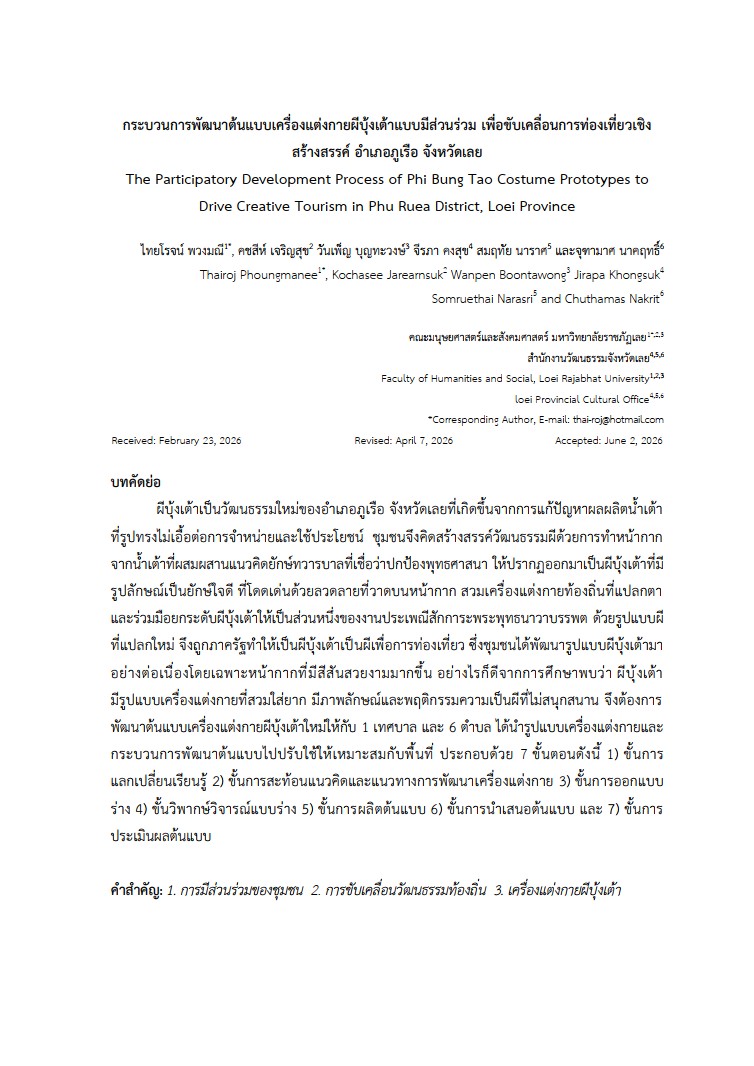
The Participatory Development Process of Phi Bung Tao Costume Prototypes to Drive Creative Tourism in Phu Ruea District, Loei Province
Keywords:
Community Participation, Local Cultural Mobilization, Phi Bung Tao CostumeAbstract
Phi Bung Tao is a new cuture in Phu Ruea District, Loei Province, originating from efforts to solve the problem of bottle gourd with irregular shapes that were difficult to sell and utilize. The community therefore creatively invented a spirit culture by crafting masks from these bottle gourds, blending them with the concept of Dvarapala giants, who are believed to protect Buddhism, into a form of Phi Bung Tao, as known as a generous giant, distinguished by the intricate patterns painted on their masks and adorned with unique local costumes. The community collaboratively elevated Phi Bung Tao to become part of the Phra Buddha Nawa Banpot worship tradition. Due to its novel ghostly form, the state sector promoted Phi Bung Tao as a tourism-oriented spirit. The community has continuously developed the Phi Bung Tao form to be more colorful and beautiful masks. However, this study found that the current Phi Bung Tao costumes were difficult to put on, and its ghostly image and behavior were perceived as lacking in vibrancy and fun. Consequently, there was a need to develop new costume prototypes for Phi Bung Tao, to be implemented across 1 municipality and 6 subdistricts, allowing each area to adapt the costume designs and development process to suit their local contexts. The development process consists of 7 steps: 1) Knowledge exchange stage, 2) Conceptual reflection and costume development guideline stage, 3) Draft design stage, 4) Draft critique stage, 5) Prototype production stage, 6) Prototype presentation stage, and 7) Prototype evaluation stage.
References
จินตวีร์ เกษมศุข. (2561). แนวคิดการมีส่วนร่วมของประชาชนเพื่อการพัฒนาชุมชนที่ยั่งยืน. วารสารวิชาการมนุษยศาสตร์และสังคมศาสตร์, 26(50), 169-186.
ชวนี ทองโรจน์. (2554). การวิจัยวัฒนธรรมเพื่อพัฒนาภูมิปัญญาท้องถิ่น. Journal of Multidisciplinary in Social Sciences (JMSS), 7(1), 129-138
เดลินิวส์. (2567). สงกรานต์ชาวเลยร่วมใจแห่ผีบุ้งเต้าสรงน้ำพระพุทธนาวาบรรพตภูเรือ. https://www.dailynews.co.th/news/3349449/
ไทยโรจน์ พวงมณี, คชสีห์ เจริญสุข, และสุภาวดี สำราญ. (2565). อัตลักษณ์และสุนทรียภาพของหน้ากากผีบุ้งเต้าที่ส่งผลต่อการพัฒนาการท่องเที่ยวบ้านไฮตาก อำเภอภูเรือ จังหวัดเลย. วารสารมังรายสาร, 10(2), 67-81.
สำนักงานเกษตรอำเภอภูเรือ. (2564). ประวัติความเป็นมา. http://phuruea.loei.doae.go.th/
?page_id=108.
สำนักงานส่งเสริมการปกครองส่วนท้องถิ่น จังหวัดเลย. (2568). ขอบเขตภารกิจของท้องถิ่นอำเภอ. https://loeilocal.go.th/public/list/data/index/menu/1645
Aol, L. (2024). Role of arts and cultural events in community development and social cohesion. International Journal of Arts, Recreation and Sports, 3(3), 39 – 51.
Choobchian, S., & Niazmand, B. (2026). Driving rural sustainability through community based cultural tourism by identifying key determinants and policy implications. Discover Sustainability, 7(732). 1-27.
Delligatti, T. M. (2021). Costume design: the basics. T.M. Delligatti. Description: New York: Routledge.
Ekeke, D.N. (2026). Concept, process and practice of costume design digitalization in contemporary nigerian theatre. Multidisciplinary Journal, 3(2), 1-10.
Haroon, D. R., Sajib, M. T. H., & Nizam, E. M. E. H. (2023). Comparative study on fashion and theatrical costume design. European Journal of Theoretical and Applied Sciences, 1(4), 49-54.
Haroon, R., & Sajib, T. H. (2023). Comparative study on fashion and theatrical costume design. EJTAS, 1(4), 51-52.
Hubley, J. (1990). Community participation theory and practice in health education.
https://www.ircwash.org/sites/default/files/144-90C-8682.pdf?__cf_chl_f_tk=5tLIl
C5AUNlQDgKeTSLwqTo3YxbdT5glcaQcqg4fTg-1783234561-1.0.1.1-zIg4R1sZmlrj6 6Ot2YWMD5A9V2xEK_WmkCsnlAC8Xf0
Konola, S. (2014). From co-design to convivial design: Insights from engaging users in a participatory clothing design process [Master’s thesis]. University of Lapland.
Koppinen, M. (2020). A textile and costume design project - including the construction
of a costume for a stage production ‘Kullervo’. Textile Design Metropolia University of Applied Sciences. https://www.theseus.fi/bitstream/handle/ 10024/338401/koppinen_maija.pdf?sequence=2
Morrison, A. (2023). Costume design methodology and process in academia. https://soar.suny.edu/server/api/core/bitstreams/3aba2d32-5a2e-4011-ad45-a6c8764e188e/content
Sarobo, A. (2014). Costume development model for tourism promotion in Mae Hong Son Province, Thailand. SHS Web of Conferences. https://www.shs-conferences.org/articles/shsconf/pdf/2014/09/shsconf_4ictr2014_01053.pdf
Wijayanti, A., Putri, E. D. H., Indriyanti, I., Rahayu, E. & Asshofi, I. U. A. (2023). Community-based heritage tourism management model: perception driving participation. African Journal of Hospitality, Tourism and Leisure, 12(4),1630-1645.
Published
How to Cite
Issue
Section
License

This work is licensed under a Creative Commons Attribution-NonCommercial-NoDerivatives 4.0 International License.
Articles in this journal are copyrighted by the x may be read and used for academic purposes, such as teaching, research, or citation, with proper credit given to the author and the journal.use or modification of the articles is prohibited without permission.
statements expressed in the articles are solely the opinions of the authors.
authors are fully responsible for the content and accuracy of their articles.
other reuse or republication requires permission from the journal."


