A Vocational Education Management Model for Industrial Trades and Industrial Education Based on the Monozukuri Concept in the KOSEN System
Article Sidebar
Main Article Content
Abstract
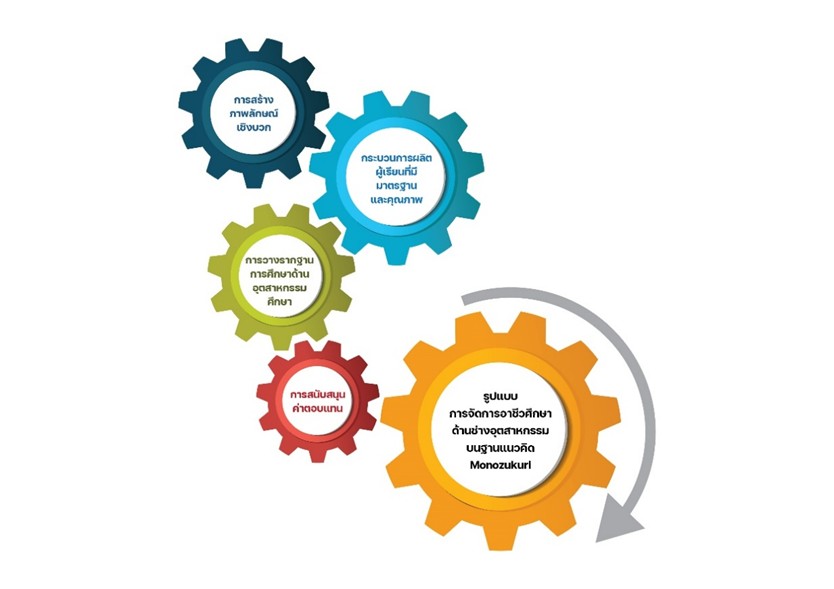
The purpose of this article is to present the study on a vocational education management model for industrial technical and industrial education based on Japan’s Monozukuri concept, drawing on the KOSEN system, which aims to develop practice-oriented manpower through hands-on learning and continuous improvement. This article employs document analysis and synthesis of relevant policies, standards, and academic evidence to reflect the current situation of Thailand’s vocational education in the industrial technical workforce domain, including systemic constraints that affect learner quality and alignment with industry skill demands. The synthesis indicates that strengthening vocational education on a Monozukuri foundation should be designed as an integrated set of four interrelated mechanisms: (1) enhancing the image and attractiveness of vocational pathways through value-based communication and clear education-to-career pathways; (2) developing learner competencies through high-quality practice-based learning such as project/problem-based learning and work-based learning, with enterprises co-defining standards and participating in assessment; (3) building a talent pipeline by establishing industrial education foundations from early levels to reinforce mathematics–science fundamentals and professional attitudes; and (4) providing incentives and compensation that reflect competencies and career progression to retain capable individuals within the system. Implementing this model requires supportive policies, adequate resources, and sustained collaboration among educational institutions, industry partners, and communities to ensure the production of a high-quality technical workforce that continuously meets national industrial development needs.
Article Details

This work is licensed under a Creative Commons Attribution-NonCommercial-NoDerivatives 4.0 International License.
References
คณะกรรมาธิการการศึกษาและการกีฬา สภานิติบัญญัติแห่งชาติ. (2561). รายงานพิจารณาศึกษา เรื่อง แนวทางประยุกต์รูปแบบการเรียนการสอนตามแนวคิด Monozukuri ในระบบ KOSEN ของญี่ปุ่นให้สอดคล้องกับระบบอาชีวศึกษาของไทย. กรุงเทพฯ: สำนักกรรมาธิการ 3 สำนักงานเลขาธิการวุฒิสภา.
จุลนี เทียนไทย และ กุลกนิษฐ์ สุธรรมชัย. (2565). การพัฒนาศักยภาพและเอกลักษณ์แรงงานอาชีวศึกษาไทยใน 3 อุตสาหกรรมหลัก: การวิเคราะห์ผ่านแผนที่เส้นทางการก้าวเข้าสู่แรงงานอาชีวศึกษาไทย ภายใต้แนวคิดความปกติใหม่ (รายงานฉบับย่อ). กรุงเทพฯ: สำนักงานการวิจัยแห่งชาติ.
ณัฐสิฏ รักษ์เกียรติวงศ์. (2559). การปฏิรูปอาชีวศึกษาของประเทศไทย. กรุงเทพฯ: สถาบันวิจัยเพื่อการพัฒนาประเทศไทย.
แผนพัฒนาเศรษฐกิจและสังคมแห่งชาติ ฉบับที่ 13 (พ.ศ. 2566–2570). (2565). ราชกิจจานุเบกษา.
พระราชบัญญัติการอาชีวศึกษา พ.ศ. 2551. (2551). ราชกิจจานุเบกษา.
ยุทธศาสตร์ชาติ (พ.ศ. 2561–2580). (2561). ราชกิจจานุเบกษา.
สมาคมส่งเสริมเทคโนโลยี (ไทย-ญี่ปุ่น). (2562). Monozukuri. สืบค้นจาก http://monodzukuri.tpa.or.th.
สำนักงานคณะกรรมการการอาชีวศึกษา. (2565). สภาพปัญหาและข้อเสนอแนะของสถานศึกษาในการขับเคลื่อนการจัดการอาชีวศึกษา. กรุงเทพฯ: สำนักงานคณะกรรมการการอาชีวศึกษา.
สำนักงานเลขาธิการวุฒิสภา. (2566). รายงานการพิจารณาศึกษาเรื่อง การจัดการอาชีวศึกษาที่ตอบสนองต่อสภาวการณ์ที่เปลี่ยนแปลง. กรุงเทพฯ: คณะกรรมาธิการการศึกษา วุฒิสภา.
Aburatani, H., Sittichivapak, S., Kano, S., & Uehara, N. (2020). Curriculum and implementation of KOSEN engineering education at KOSEN-KMITL, Thailand. In Proceedings of the 16th International CDIO Conference by Chalmers University of Technology, Gothenburg, Sweden (pp. 54–64). Gothenburg, Sweden: Chalmers University of Technology.
International Labour Organization. (2024). Guide for policymakers: Quality Apprenticeships Recommendation, 2023 (No. 208). Retrieved from https://www.ilo.org/sites/default/files/2024-12/1684_SKILLS_Quality_Apprenticeships_WEB.pdf.
National Institute of Technology (KOSEN). (2023). Model Core Curriculum 2023 (English). Retrieved from https://www.kosen-k.go.jp/wp/wp-content/uploads/2025/10/MCC2023-English.pdf.
National Institute of Technology (KOSEN)(2025). About the National Institute of Technology (KOSEN). Retrieved from https://www.kosen-k.go.jp/en/.
OECD. (2020). Improving evidence on VET: Comparative data and indicators. Paris: OECD Publishing.
OECD. (2023). Building future-ready vocational education and training systems. Paris: OECD Publishing.
OECD. (2024). Career guidance, social inequality and social mobility: Insights from international data (OECD Education Spotlights, No. 11). Paris: OECD Publishing.
Thai–German Cooperation. (2019, June 2). Introduction of Dual Vocational Training (DVT). Retrieved from https://www.thai-german-cooperation.info/en_US/history_education_6/.
UNESCO-UNEVOC. (2022). UNESCO strategy for TVET 2022–2029. Retrieved from https://unevoc.unesco.org/pub/unesco_strategy_for_tvet_2022-2029.pdf.
Yoshida, M., & Wada, M. (2008). Effects of Monozukuri curriculum to promote participation of lower grade students in graduation research at technical college: Development of 5-inch locomotive model set. Transactions of the Japan Society of Mechanical Engineers Series C, 74(738), 484–490.
