The Integration of the Third Royal Working Principle, “Solving Problems from a Small Point”, with the Inner Development Goals for Curriculum Development to Promote Life Skills in Thinking and Relationships (Non-Technical Skills)
Keywords:
Non-Technical Skills, Life Skills, Relationships, Royal Working Principle, Solving Problems from a Small PointAbstract
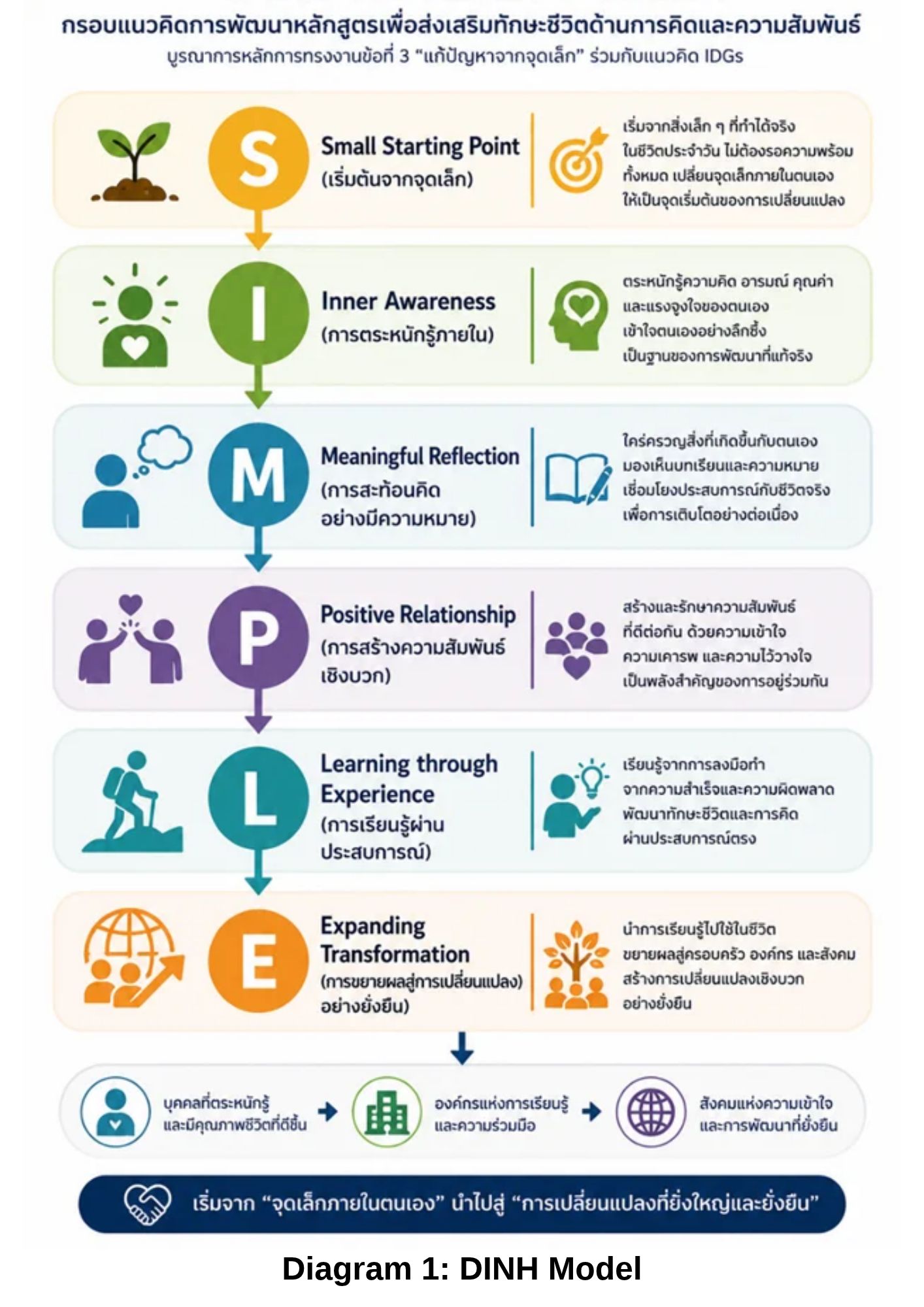
This research aimed to: 1) analyze the Third Royal Working Principle, “Solving Problems from a Small Point,” in relation to life skills in thinking and relationships; 2) study the concepts of Inner Development Goals related to the promotion of life skills in thinking and relationships; and 3) integrate the Third Royal Working Principle with the Inner Development Goals framework for curriculum development promoting life skills in thinking and relationships (non-technical skills). This study employed philosophical research methods, including conceptual analysis, hermeneutic interpretation, and philosophical synthesis. The findings revealed that: 1) The 3rd Royal Working Principle systematically fosters analytical thinking alongside collaborative relationships. 2) The Inner Development Goals (IDGs) on inner awareness directly enhance critical thinking and positive interpersonal connections. 3) The integration of both concepts yielded the "S.I.M.P.L.E. Model," comprising six dimensions: Small Starting Point (S), Inner Awareness (I), Meaningful Reflection (M), Positive Relationship (P), Learning through Experience (L), and Expanding Transformation (E), serving as a sustainable curriculum framework for cultivating non-technical life skills. The new body of knowledge derived from this research is the “S.I.M.P.L.E. Model,” a conceptual framework for sustainable curriculum development promoting non-technical skills.
References
ชัญญานุช โมราศิลป์ และทักษญา สง่าโยธิน. (2562). แนวทางการน้อมนำหลักการทรงงานของพระบาทสมเด็จพระเจ้าอยู่หัวรัชกาลที่ 9 ไปใช้ในการปฏิบัติงานขององค์กรธุรกิจ. Veridian E-Journal, Silpakorn University, 12(1), 710–735.
ชัยโรจน์ นพเฉลิมโรจน์. (2565). การคิดนวัตกรรมด้วยหลักการทรงงานตามหลักปรัชญาหลังนวยุค. วารสารการวิจัยเพื่อพัฒนาชุมชน, 5(2), 111-117.
เมธา หริมเทพาธิป. (2559). การศึกษาตามหลักปรัชญาหลังนวยุคนิยมสายกลาง : วิเคราะห์จากหลักการทรงงานของพระบาทสมเด็จพระเจ้าอยู่หัวรัชกาลที่ 9. วารสารศึกษาศาสตร์ มมร, 4(2), 45–60.
รัชนี อิ่มอก. (2564). การจัดการเรียนรู้ตามหลักการทรงงานเพื่อพัฒนาความเป็นพลเมือง. วารสารวิชาการศึกษาศาสตร์, 22(1), 85–102.
สำนักงานคณะกรรมการพิเศษเพื่อประสานงานโครงการอันเนื่องมาจากพระราชดำริ. (2555). หลักการทรงงานในพระบาทสมเด็จพระเจ้าอยู่หัว. กรุงเทพมหานคร: สำนักงานคณะกรรมการพิเศษเพื่อประสานงานโครงการอันเนื่องมาจากพระราชดำริ
________. (2559). ศาสตร์พระราชาสู่การพัฒนาอย่างยั่งยืน. กรุงเทพมหานคร: สำนักงานคณะกรรมการพิเศษเพื่อประสานงานโครงการอันเนื่องมาจากพระราชดำริ.
สำนักงานคณะกรรมการพัฒนาการเศรษฐกิจและสังคมแห่งชาติ. (2554). แผนพัฒนาเศรษฐกิจและสังคมแห่งชาติ ฉบับที่ 11. กรุงเทพมหานคร: สำนักนายกรัฐมนตรี.
Bailey, R. (2014). The role of soft skills in education and workforce development. London: Routledge.
Bonwell, C. C., & Eison, J. A. (1991). Active learning: Creating excitement in the classroom. Washington, DC: George Washington University.
Endsley, M. R. (1995). Toward a theory of situation awareness in dynamic systems. Human Factors, 37(1), 32–64.
Fletcher, G., Flin, R., McGeorge, P., Glavin, R., Maran, N., and Patey, R. (2003). Anaesthetists” non-technical skills (ANTS): Evaluation of a behavioural marker system. British Journal of Anaesthesia, 90(5), 580–588.
Flin, R., and Martin, L. (2001). Behavioural markers for crew resource management: A review of current practice. International Journal of Aviation Psychology, 11(1), 95–118.
________, O”Connor, P., and Crichton, M. (2008). Safety at the sharp end: A guide to non-technical skills. Aldershot: Ashgate.
Goleman, D. (1995). Emotional intelligence: Why it can matter more than IQ. New York: Bantam Books.
Gordon, M., Darbyshire, D., and Baker, P. (2012). Non-technical skills training to enhance patient safety: A systematic review. Medical Education, 46(11), 1042–1054.
Inner Development Goals. (2023). Inner Development Goals framework. Stockholm: Inner Development Goals Initiative.
Jordan, T. (2021). Inner transformation for sustainability and systems change. Journal of Awareness-Based Systems Change, 1(1), 45–63.
Klein, G. (2008). Naturalistic decision making. New York: Psychology Press.
Kolb, D. A. (1984). Experiential learning: Experience as the source of learning and development. New Jersey: Prentice Hall.
Luft, J. (1970). Group processes: An introduction to group dynamics. Palo Alto, CA: National Press Books.
Martin, J. R. (2001). Cohesion and Texture. In D. Schiffrin, D. Tannen, and H. E. Hamilton (Eds.), The Handbook of Discourse Analysis (pp. 35-53). Malden, MA: Blackwell.
Mezirow, J. (1991). Transformative dimensions of adult learning. San Francisco: Jossey-Bass.
Reader, T. W., Flin, R., Lauche, K., and Cuthbertson, B. H. (2006). Non-technical skills in the intensive care unit. British Journal of Anaesthesia, 96(5), 551–559.
Salas, E., Sims, D. E., and Burke, C. S. (2009). Is there a “Big Five” in teamwork? Small Group Research, 36(5), 555–599.
Schön, D. A. (1983). The reflective practitioner: How professionals think in action. New York: Basic Books.
Schumacher, E. F. (1973). Small is beautiful: Economics as if people mattered. London: Blond and Briggs.
UNESCO. (2021). Reimagining our futures together: A new social contract for education. Paris: UNESCO.
Wamsler, C. (2020). Education for sustainability: Fostering a more conscious society and transformation toward sustainability. International Journal of Sustainability in Higher Education, 21(1), 112–130.
World Health Organization. (1997). Life skills education for children and adolescents in schools. Geneva: World Health Organization.
________. (1999). Partners in life skills education: Conclusions from a United Nations inter-agency meeting. Geneva: World Health Organization.
Downloads
Published
How to Cite
Issue
Section
License
Copyright (c) 2026 Institute of Sufficiency Journal

This work is licensed under a Creative Commons Attribution-NonCommercial-NoDerivatives 4.0 International License.