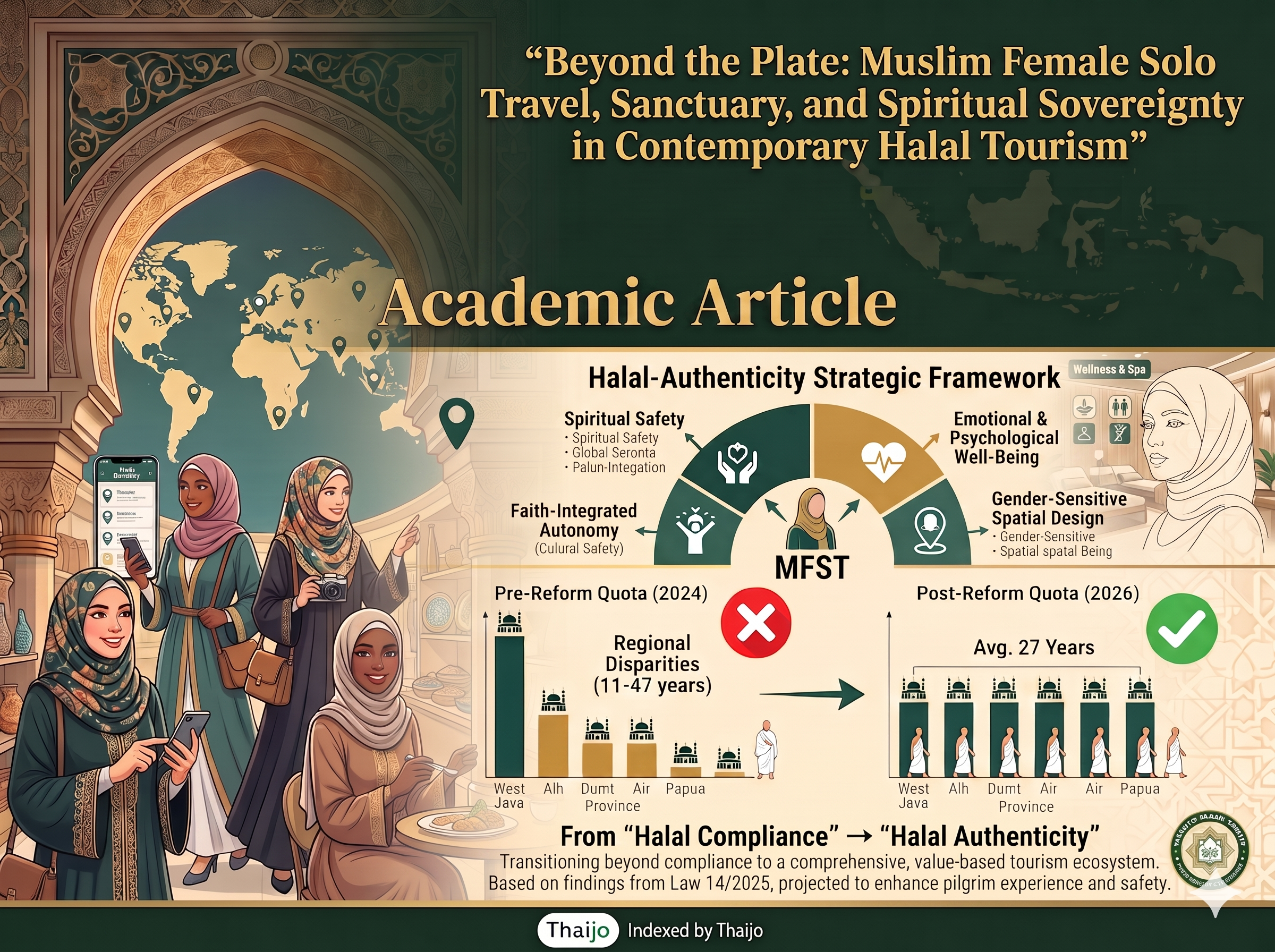
Beyond the Plate: Muslim Female Solo Travel, Sanctuary, and Spiritual Sovereignty in Contemporary Halal Tourism
คำสำคัญ:
Muslim Female Solo Travel (MFST), Halal-Authenticity Framework, Sanctuary and Spiritual Sovereignty, Faith-Integrated Autonomy, Gender-Segregated Hospitalityบทคัดย่อ
The global tourism landscape is undergoing a significant transformation as Muslim Female Solo Travelers (MFSTs) emerge as a rapidly growing segment shaping contemporary travel demand. Despite their increasing economic and socio-cultural influence, dominant halal tourism models remain largely consumption-oriented, focusing primarily on dietary compliance and ritual provision. This study addresses this limitation by reconceptualizing Muslim female solo travel as a pursuit of sanctuary and spiritual sovereignty. Adopting a conceptual and interdisciplinary approach, this paper draws on literature from halal tourism, gender studies, feminist geography, and hospitality management. It proposes the Halal-Authenticity Framework, which positions halal tourism as an integrated value system based on four key dimensions: spiritual safety, gender-sensitive spatial design, faith-integrated autonomy, and emotional and psychological well-being. The analysis highlights the importance of privacy-oriented and gender-sensitive hospitality environments in enhancing perceived safety, trust, and overall travel experience. These elements are shown to influence destination preference and long-term loyalty among MFSTs. The study contributes to halal tourism scholarship by shifting the analytical focus from compliance-based services to experiential and value-based dimensions. It also provides strategic implications for policymakers and industry stakeholders, suggesting that halal authenticity can serve as a competitive advantage in developing inclusive, trust-based, and sustainable tourism systems.
เอกสารอ้างอิง
Abu-Lughod, L. (2002). Do Muslim women really need saving? Anthropological reflections on cultural relativism and its others. American Anthropologist, 104(3), 783–790. https://doi.org/10.1525/aa.2002.104.3.783
Adeimi, J. (2023). Critical femininities on shores: Unveiling gendered realities within ladies-only resorts in Lebanon. Arab Economic and Business Journal, 15(2), Article 5. https://doi.org/10.38039/2214-4625.1034
Al Riyami, H. (2021). The perceived risks of Western women towards traveling to Oman. In N. Slak Valek & H. Almuhrzi (Eds.), Women in tourism in Asian Muslim countries (pp. 131–151). Springer. https://doi.org/10.1007/978-981-33-4757-1_9
Al-Hamarneh, A., & Steiner, C. (2004). Islamic tourism: Rethinking the strategies of tourism development in the Arab world after September 11, 2001. Comparative Studies of South Asia, Africa and the Middle East, 24(1), 173–182. https://doi.org/10.1215/1089201X-24-1-175
Ali, B., & Jungudo, U. M. (n.d.). Towards holistic care: Opportunities, challenges, and future prospects of the ibadah-friendly hospital. Retrieved December 20, 2025, from https://www.researchgate.net/profile/Bello-Ali-2/publication/397642739_Towards_Holistic_Care1/links/691897201bb5f2388c1e9236/Towards-Holistic-Care1.pdf
Battour, M., & Ismail, M. N. (2016). Halal tourism: Concepts, practises, challenges and future. Tourism Management Perspectives, 19, 150–154. https://doi.org/10.1016/j.tmp.2015.12.008
Carbone, F. (2017). International tourism and cultural diplomacy: A new conceptual approach towards global mutual understanding and peace through tourism. Tourism: An International Interdisciplinary Journal, 65(1), 61–74. https://www.researchgate.net/publication/317742834_International_tourism_and_cultural_diplomacy_A_new_conceptual_approach_towards_global_mutual_understanding_and_peace_through_tourism
Gan, J.-E., & Trupp, A. (2025). Deciphering Malaysia's tourism self-image: Insights from industry. Current Issues in Tourism, 1–18. Advance online publication. https://doi.org/10.1080/13683500.2025.2487619
Hopkins, P. E. (2009). Women, men, positionalities and emotion: Doing feminist geographies of religion. ACME: An International Journal for Critical Geographies, 8(1), 1–17. https://www.researchgate.net/publication/229053405_Women_men_positionalities_and_emotion_Doing_feminist_geographies_of_religion
Kaufer, D., & Al-Malki, A. M. (2009). A first for women in the kingdom: Arab/West representations of female trendsetters in Saudi Arabia. Journal of Arab & Muslim Media Research, 2(1–2), 113–133. https://www.researchgate.net/publication/354062340_A_'first'_for_women_in_the_kingdom_Arabwest_representations_of_female_trendsetters_in_Saudi_Arabia
Keadplang, K. (2025). Muslim-friendly luxury travel in Thailand: Redefining high-value tourism through cultural sensitivity and service innovation. Thailand Islamic Journal, 2(1), 56–72. https://so16.tci-thaijo.org/index.php/TIJ/article/view/1866
Nisha, F., & Cheung, C. (2025). Female Muslim tourism and familial caretaking: Intersection of gender and religion. Journal of Hospitality & Tourism Research, 49(6), 1109–1124. https://doi.org/10.1177/10963480241289535
Nisha, F. N. (2023). Tourism, gender and religion: Female Muslims' perceptions of international tourism—An intersectional perspective (Publication No. 200/12770) [Doctoral dissertation, The Hong Kong Polytechnic University]. https://theses.lib.polyu.edu.hk/handle/200/12770
Oktadiana, H., Pearce, P. L., & Chon, K. (2016). Muslim travellers' needs: What don't we know? Tourism Management Perspectives, 20, 124–130. https://doi.org/10.1016/j.tmp.2016.08.004
Osman, I., Junid, J., Ali, H., Buyong, S. Z., Syed Marzuki, S. Z., & Othman, N. (2024). Consumption values, image and loyalty of Malaysian travellers towards Muslim-friendly accommodation recognition (MFAR). Journal of Islamic Marketing, 15(3), 682–719. https://doi.org/10.1108/JIMA-09-2022-0245
Rahman, M. K., Zailani, S., & Musa, G. (2017). What travel motivational factors influence Muslim tourists towards MMITD? Journal of Islamic Marketing, 8(1), 48–73. https://doi.org/10.1108/JIMA-05-2015-0030
Randeree, K. (2020). Demography, demand and devotion: Driving the Islamic economy. Journal of Islamic Marketing, 11(2), 301–319. https://doi.org/10.1108/JIMA-06-2018-0102
Said, M. F., Adham, K. A., Muhamad, N. S., & Sulaiman, S. (2022). Exploring halal tourism in Muslim-minority countries: Muslim travellers' needs and concerns. Journal of Islamic Marketing, 13(4), 824–842. https://doi.org/10.1108/JIMA-07-2020-0202
Smith, M., Puczkó, L., & Rátz, T. (2009). Twenty-three districts in search of a city: Budapest—The capitaless capital? In R. Maitland & B. Ritchie (Eds.), City tourism: National capital perspectives (1st ed., pp. 201–213). CABI. https://doi.org/10.1079/9781845935467.0201
Tavakoli, R., & Mura, P. (2021). Muslim women travellers' constraints: A critical review. In N. Slak Valek & H. Almuhrzi (Eds.), Women in tourism in Asian Muslim countries (pp. 25–40). Springer. https://doi.org/10.1007/978-981-33-4757-1_3
Valentine, G. (2007). Theorizing and researching intersectionality: A challenge for feminist geography. The Professional Geographer, 59(1), 10–21. https://doi.org/10.1111/j.1467-9272.2007.00587.x
Wilson, E., & Harris, C. (2006). Meaningful travel: Women, independent travel and the search for self and meaning. Tourism: An International Interdisciplinary Journal, 54(2), 161–172.
ดาวน์โหลด
เผยแพร่แล้ว
รูปแบบการอ้างอิง
ฉบับ
ประเภทบทความ
สัญญาอนุญาต
ลิขสิทธิ์ (c) 2026 Internatinal Islamic College Bangkok, Krik University

อนุญาตภายใต้เงื่อนไข Creative Commons Attribution-NonCommercial-NoDerivatives 4.0 International License.
วารสารที่ได้รับการตีพิมพ์เป็นลิขสิทธ์ของวิทยาลัยนานาชาติอิสลามกรุงเทพ มหาวิทยาลัยเกริก
ข้อความที่ปรากฎในบทความแต่ละเรื่องในวารสารวิชาการเล่มนี้เป็นความคิดเห็นส่วนตัวของผู้เขียนแต่ละท่านไม่เกี่ยวข้องกับวิทยาลัยนานาชาติอิสลามกรุงเทพ และคณาจารย์ท่านอื่น แต่อย่างใด ความรับผิดชอบองค์ประกอบทั้งหมดของบทความแต่ละเรื่องเป็นของผู้เขียน