Factors Affecting Consumers’ Purchasing Decisions of Almond Protein Noodles in Bangkok
Article Sidebar
Main Article Content
Abstract
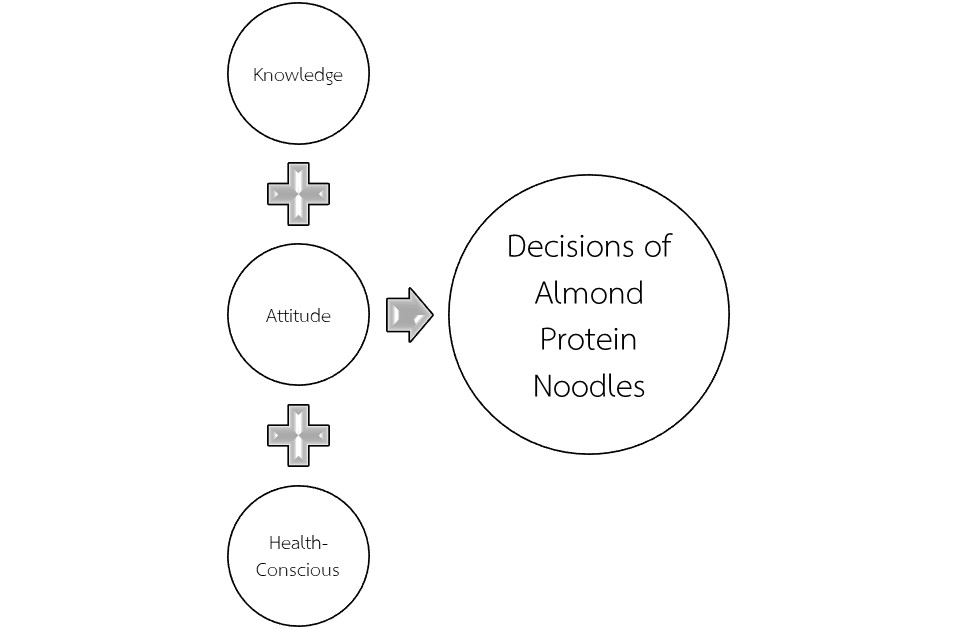
This research article aimed to (1) study the behavior, knowledge, and attitudes of consumers toward the decision to purchase almond protein noodles in Bangkok and (2) study the factors influencing consumers' decision to purchase almond protein noodles in Bangkok. This research was a quantitative study using questionnaires as a data collection tool from a sample of 300 people who had purchased or consumed healthy alternative noodle products within the past year. Data were analyzed using descriptive statistics and logistic regression analysis. The results showed that (1) most consumers were female, aged between 25–34 years, had a bachelor's degree, were private sector employees, and had an average monthly income between 15,001–30,000 baht. Their overall health behavior was at a frequent level, with consumers prioritizing the selection of nutritious food and following health information through online media. They had a good level of knowledge about almond protein noodles and had a positive attitude towards the product, viewing it as a healthy and worthwhile food to consume. (2) The results of the logit model analysis showed that the level of knowledge, attitude, and health behavior of consumers had a statistically significant influence on the decision to purchase almond protein noodles at the 0.01 level, while gender, age, occupation, and income did not show a significant influence. The model achieved a prediction accuracy of 74.7%. The study results indicate that purchasing decisions for healthy food products in urban areas are more influenced by behavioral factors, including knowledge, attitudes, and health behaviors, than by demographic factors. This aligns with the Knowledge–Attitude–Practice Model (KAP), which explains that positive knowledge and attitudes can effectively lead to positive consumption behaviors towards healthy products.
Article Details

This work is licensed under a Creative Commons Attribution-NonCommercial-NoDerivatives 4.0 International License.
References
กนกวรรณ คงธนาคมธัญกิจ. (2563). ปัจจัยที่ส่งผลต่อการตัดสินใจซื้ออาหารเพื่อสุขภาพในรูปแบบพร้อมทานของผู้บริโภคในเขตกรุงเทพมหานคร. (บริหารธุรกิจมหาบัณฑิต, มหาวิทยาลัยธรรมศาสตร์).
กมลมาลย์ แจ้งล้อม, ปุญญภพ ตันติปิฎก และ กีรติญา ครองแก้ว. (2567). สำรวจเทรนด์สุขภาพเวลเนสชาวไทยด้านดูแล รักษา และป้องกัน…ธุรกิจดาวรุ่งที่กำลังเติบโต. สืบค้นจาก https://www.scbeic.com/th/detail/product/health-and-wellness-survey-170124.
กรชนก หวังถวิล, อนิรุทธ์ ผ่องแผ้ว, พิชัย ลัทธศิกดิ์ศิริ และ พิชัย ทรัพย์เกิด. (2567). ปัจจัยที่มีอิทธิพลต่อการตัดสินใจบริโภคอาหารเพื่อสุขภาพของประชาชน ในเขตกรุงเทพมหานคร. วารสาร มจร เพชรบุรีปริทรรศน์, 7(1), 122–134.
ทวีศักดิ์ เทพพิทักษ์. (2556). พฤติกรรมผู้บริโภค. กรุงเทพฯ: จุฬาลงกรณ์มหาวิทยาลัย.
ศูนย์วิจัยกสิกรไทย. (2565). โปรตีนทางเลือกเทรนด์อาหารเพื่ออนาคต เติบโตอย่างที่คิด?. สืบค้นจาก https://www.kasikornresearch.com/th/analysis/k-social-media/Pages/Plant-Based-FB-27-07-2022.aspx.
อาจารีย์ อุดมพันธ์. (2563). ทัศนคติและความตั้งใจซื้อของผู้บริโภคต่ออาหารฟังก์ชันในเขตกรุงเทพมหานคร. (บริหารธุรกิจมหาบัณฑิต, มหาวิทยาลัยธรรมศาสตร์).
Baş, M., Kahriman, M., Ayakdas, G., Hajhamidiasl, L., & Koseoglu, S. K. (2024). Driving factors influencing the decision to purchase plant-based beverages: A sample from Türkiye. Foods, 13(11), 1760.
Creative Thailand. (2564). Plant-based เทรนด์อาหารจากพืชเพื่อความยั่งยืน. สืบค้นจาก https://www.creativethailand.org/article-read?article_id=32816.
Dean, S., Gomes, M., Silva, W., Steele, M., Wood, K., Du, M., Costa, T., Serão, N., Gionbelli, M. & Duarte, M. (2024). Vitamin A–Enriched Diet at Late Gestation Affects Intramuscular Fat Deposition in Beef Offspring. Meat and Muscle Biology, 8(1), 1-12.
Esfandiari, M., Sciacca, B., Feijóo, S., Laffan, D. A., Milosevic, T., O'Toole, C., & Norman, J. O. H. (2025). Trends in digital technologies to address children's online safety education: A systematic scoping review. International Journal of Educational Research Open, 9, 100462.
Global Wellness Institute. (2024). The global wellness economy reaches a new peak of 6.3 trillion and is forecast to hit 9 trillion by 2028. Retrieved from https://globalwellnessinstitute.org/press-room/press-releases/the-global-wellness-economy-reaches-a-new-peak-of-6-3-trillion-and-is-forecast-to-hit-9-trillion-by-2028/.
Global Wellness. (2025). The Future of Wellness: 2025 Trends. Retrieved from https://www.globalwellnesssummit.com/product/2025-future-of-wellness-trends-report/
Grand View Research. (2023). Protein-fortified noodles & pasta market (2024–2030). Retrieved from https://www.grandviewresearch.com/industry-analysis/protein-fortified-noodles-pasta-market-report.
Hair, J. F., Black, W. C., Babin, B. J., & Anderson, R. E. (2019). Multivariate data analysis. (8th ed.). London: Cengage Learning.
IMARC Group. (2024). Thailand health and wellness market report 2024–2033. Retrieved from https://www.imarcgroup.com/thailand-health-wellness-market.
Kotler, P. (2003). Marketing management. (11th ed.). Upper Saddle River, NJ: Prentice Hall.
Mahfuza, E. J., Hassan, M. F., & Ahamed, M. S. (2023). Consumer’s preferences for healthy food consumption: An empirical analysis from Mymensingh city in Bangladesh. Archives of Agriculture and Environmental Science, 8(4), 558-564.
Suszek, A., & Guze, S. (2024). A Logistic Regression Model for the Analysis of Attitudes and Behaviours Towards Functional Foods Among Senior Consumers Aged 60+ Years. Sustainability, 16(24), 11015.
