The Development of an Online Educational Game on Visual Elements to Promote Art Learning among Grade 6 Students at Ratwittaya School, Phetchaburi Province
Keywords:
An online educational game, visual elements, Art Learning ManagementAbstract
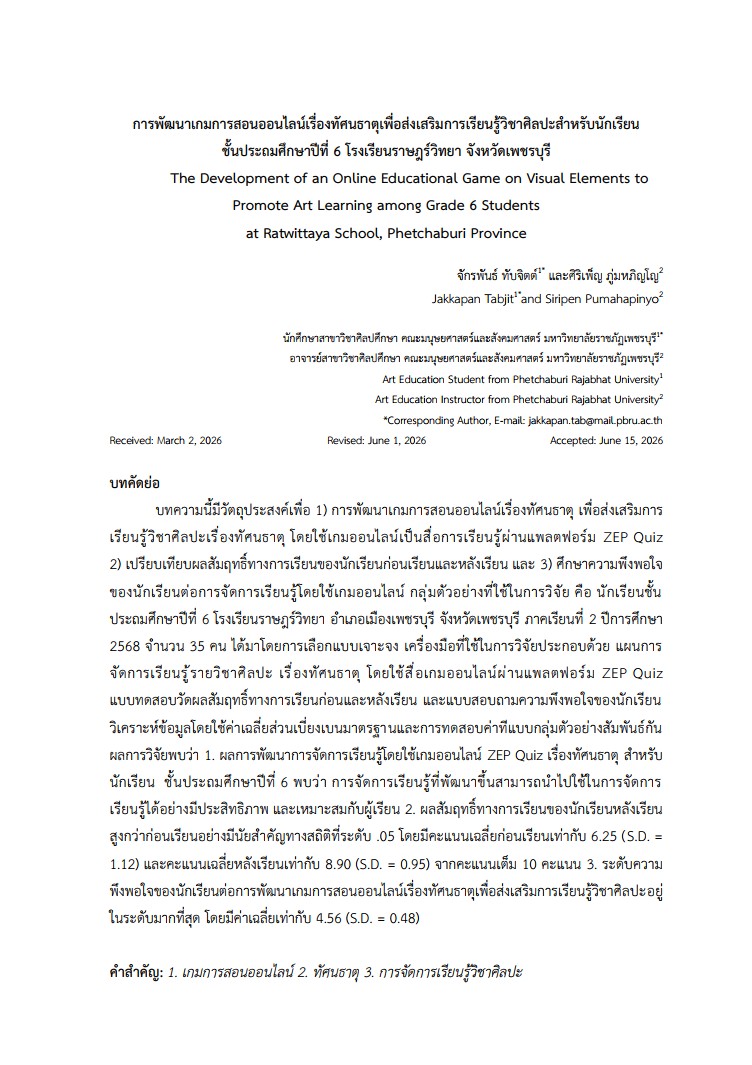
This Article aimed to study : 1) develop an online educational game on Visual Elements to promote art learning using the ZEP Quiz platform as a learning medium; 2) compare students' learning achievement before and after learning through the online educational game; and 3) investigate students' satisfaction with learning through the online educational game. The sample consisted of 35 Grade 6 students from Ratwittaya School, Mueang Phetchaburi District, Phetchaburi Province, during the second semester of the 2025 academic year. The participants were selected using purposive sampling. The research instruments included: (1) lesson plans for the Art course on Visual Elements using an online educational game through the ZEP Quiz platform, (2) a pre-test and post-test to measure students' learning achievement, and (3) a student satisfaction questionnaire. The collected data were analyzed using mean, standard deviation, and the paired-samples t-test. The research results were found as follows; 1. The results of the quality evaluation revealed that the online instructional game on visual elements was rated at the highest level of quality. 2. The students’ learning achievement after learning was significantly higher than before learning at the .05 level. The mean score before learning was 6.25 (S.D. = 1.12), while the mean score after learning was 8.90 (S.D. = 0.95) out of 10 points. 3. Students' satisfaction with the online educational game for promoting art learning was at the highest level, with a mean score of 4.56 (S.D. = 0.48).
References
กระทรวงศึกษาธิการ. (2560). หลักสูตรแกนกลางการศึกษาขั้นพื้นฐาน พุทธศักราช 2551 (ฉบับปรับปรุง พ.ศ. 2560). โรงพิมพ์ชุมนุมสหกรณ์การเกษตรแห่งประเทศไทย.
กิติยา แสงทอง. (2563). การใช้เทคโนโลยีปัญญาประดิษฐ์เพื่อส่งเสริมการเรียนรู้เชิงสร้างสรรค์ [วิทยานิพนธ์ครุศาสตรมหาบัณฑิต, จุฬาลงกรณ์มหาวิทยาลัย]. https://digital.car.chula.ac.th
สำนักงานคณะกรรมการการศึกษาขั้นพื้นฐาน. (2566). แนวทางการจัดการเรียนรู้เพื่อพัฒนาผลลัพธ์การเรียนรู้ของผู้เรียน. https://www.obec.go.th
Dewey, J. (1938). Experience and education. Macmillan.
Jonassen, D. H. (1999). Designing constructivist learning environments. In C. M. Reigeluth (Ed.), Instructional-design theories and models (Vol. II). Lawrence Erlbaum Associates.
Luckin, R., Holmes, W., Griffiths, M., & Forcier, L. B. (2016). Intelligence unleashed: An argument for AI in education. Pearson.
Piaget, J. (1936). Origins of intelligence in the child. Kegan Paul.
Santos, M., & Chen, Y. (2020). Creativity and design-based learning in art education. Journal of Art Education, 73(4), 22–30.
Vygotsky, L. S. (1978). Mind in society: The development of higher psychological processes. Harvard University Press.
Published
How to Cite
Issue
Section
License

This work is licensed under a Creative Commons Attribution-NonCommercial-NoDerivatives 4.0 International License.
Articles in this journal are copyrighted by the x may be read and used for academic purposes, such as teaching, research, or citation, with proper credit given to the author and the journal.use or modification of the articles is prohibited without permission.
statements expressed in the articles are solely the opinions of the authors.
authors are fully responsible for the content and accuracy of their articles.
other reuse or republication requires permission from the journal."


