Evaluating the Science Power Ten Project on the Academic Leadership of Lead Teachers Using Stake’s Countenance Model
Article Sidebar
Main Article Content
Abstract
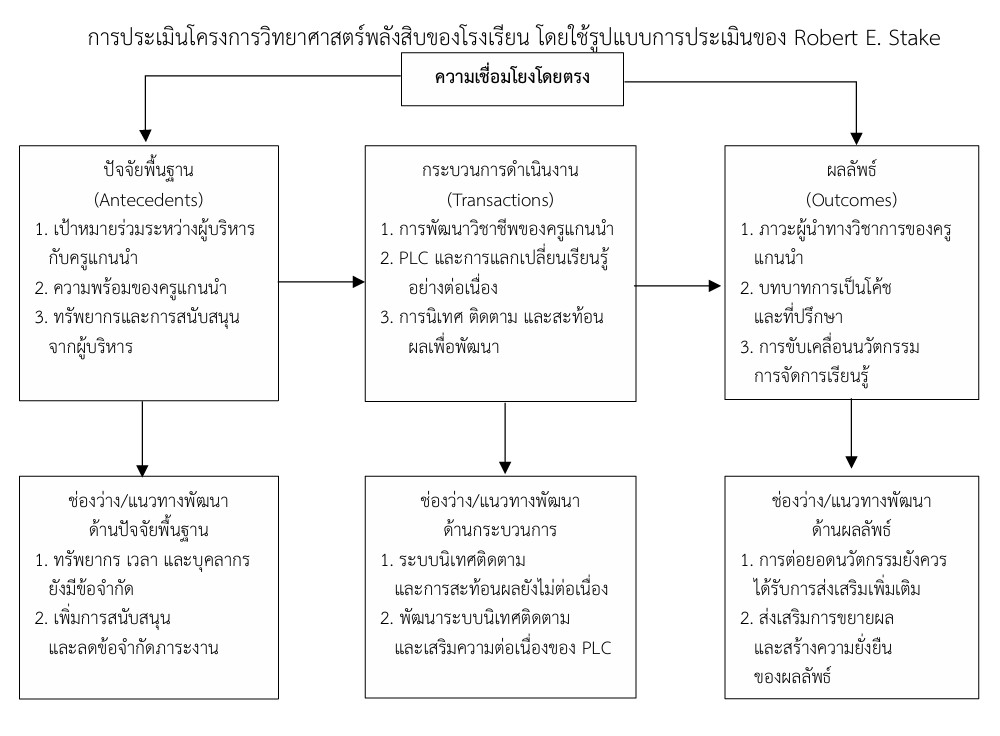
This study aimed to evaluate the congruence between the expected and actual conditions of (1) antecedents, (2) transactions, and (3) outcomes regarding the academic leadership of lead teachers under the Science Power Ten Project at Anuban Surat Thani School. Stake’s Countenance Model was employed as the evaluation framework. The sample consisted of 31 individuals selected through purposive sampling, including 5 school administrators, 1 project coordinator, 7 lead teachers, and 18 teachers who received knowledge transfer from the lead teachers. The research instruments included questionnaires comprising 92 items covering antecedents, transactions, and academic leadership outcomes of lead teachers; a five-question semi-structured interview form; and an 18-item documentary evidence record form. All instruments were validated by five experts, yielding an Index of Item-Objective Congruence (IOC) ranging from 0.80 to 1.00. The reliability coefficients of the questionnaires were high (α = 0.985, 0.976, 0.911, and 0.912, respectively). Data were analyzed using mean, standard deviation, and content analysis. The findings revealed that all three domains met the evaluation criteria and demonstrated congruence between the expected and actual conditions. The antecedents and transactions were rated at a high level, while the outcomes regarding the academic leadership of lead teachers were rated at the highest level. Clear policy direction, administrative support, and professional development through Professional Learning Communities (PLC) played significant roles in enhancing the academic leadership of lead teachers. Furthermore, Stake’s Countenance Model explained the gaps between the expected and actual conditions as areas for development, providing useful information for planning academic support systems and expanding the project at school and network levels.
Article Details

This work is licensed under a Creative Commons Attribution-NonCommercial-NoDerivatives 4.0 International License.
References
กฤษณะ ไกรสี. (2568). ความสำคัญ การนิเทศ ติดตาม และประเมินผลการจัดการศึกษาต่อการพัฒนาการจัดการเรียนการสอนในโรงเรียน. บัณฑิตศึกษาปริทรรศน์ วิทยาลัยสงฆ์นครสวรรค์, 13(1), 75–84.
น้ำฝน ยาปัน และ เฮนรี่ ยู อัญชุนดา. (2568). ความสัมพันธ์ระหว่างการบริหารทรัพยากรทางการศึกษาของผู้บริหารสถานศึกษากับคุณภาพผู้เรียนของสถานศึกษาในสังกัดสำนักงานเขตพื้นที่การศึกษาประถมศึกษาพิษณุโลก เขต 2. Journal of Applied Education, 3(3), 43–52.
นิภาวรรณ ศิริธนิกุล, รุจิร์ ภู่สาระ และ ภาวิดา ธาราศรีสุทธิ. (2566). แนวทางการบริหารสถานศึกษาที่มีต่อการลดภาระงาน ตามการรับรู้ของครูในโรงเรียนมัธยมศึกษาจังหวัดสมุทรสงคราม สังกัดสำนักงานเขตพื้นที่การศึกษามัธยมศึกษาสมุทรสาคร สมุทรสงคราม. วารสารวิชาการมหาวิทยาลัยราชภัฏเพชรบุรี, 13(1), 52–61.
โรงเรียนอนุบาลสุราษฎร์ธานี. (2563). รายงานการประเมินตนเองของสถานศึกษา (SAR) ปีการศึกษา 2563. สุราษฎร์ธานี: โรงเรียนอนุบาลสุราษฎร์ธานี.
โรงเรียนอนุบาลสุราษฎร์ธานี. (2566–2568). รายงานการประเมินตนเองของสถานศึกษา (SAR) ปีการศึกษา 2566–2568. สุราษฎร์ธานี: โรงเรียนอนุบาลสุราษฎร์ธานี.
ศิริชัย กาญจนวาสี. (2562). ทฤษฎีการประเมิน. (พิมพ์ครั้งที่ 9). กรุงเทพฯ: สำนักพิมพ์จุฬาลงกรณ์มหาวิทยาลัย.
สร้อยสุดา กรีน. (2563). รูปแบบการพัฒนาภาวะผู้นำครูในการจัดการเรียนรู้ในโรงเรียนมัธยมศึกษา สังกัดสำนักงานศึกษาธิการภาค 11. (ครุศาสตรดุษฎีบัณฑิต, มหาวิทยาลัยราชภัฏสกลนคร).
สำนักงานเขตพื้นที่การศึกษาประถมศึกษาสุราษฎร์ธานี เขต 1. (2564). หนังสือราชการการอบรมโรงเรียนอนุบาลสุราษฎร์ธานีเป็นโรงเรียนศูนย์โครงการวิทยาศาสตร์พลังสิบ. สุราษฎร์ธานี: สำนักงานเขตพื้นที่การศึกษาประถมศึกษาสุราษฎร์ธานี เขต 1.
สำนักงานคณะกรรมการการศึกษาขั้นพื้นฐาน. (2565). คู่มือโครงการวิทยาศาสตร์พลังสิบ/หลักสูตรรายวิชา เพิ่มเติมโครงการวิทยาศาสตร์พลังสิบ. กรุงเทพฯ: สำนักงานคณะกรรมการการศึกษาขั้นพื้นฐาน.
หฤชนันก์ แสนกันยา. (2565). โปรแกรมเสริมสร้างภาวะผู้นำทางวิชาการสำหรับครูในศตวรรษที่ 21 สังกัดสำนักงานเขตพื้นที่การศึกษาประถมศึกษากาฬสินธุ์ เขต 2. (การศึกษามหาบัณฑิต, มหาวิทยาลัยมหาสารคาม).
Danielson, C. (2013). The framework for teaching: Evaluation instrument. Chicago, IL: Danielson Group.
DuFour, R., & Fullan, M. (2013). Cultures built to last: Systemic PLCs at work. Indiana: Solution Tree Press.
Eddy, P. L., & Kirby, E. (2020). Leading for tomorrow: A primer for succeeding in higher education leadership. New Jersey: Rutgers University Press.
Hallinger, P., Piyaman, P., & Viseshsiri, P. (2017). Assessing the effects of learning-centered leadership on teacher professional learning in Thailand. Teaching and Teacher Education, 67, 464–476.
Katzenmeyer, M., & Moller, G. (2009). Awakening the sleeping giant: Helping teachers develop as leaders. (3rd ed.). Thousand Oaks, California: Corwin Press.
Lieberman, A., Campbell, C., & Yashkina, A. (2017). Teacher learning and leadership: Of, by, and for teachers. Oxfordshire: Routledge.
McDavid, J. C., Huse, I., & Hawthorn, L. R. L. (2019). Program evaluation and performance measurement: An introduction to practice. (3rd ed.). Thousand Oaks, California: Sage.
Mullis, I. V. S., Martin, M. O., Foy, P., Kelly, D. L., & Fishbein, B. (2020). TIMSS 2019 international results in mathematics and science. Boston: Boston College, TIMSS & PIRLS International Study Center.
Saadati, F., Bastian, A., & Kaiser, G. (2026). Growth of teacher professional competence through professional development programs: A study of mathematics teachers in Chile. Educational Studies in Mathematics, 122, 511–536.
Sheninger, E. (2019). Digital leadership: Changing paradigms for changing times. (2nd ed.). Thousand Oaks, California: Corwin Press.
Stake, R. E. (1967). The countenance of educational evaluation. Teachers College Record, 68(7), 523–540.
York-Barr, J., & Duke, K. (2004). What do we know about teacher leadership? Findings from two decades of scholarship. Review of Educational Research, 74(3), 255–316.
