Development of the MET Model Learning Management Innovation to Enhance Communication and Technology Competencies in Seminar in Mathematics Education
Article Sidebar
Main Article Content
Abstract
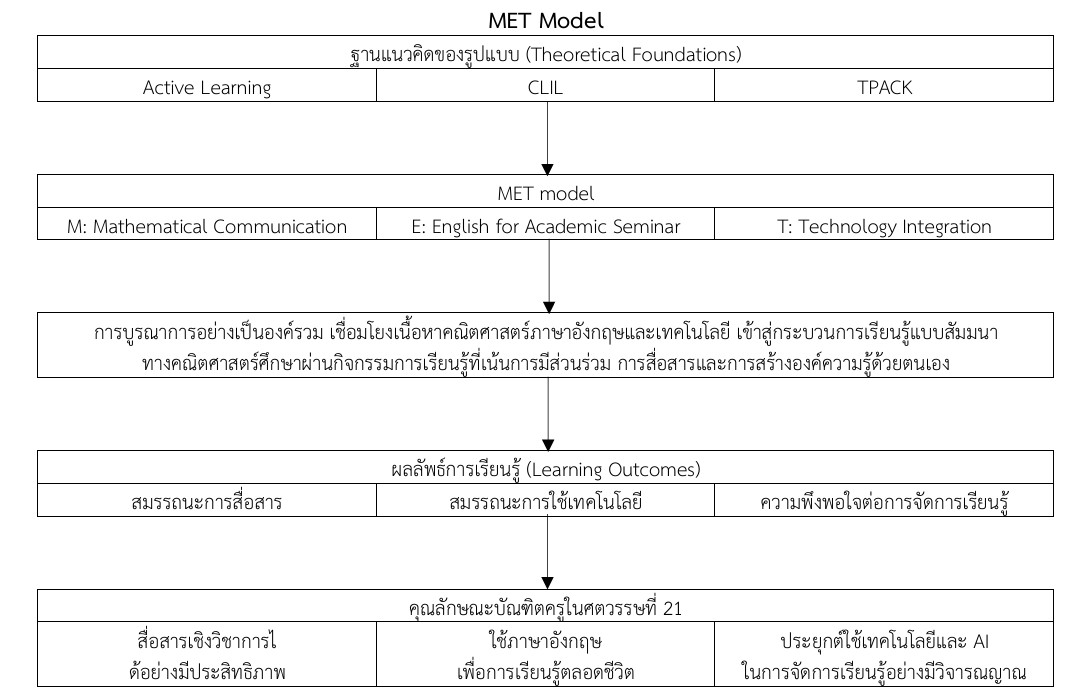
This research article aimed to: 1) develop and validate the quality of the MET Model learning management approach for the Seminar in Mathematics Education course; 2) investigate the effects of the MET Model on the communication and technology competencies of students majoring in Mathematics and English; and 3) examine the satisfaction of students majoring in Mathematics and English with the MET Model learning management approach. This study employed a research and development (R&D) methodology. The sample consisted of 22 fourth-year students majoring in Mathematics and English who were enrolled in the second semester of the 2025 academic year and were selected through purposive sampling. The research instruments included: 1) the MET Model learning management model, 2) a 14-week learning management plan, 3) a communication competency assessment form, 4) a technology competency assessment form, and 5) a satisfaction questionnaire. Data were analyzed using the mean, standard deviation, Wilcoxon Signed-Rank Test, and content analysis. The results revealed that: 1) the MET Model consisted of three main components: M – Mathematical Communication, E – English for Academic Seminar, and T – Technology Integration, and its overall appropriateness was rated at the highest level; 2) the communication and technology competencies of students majoring in Mathematics and English after the implementation of the MET Model were significantly higher than those before the implementation; and 3) the overall satisfaction of students majoring in Mathematics and English with the MET Model was at the highest level.
Article Details

This work is licensed under a Creative Commons Attribution-NonCommercial-NoDerivatives 4.0 International License.
References
จิราภรณ์ ดีประเสริฐ, ปารเมศ ชิณะแขว, รัชนีเพ็ญ พลเยี่ยม, ปิยะธิดา ชนะพันธ์, พิสิฐ พินิจสกุล และ นรินทรา มิ่งโอโล. (2568). การพัฒนากิจกรรมการเรียนรู้โดยใช้สมองเป็นฐานเพื่อยกระดับผลสัมฤทธิ์ทางการเรียนและความพึงพอใจในวิชาคณิตศาสตร์ เรื่อง ตรรกศาสตร์เบื้องต้น. วารสารราชภัฏสุรินทร์วิชาการ, 3(3), 197–206.
ธนากร ม่วงกล้วย, พัชระ นวลปาน, พงศ์ประพันธ์ พงษ์โสภณ และ จีระวรรณ เกษสิงห์. (2568). TPACK ในการศึกษาไทยช่วงปี 2020–2024. Journal of Education and Innovation, 27(2), 321–335.
ปริญ ภัทรปัญญากูร, ประสาร ศรีพงษ์เพลิด, ทิพย์สุดา ปรีดาพันธุ์, คชษิณ สุวิชา, วันชาติ ชาญวิจิตร, ขวัญชนก อำภา, อัธยา เมิดไธสง และ นรินทรา มิ่งโอโล. (2568). การพัฒนารูปแบบการจัดการเรียนรู้ ROIET เพื่อเสริมสร้างสมรรถนะทางประวัติศาสตร์ของนักศึกษาชั้นปีที่ 1 มหาวิทยาลัยราชภัฏร้อยเอ็ด. วารสารราชภัฏสุรินทร์วิชาการ, 3(5), 73–88.
ปิยะธิดา ชนะพันธ์, พิสิฐ พินิจสกุล, อัจจนา น้อยบุดดี, ทแกล้ว แกล้วกล้า และ ศุภชัย ราชอาจ. (2567). การส่งเสริมการจัดการเรียนรู้แบบ CLIL สำหรับนักศึกษาสาขาวิชาคณิตศาสตร์และภาษาอังกฤษ มหาวิทยาลัยราชภัฏร้อยเอ็ด. วารสารพุทธศาสตร์ มจร อุบลราชธานี, 6(2), 2134–2147.
สำนักงานเลขาธิการสภาการศึกษา. (2560). แผนการศึกษาแห่งชาติ พ.ศ. 2560–2579. กรุงเทพฯ: สำนักงานเลขาธิการสภาการศึกษา.
Coyle, D., Hood, P., & Marsh, D. (2010). CLIL: Content and language integrated learning. Cambridge: Cambridge University Press.
Freeman, S., Eddy, S. L., McDonough, M., Smith, M. K., Okoroafor, N., Jordt, H., & Wenderoth, M. P. (2014). Active learning increases student performance in science, engineering, and mathematics. Proceedings of the National Academy of Sciences, 111(23), 8410–8415.
Gall, M. D., Gall, J. P., & Borg, W. R. (2003). Educational Research: An Introduction. (7th ed.). Boston, Massachusetts: Allyn and Bacon.
Mingolo, N. (2024). The impact of cooperative learning activities using the Team-Assisted Individualization (TAI) technique combined with activity-based learning on problem-solving abilities and mathematical connections abilities in the subject of congruence. Higher Education Studies, 14(4), 206–215.
Mishra, P., & Koehler, M. J. (2006). Technological pedagogical content knowledge: A framework for teacher knowledge. Teachers College Record, 108(6), 1017–1054.
National Council of Teachers of Mathematics. (2023). Principles to actions: Ensuring mathematical success for all. Reston, Virginia: National Council of Teachers of Mathematics.
OECD. (2019). OECD future of education and skills 2030: OECD learning compass 2030. Paris: OECD Publishing.
Piaget, J. (1972). The psychology of the child. New York: Basic Books.
Shulman, L. S. (1986). Those who understand: Knowledge growth in teaching. Educational Researcher, 15(2), 4–14.
UNESCO. (2021). Reimagining our futures together: A new social contract for education. Paris: UNESCO Publishing.
Voogt, J., Fisser, P., Pareja Roblin, N., Tondeur, J., & van Braak, J. (2013). Technological pedagogical content knowledge: A review of the literature. Journal of Computer Assisted Learning, 29(2), 109–121.
Vygotsky, L. S. (1978). Mind in society: The development of higher psychological processes. Cambridge MA: Harvard University Press.
