The Development of a School Safety Enhancement and Student Support System Using the M CHANGE Model Innovation at Suroutmaijaroen School, Pathum Thani Primary Educational Service Area Office 1
Article Sidebar
Main Article Content
Abstract
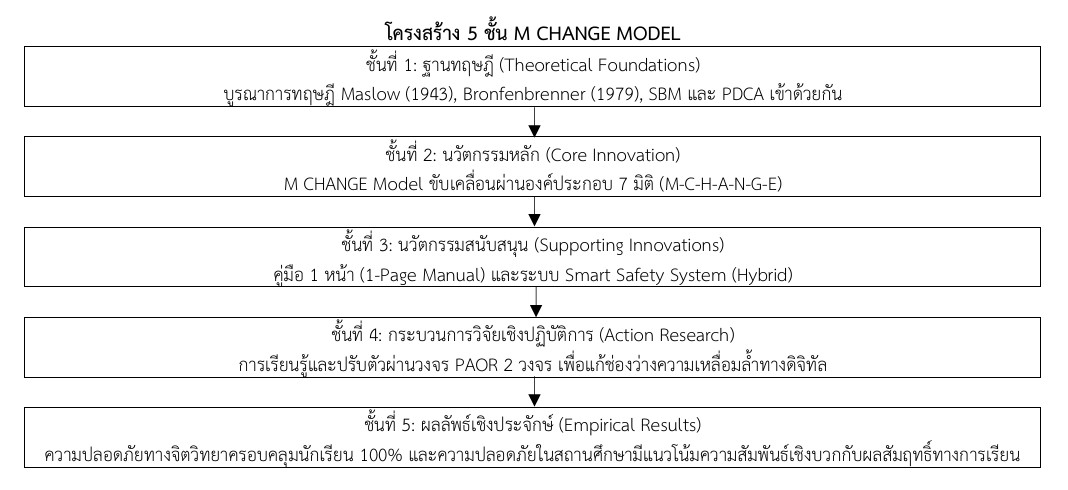
This research aimed to (1) study the conditions and problems of school safety operations and the student support system, (2) develop and evaluate the appropriateness of the M CHANGE Model innovation, (3) implement the model through action research, and (4) evaluate its suitability, feasibility, and stakeholder satisfaction. A mixed-methods research design combining research and development (R&D) and action research approaches was employed over a 22-month period across four phases. The target groups consisted of 13 educational personnel, 158 students in Grades 4–9, and 158 parents (total n = 329), along with 12 student representatives and 5 experts. Nine research instruments—questionnaires, interview forms, evaluation forms, and recording forms—were utilized, and data were analyzed using mean, standard deviation, Independent Samples t-test, Paired Samples t-test, One-Sample t-test, One-way ANOVA, and content analysis. The findings revealed that: (1) overall school safety operations were rated at a high level (Mean = 3.74, S.D. = 0.63), with physical and mental well-being scoring lowest (Mean = 3.54); a statistically significant perception gap was found between personnel (Mean = 4.12) and students (Mean = 3.74) at the .05 level; (2) the M CHANGE Model, comprising seven components, a one-page manual, and a Smart Safety System, was rated at the highest level by experts using a rating-scale evaluation (Mean = 4.51, S.D. = 0.41); (3) implementation across two action research cycles resulted in a 72.22% reduction in physical altercations, a 66.67% reduction in bullying incidents, 100% student access to reporting channels, and a mean academic achievement showing an increasing trend from 73.41% to 76.14%; and (4) post-implementation suitability and feasibility were rated at a high level (Mean = 4.35, S.D. = 0.39), as was overall stakeholder satisfaction (Mean = 4.25, S.D. = 0.55).
Article Details

This work is licensed under a Creative Commons Attribution-NonCommercial-NoDerivatives 4.0 International License.
References
กัมปนาท นาคบัว. (2565). การศึกษาแนวทางการดำเนินงานรักษาความปลอดภัยของสถานศึกษา สังกัดสำนักงานเขตพื้นที่การศึกษาประถมศึกษาพิษณุโลก เขต 1. (การศึกษามหาบัณฑิต, มหาวิทยาลัยนเรศวร).
บุญชม ศรีสะอาด. (2560). การวิจัยเบื้องต้น (พิมพ์ครั้งที่ 10). กรุงเทพฯ: สุวีริยาสาส์น.
ปัญญ์ชิตา สมบัติเพิ่ม. (2566). แนวทางการดำเนินงานสถานศึกษาปลอดภัยของสถานศึกษา สังกัดสำนักงานเขตพื้นที่การศึกษามัธยมศึกษากาฬสินธุ์. (คุรุศาตรมหาบัณฑิต, มหาวิทยาลัยราชภัฏมหาสารคาม).
รุ่งนภา สุขสำแดง. (2563). ปัญหาการดำเนินงานระบบดูแลช่วยเหลือนักเรียนของสถานศึกษาในสังกัดสำนักงานเขตพื้นที่การศึกษาประถมศึกษาพระนครศรีอยุธยาเขต 1. (ครุศาสตรมหาบัณฑิต, มหาวิทยาลัยราชภัฎพระนครศรีอยุธยา).
โรงเรียนสุเหร่าใหม่เจริญ. (2567). รายงานสภาพปัญหาการดำเนินงานด้านความปลอดภัยในสถานศึกษาและระบบการดูแลช่วยเหลือนักเรียน. ปทุมธานี: โรงเรียนสุเหร่าใหม่เจริญ สำนักงานเขตพื้นที่การศึกษาประถมศึกษาปทุมธานี เขต 1.
ลัดดาวัลย์ โคตรพิมพ์. (2564). แนวทางการพัฒนาระบบดูแลช่วยเหลือนักเรียน โรงเรียนสังกัดสำนักงานเขตพื้นที่การศึกษามัธยมศึกษา เขต 27. (การศึกษามหาบัณฑิต, มหาวิทยาลัยมหาสารคาม).
สำนักงานคณะกรรมการการศึกษาขั้นพื้นฐาน. (2559). แนวทางการดำเนินงานระบบการดูแลช่วยเหลือนักเรียน. กรุงเทพฯ: กระทรวงศึกษาธิการ.
อดิศร ดีปานธรรม. (2561). การพัฒนารูปแบบการจัดการด้านความปลอดภัยแบบมีส่วนร่วมในสถานศึกษา สังกัดสำนักงานคณะกรรมการการศึกษาขั้นพื้นฐาน. (ปรัชญาดุษฎีบัณฑิต, มหาวิทยาลัยราชภัฎราชนครินทร์).
Berkowitz, R., Moore, H., Astor, R. A., & Benbenishty, R. (2017). A research synthesis of the associations between socioeconomic background, inequality, school climate, and academic achievement. Review of educational research, 87(2), 425-469.
Borg, W.R & Gall, M.D. Gall. (1983). Educational Research: An Introduction. (Fifth Edition). New York: Longman.
Bronfenbrenner, U. (1979). The ecology of human development: Experiments by nature and design. Harvard University Press.
Bucher, K. T., & Manning, M. L. (2005). Creating safe schools. The Clearing House: A Journal of Educational Strategies, Issues and Ideas, 79(1), 55-60.
Cohen, J., McCabe, E. M., Michelli, N. M., & Pickeral, T. (2009). School climate: Research, policy, practice, and teacher education. Teachers college record, 111(1), 180-213.
Creswell, J. W., & Plano Clark, V. L. (2018). Designing and Conducting Mixed Methods Research. (3rd ed.). Thousand Oaks, CA: SAGE.
Deming, W. E. (1986). Out of the crisis. Cambridge, MA Center for Advanced Engineering Study, Massachusetts Institute of Technology.
Edmondson, A. (1999). Psychological safety and learning behavior in work teams. Administrative science quarterly, 44(2), 350-383.
Fullan, M. (2007). The New Meaning of Educational Change. (4th ed.). New York: Teachers College Press.
Kemmis, S., Mctaggart, R., & Nixon, R. (2014). The Action Research Planner: Doing Critical Participatory Action Research. Singapore: Springer.
Leithwood, K., & Riehl, C. (2003). What we know about successful school leadership. Nottingham: National College for School Leadership.
Lundy, L. (2007). 'Voice' is not enough: Conceptualising Article 12 of the United Nations Convention on the Rights of the Child. British Educational Research Journal, 33(6), 927–942.
Maslow, A. H. (1943). A theory of human motivation. Psychological Review, 50(4), 370–396.
Mitchell, M. M., Bradshaw, C. P., & Leaf, P. J. (2010). Student and teacher perceptions of school climate: A multilevel exploration of patterns of discrepancy. Journal of school health, 80(6), 271-279.
Norman, D. (2013). The Design of Everyday Things. (Revised and Expanded ed.). New York: Basic Books.
Olweus, D. (1993). Bullying at school: What we know and what we can do. Malden, MA: Blackwell Publishing
Rogers, E. M. (2003). Diffusion of innovations. (5th ed.). New York: Free Press.
Stufflebeam, D. L., & Coryn, C. L. S. (2014). Evaluation theory, models, and applications. (2nd ed.). San Francisco, CA: Jossey-Bass.
Syvertsen, A. K., Flanagan, C. A., & Stout, M. D. (2009). Code of silence: Students' perceptions of school climate and willingness to intervene in a peer's dangerous plan. Journal of Educational Psychology, 101(1), 219–232.
Thapa, A., Cohen, J., Guffey, S., & Higgins-D’Alessandro, A. (2013). A review of school climate research. Review of educational research, 83(3), 357-385.
Ttofi, M. M., & Farrington, D. P. (2011). Effectiveness of school-based programs to reduce bullying: A systematic and meta-analytic review. Journal of experimental criminology, 7(1), 27-56.
Von Bertalanffy, L. (1968). General System Theory: Foundations, Development. New York: George Braziller.
World Health Organization. (2016). INSPIRE: Seven strategies for ending violence against children. Geneva: World Health Organization.
