Lessons Learned from Best Practices in Developing Entrepreneurial Skills among Students in Schools under the Bangkok Metropolitan Administration
Article Sidebar
Main Article Content
Abstract
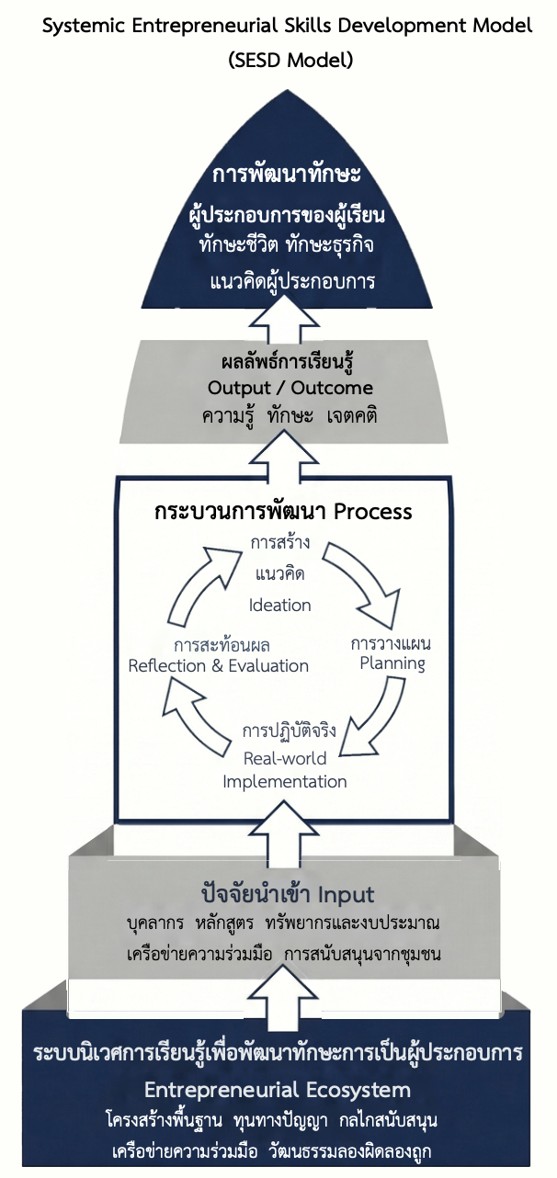
This study employed a qualitative case study approach with two objectives: (1) to extract lessons learned from best practices in developing students’ entrepreneurial skills, and (2) to evaluate the quality of such best practices in schools under the Bangkok Metropolitan Administration. The research was conducted in two phases. In Phase 1, Suwitserianusorn School was selected as the case study. Fifteen key informants, including school administrators, teachers, and students, were purposively selected. Data were collected through semi-structured interviews, focus group discussions, participant observation, and document analysis, and were analyzed using inductive content analysis In Phase 2, the quality of the identified best practices was evaluated by five experts using an assessment form covering accuracy, appropriateness, feasibility, usefulness, cost-effectiveness, and sustainability. The data were analyzed using descriptive statistics. The findings revealed that: (1) the best practices for developing students’ entrepreneurial skills were characterized as a systemic process consisting of input, process, and output/outcome components. The school integrated career education subjects, supplementary courses in Thai desserts and bakery, Ticket to Life scouting activities, student market activities, and MSS Café & Workshop as authentic learning spaces. Students participated in product planning, trial production, cost calculation, pricing, and product sales. In particular, upper secondary students played a leading role in organizing activities and transferring experience to younger students. As a result, students developed analytical thinking, problem-solving, planning, teamwork, responsibility, and creativity. The findings also indicated that these practices were supported by a learning ecosystem consisting of physical infrastructure, intellectual capital, support mechanisms, collaborative networks, and an organizational culture that promoted experiential learning. (2) The overall quality of the best practices was rated at the highest level, with cost-effectiveness receiving the highest mean score, followed by usefulness and sustainability, while feasibility was rated at a high level. These findings led to the synthesis of the Systemic Entrepreneurial Skills Development Model (SESD Model), which can serve as a practical framework for developing students’ entrepreneurial skills in a concrete and sustainable manner.
Article Details

This work is licensed under a Creative Commons Attribution-NonCommercial-NoDerivatives 4.0 International License.
References
กรุงเทพมหานคร. (2566). รายงานสถานการณ์ทางสังคมและความเหลื่อมล้ำในเขตกรุงเทพมหานคร. กรุงเทพฯ: สำนักยุทธศาสตร์และประเมินผล กรุงเทพมหานคร.
จิตรสุดา ลิมเกรียงไกร. (2565). ระบบนิเวศที่เอื้อต่อการส่งเสริมความเป็นผู้ประกอบการสังคมในมหาวิทยาลัยไทย. วารสารสังคมศาสตร์ จุฬาลงกรณ์มหาวิทยาลัย, 52(1), 170–188.
นริศรา ทองยศ, ดาวรุวรรณ ถวิลการ และ กนกอร สมปราชญ์. (2565). แนวทางการพัฒนาความเป็นผู้ประกอบการใหม่ของนักศึกษา วิทยาลัยอาชีวศึกษา. วารสารวิชาการธรรมทรรศน์, 22(3), 281-291.
มนัญชยา อัคคีเดช. (2567). การศึกษาคุณลักษณะการเป็นผู้ประกอบการของนักเรียน ชั้นประถมศึกษาปีที่ 6 ด้วยการใช้กิจกรรมการเรียนรู้ โดยใช้ปัญหาเป็นฐานในวิชาสังคมศึกษา. วารสารวไลยอลงกรณ์ปริทัศน์, 14(1), 53–64.
สำนักงานเลขาธิการสภาการศึกษา. (2564). แนวทางการจัดการศึกษาเพื่อการมีงานทำและสร้างรายได้ (Learn to Earn).กรุงเทพฯ: สำนักงานเลขาธิการสภาการศึกษา.
สำนักงานสภาพัฒนาการเศรษฐกิจและสังคมแห่งชาติ. (2566). แผนพัฒนาเศรษฐกิจและสังคมแห่งชาติ ฉบับที่ 13 (พ.ศ. 2566–2570). กรุงเทพฯ: สำนักงานสภาพัฒนาการเศรษฐกิจและสังคมแห่งชาติ.
Becker, G. S. (1989). Human capital: a theoretical and empirical analysis, with special reference to education. Chicago: University of Chicago Press.
Gangi, Y., & Sirelkatim, F. (2023). The best practices in entrepreneurship education: A review, conceptual model, and propositions. Journal of Entrepreneurship Education, 26(4), 1-14.
Jurgelevičius, A., Butvilas, T., Kovaitė, K., & Šūmakaris, P. (2025). Developing an entrepreneurial ecosystem framework for student-led start-ups in higher education. Education Sciences, 15(7), 837.
Kolb, D. A. (2014). Experiential learning: Experience as the source of learning and development. New Jersey: FT press.
Motta, V. F., & Galina, S. V. R. (2023). Experiential learning in entrepreneurship education: A systematic literature review. Teaching and Teacher Education, 121, 103919.
OECD. (2021). OECD skills outlook 2021: Learning for life. Paris: OECD Publishing.
Partnership for 21st Century Learning. (2019). Framework for 21st century learning. Retrieved from http://static.battelleforkids.org/documents/p21/P21_Framework_DefinitionsBFK.pdf.
Udekwe, E., & Iwu, C. G. (2024). The nexus between digital technology, innovation, entrepreneurship education, and entrepreneurial intention and entrepreneurial motivation: A systematic literature review. Education Sciences, 14(11), 1211.
United Nations. (2022). The sustainable development goals report 2022. Retrieved from https://unstats.un.org/sdgs/report/2022/.
Von Bertalanffy, L. (1968). General System Theory: Foundations, Development. New York: George Braziller.
