The Development of Learning Achievement in Folk Dance through Gamification-Based Instruction Integrated with Bingo Games among Grade 5 Students
Article Sidebar
Main Article Content
Abstract
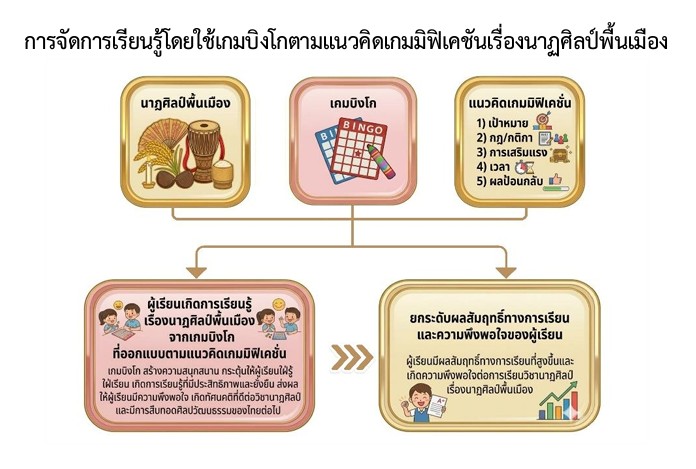
The purposes of this research were: (1) to compare the pre-learning and post-learning achievement in Folk Dance among Grade 5 students who were taught through gamification-based instruction integrated with Bingo games, and (2) to investigate the students’ satisfaction with the gamification-based instruction integrated with Bingo games in learning Folk Dance. The sample consisted of 12 Grade 5 students at Thai Christian Sapanluang School during the 2025 academic year. The participants were selected using purposive sampling. The research instruments included: (1) lesson plans based on gamification integrated with Bingo games for learning Folk Dance, (2) a learning achievement test, and (3) a student satisfaction questionnaire toward the instructional approach. The data were analyzed using mean, standard deviation (S.D.), and the Wilcoxon Matched-Pairs Signed-Ranks Test. The findings revealed that (1) the students’ posttest achievement scores were significantly higher than their pretest achievement scores at the .05 level of statistical significance, and (2) the students’ satisfaction with the gamification-based instruction integrated with Bingo games for learning Folk Dance was at the highest level, with a mean score of 4.88 and a standard deviation (S.D.) of 0.19.
Article Details

This work is licensed under a Creative Commons Attribution-NonCommercial-NoDerivatives 4.0 International License.
References
กนกรัตน์ จิรสัจจานุกูล และ จิระนันท์ โตสิน. (2561). การศึกษาเปรียบเทียบความพึงพอใจต่อการเรียนการสอนแบบเกมมิฟิเคชั่นของนักศึกษาปริญญาตรี มหาวิทยาลัยราชภัฏเพชรบุรี. วารสารพัฒนศิลป์วิชาการ, 2(1), 151-160.
กระทรวงศึกษาธิการ. (2550). การวัดและประเมินผลนาฏศิลป์. กรุงเทพฯ: โรงพิมพ์คุรุสภาลาดพร้าว
ชนัตถ์ พูนเดช และ ธนิตา เลิศพรกุลรัตน์. (2559). แนวทางการจัดการเรียนรู้ด้วยแนวคิดเกมมิฟิเคชัน. Journal of Education and Innovation, 18(3), 331–339.
ณัชชาภรณ์ สาโรจน์ (2565). การจัดการเรียนรู้โดยใช้เทคนิคเกมมิฟิเคชัน เพื่อส่งเสริมความสามารถในการอ่านภาษาอังกฤษเพื่อความเข้าใจ สำหรับนักเรียนชั้นมัธยมศึกษาปีที่ 2 โรงเรียนอุทัยวิทยาคม จังหวัดอุทัยธานี. (การศึกษามหาบัณฑิต, มหาวิทยาลัยนเรศวร).
นวรัตน์ แดงทุ่ง. (2564). การพัฒนาผลสัมฤทธิ์ทางการเรียน เรื่อง ชนิดของคำไทย โดยการจัดการเรียนรู้ด้วยเกมร่วมกับบอร์ดเกม สำหรับนักเรียนชั้นประถมศึกษาปีที่ 3. (การศึกษามหาบัณฑิต, มหาวิทยาลัยนเรศวร).
นิธิพรรณ มูสิกอุปถัมภ์, วีระ วงศ์สรรค์ และ ธนาดล สมบูรณ์. (2565). การพัฒนาผลสัมฤทธิ์ทางการเรียน เรื่อง นาฏศิลป์สร้างสรรค์ โดยใช้นาฏยประดิษฐ์ สำหรับนักเรียนระดับชั้นมัธยมศึกษาตอนปลายโรงเรียนในสังกัดสำนักงานเขตพื้นที่การศึกษามัธยมศึกษาสมุทรสาคร สมุทรสงคราม. วารสารวิจยวิชาการ, 5(6), 233–248.
ปรียานนท์ คุณแสน, ณิชาภาท์ กันขุนทศ และ นาตยา หกพันนา. (2568). การพัฒนาความสามารถด้านการอ่านสระในภาษาไทยด้วยการจัดกิจกรรม การเรียนรู้โดยใช้เกมบิงโกของนักเรียนชั้นประถมศึกษาปีที่ 1. วารสารมนุษยศาสตร์ สังคมศาสตร์ และนวัตกรรม มหาวิทยาลัยกาฬสินธุ์, 4(2), 9–21.
พิชญ์พิสิฐ ฤกษ์สิทธิชัย และ วิไลภรณ์ วิชญาวัฒน์. (2569). การพัฒนากิจกรรมชุมนุมนาฏศิลป์โขน เพื่อส่งเสริมภูมิพลังวัฒนธรรม สำหรับนักเรียนระดับชั้นประถมศึกษา. วารสารปราชญ์ประชาคม, 4(2), 215–230.
ยศธพรชัย คำทะเนตร, ปวีณา ขันธ์ศิลา และ ประภาพร หนองหารพิทักษ์. (2568). การจัดการเรียนรู้โดยใช้แนวคิดเกมมิฟิเคชัน เพื่อพัฒนาผลสัมฤทธิ์ทางการเรียน คณิตศาสตร์ เรื่องจำนวนเต็ม ของนักเรียนชั้นมัธยมศึกษาปีที่ 1. Suan Sunandha Asian Social Science, 19(1), 94–106.
ศรัณยา หนูใหญ่ศิริ และ ชาริณี ตรีวรัญญู. (2567). กิจกรรมนาฏศิลป์ตามแนวคิดการเคลื่อนไหวเชิงสร้างสรรค์ กับทักษะสมองอีเอฟของนักเรียนประถมศึกษาตอนต้น. วารสารวิชาการศึกษาศาสตร์ ศรีนครินทรวิโรฒ, 25(2), 49–66.
เสฏฐวุฒิ บรรดาศักดิ์ และ ชนินันท์ ยอดนาม. (2568). ผลของการจัดการเรียนรู้โดยใช้สื่อดิจิทัล เรื่องท่ารำนาฏยศัพท์เบื้องต้น เพื่อส่งเสริมทักษะท่ารำโขน สำหรับนักเรียนชั้นประถมศึกษาปีที่ 4 โรงเรียนสาธิตมหาวิทยาลัยศรีนครินทรวิโรฒ ประสานมิตร (ฝ่ายประถม). วารสารราชภัฏสุรินทร์วิชาการ, 3(2), 57–70.
Csikszentmihalyi, M. (1990). Flow: The Psychology of Optimal Experience. New York: Harper & Row.
Harrington, I., & Mellors, M. J. (2021). Utilising Online Gamification to Promote Student Success and Retention in Tertiary Settings. International Journal of Higher Education, 10(7), 45-52.
