Development of a Self-Transcendence Scale for Secondary Students
Article Sidebar
Main Article Content
Abstract
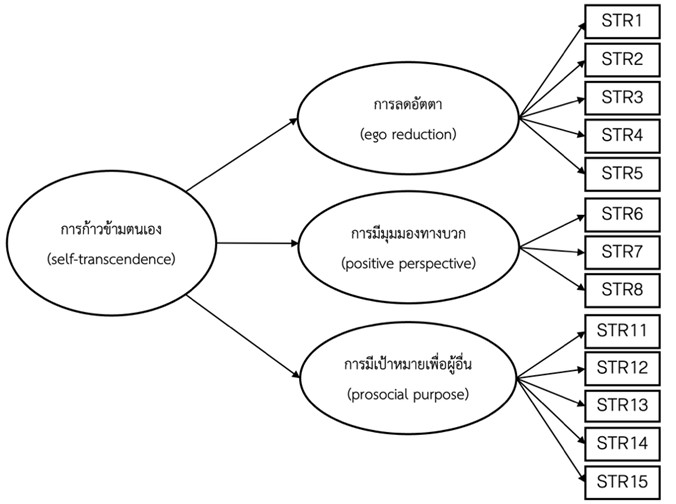
Self-transcendence is a positive characteristic that enables students to overcome their limitations or further develop their capabilities. However, most existing self-transcendence scales measure only the spiritual dimension, which is inconsistent with educational contexts. This research therefore aimed to 1) develop a Self-Transcendence Scale for secondary students, and 2) examine the psychometric quality of the developed scale. This study is scale development and validation. The sample consisted of 1,200 upper secondary school students under the jurisdiction of the Secondary Educational Service Area Office, Bangkok, for the academic year 2025, selected through multistage random sampling. The research instrument was the self-transcendence scale for secondary students. Statistical analyses included content validity index analysis, internal consistency reliability estimation using the omega coefficient, and construct validity examination through two types of factor analysis, namely exploratory factor analysis and confirmatory factor analysis. The result of the study found that: 1) the self-transcendence scale for secondary students consisted of 13 items with a 5-point rating scale format based on a multidimensional between-items structure, comprising three factors: ego reduction, positive perspective, and prosocial purpose; and 2) the scale demonstrated content validity with item-level content validity index (I-CVI) values ranging from .750 to 1.000. When administered to the full sample (n = 900), the overall reliability coefficient was .896, with factor-level reliability ranging from .756 to .812. The exploratory factor analysis provided preliminary evidence of a three-factor structure with the theoretical framework, and the confirmatory factor analysis indicated that the measurement model fit the empirical data acceptably (2(56, n = 900) = 163.904, p < .001, CFI = .976, TLI = .966, RMSEA = .046).
Article Details

This work is licensed under a Creative Commons Attribution-NonCommercial-NoDerivatives 4.0 International License.
References
Acton, G. J., & Wright, K. B. (2000). Self-transcendence and family caregivers of adults with dementia. Journal of Holistic Nursing, 18(2), 143-158.
Benish-Weisman, M. (2015). The interplay between values and aggression in adolescence: A longitudinal study. Developmental Psychology, 51(5), 677–687.
Brdar, I., Rijavec, M., & Lončarić, D. (2006). Goal orientations, coping with school failure and school achievement. European Journal of Psychology of Education, 21(1), 53–70.
Caprara, G. V., & Steca, P. (2007). Prosocial agency: The contribution of values and self–efficacy beliefs to prosocial behavior across ages. Journal of Social and Clinical Psychology, 26(2), 218-239.
Castelo, N., White, K., & Goode, M. R. (2021). Nature promotes self-transcendence and prosocial behavior. Journal of Environmental Psychology, 76, 101639.
Chomeya, R., Tayraukham, S., Tongkhambanchong, S., & Saravitee, N. (2024). SAMPLE SIZE DETERMINATION Techniques for Multivariate Behavioral Sciences Research Emphasizing SEM. Journal of Education and Innovation, 26(2), 438–447.
Cloninger, C. R., Svrakic, D. M., & Przybeck, T. R. (1993). A psychobiological model of temperament and character. Archives of General Psychiatry, 50(12), 975–990.
Danioni, F., Ranieri, S., & Villani, D. (2020). The Role of Personal Values in Gambling: A Preliminary Study with Italian Adolescents. The Journal of Genetic Psychology, 181(6), 413–426.
Dorais, S., & Gutierrez, D. (2021). The influence of spiritual transcendence on a centering meditation: A growth curve analysis of resilience. Religions, 12(8), 573.
Ellermann, C. R., & Reed, P. G. (2001). Self-transcendence and depression in middle-aged adults. Western Journal of Nursing Research, 23(7), 698-713.
Fornell, C., & Larcker, D. F. (1981). Evaluating structural equation models with unobservable variables and measurement error. Journal of Marketing Research, 18(1), 39–50.
Garcia-Romeu, A. (2010). Self-transcendence as a measurable transpersonal construct. Journal of Transpersonal Psychology, 42(1), 26-47.
Ge, B. H., & Yang, F. (2023). Transcending the self to transcend suffering. Frontiers in Psychology, 14, 1113965.
Hair, J.F., Black, W.C., Babin, B.J. & Anderson, R.E. (2018). Multivariate Data Analysis. (8th ed.). London: Cengage Learning.
Haugan, G., Rannestad, T., Garåsen, H., Hammervold, R., & Espnes, G. A. (2012). The self-transcendence scale: An investigation of the factor structure among nursing home patients. Journal of Holistic Nursing, 30(3), 147-159.
Henseler, J., Ringle, C. M., Sarstedt, M., & Sarstedt, M. (2015). A new criterion for assessing discriminant validity in variance-based structural equation modeling. Journal of the Academy of Marketing Science, 43(1), 115–135.
Ho, H. M., Tseng, Y. H., Hsin, Y. M., Chou, F. H., & Lin, W. T. (2016). Living with illness and self-transcendence: The lived experience of patients with spinal muscular atrophy. Journal of Advanced Nursing, 72(11), 2695-2705.
Huang, M., & Yang, F. (2023). Self-transcendence or self-enhancement: People’s perceptions of meaning and happiness in relation to the self. Journal of Experimental Psychology General, 152(2), 590–610.
Kähönen, J. (2023). Psychedelic unselfing: self-transcendence and change of values in psychedelic experiences. Frontiers in Psychology, 14, 1104627.
Kang, Y., Cooper, N., Pandey, P., Scholz, C., O’Donnell, M. B., Lieberman, M. D., & Falk, E. B. (2018). Effects of self-transcendence on neural responses to persuasive messages and health behavior change. Proceedings of the National Academy of Sciences, 115(40), 9974-9979.
Kitson, A., Chirico, A., Gaggioli, A., & Riecke, B. E. (2020). A Review on Research and Evaluation Methods for Investigating Self-Transcendence. Frontiers in Psychology, 11, 547687.
Miller, J. T., & Verhaeghen, P. (2022). Mind full of kindness: self-awareness, self-regulation, and self-transcendence as vehicles for compassion. BMC Psychology, 10, 188.
Moshki, M., SabetiKakhk, F., Mousavi, A., & Dogonchi, M. (2023). Psychometrics properties of the spiritual transcendence scale (STS) among Iranian university students. Journal of Spirituality in Mental Health, 25(1), 55–70.
Murti, N. W. H., Erawati, M., & Rochana, N. (2021). Exploration factor analysis, validity and reliability tests of the self-transcendence scale on HIV/aids patients. Nurse and Health: Jurnal Keperawatan, 10(1), 79-88.
Piedmont, R. L. (1999). Does spirituality represent the sixth factor of personality? Spiritual Transcendence and the Five-Factor Model. Journal of Personality, 67(6), 985–1013.
Polit, D. F., & Beck, C. T. (2006). The content validity index: Are you sure you know what’s being reported? critique and recommendations. Research in Nursing &Amp; Health, 29(5), 489–497.
Preston, J. L., Coleman, T. J., & Shin, F. (2023). Spirituality of Science: Implications for Meaning, Well Being, and Learning. Personality and Social Psychology Bulletin, 51(4), 632-643.
Reed, P. G. (2014). Middle range theory for nursing. (3rd ed.). New York: Springer.
Schwartz, S. H. (1992). Universals in the content and structure of values: theory and empirical tests in 20 countries. Advances in Experimental Social Psychology, 25, 1–65.
Schwartz, S. H. (2012). An Overview of the Schwartz theory of basic values. Online Readings in Psychology and Culture, 2(1), 11.
Stiller, A.-K. (2020). Emotion Regulation in Educational Contexts: The Role of Positive Strategies and Self-control. Retrieved from https://tuprints.ulb.tu-darmstadt.de/server/api/core/bitstreams/f59e6caf-c0e0-46ed-8689-ee2731073c17/content.
Teixeira, M. E. (2008). Self-transcendence: A concept analysis for nursing praxis. Holistic Nursing Practice, 22(1), 25-31.
Wong, P. T. P., Arslan, G., Arslan, G., Bowers, V. L., Peacock, E. J., Kjell, O. N. E., Ivtzan, I., & Lomas, T. (2021). Self-transcendence as a buffer against COVID-19 suffering: The development and validation of the self-transcendence measure-B. Frontiers in Psychology, 12, 648549.
Yaden, D. B., Haidt, J., Hood, R. W., Jr, Vago, D. R., & Newberg, A. B. (2017). The varieties of self-transcendent experience. Review of General Psychology: Journal of Division 1, of the American Psychological Association, 21(2), 143–160.
Yeager, D. S., Henderson, M. D., Paunesku, D., Walton, G. M., D'Mello, S., Spitzer, B. J., & Duckworth, A. L. (2014). Boring but important: A self-transcendent purpose for learning fosters academic self-regulation. Journal of Personality and Social Psychology, 107(4), 559–580.
