The Development of Creative Writing Ability and Collaborative Skills of Grade 6 Students Using Gilbert’s Creative Writing Instructional Process
Article Sidebar
Main Article Content
Abstract
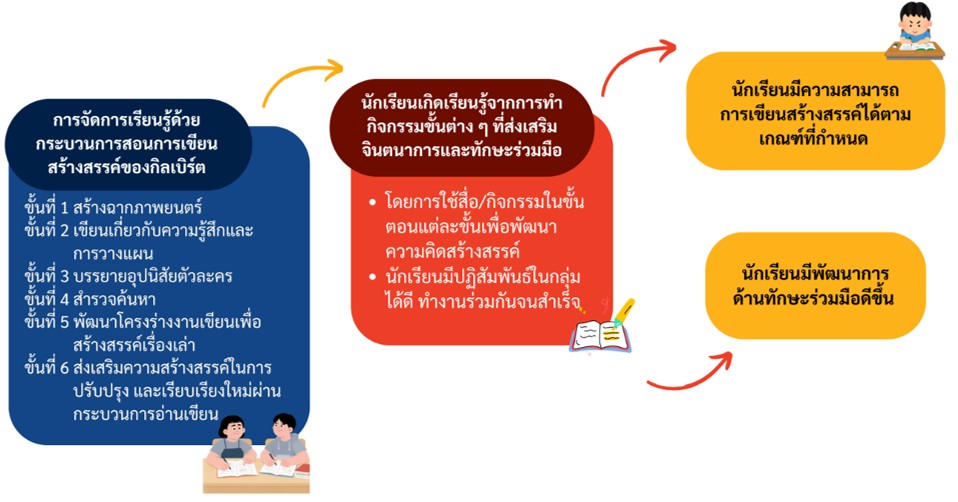
The purposes of this research were to: (1) investigate the creative writing proficiency of Grade 6 students taught through Gilbert’s creative writing process compared to the 70% criterion, and (2) examine the development of students' collaborative skills through the implementation of the same process. This study employed a pre-experimental research design. The research sample consisted of 12 Grade 6 students at Wat Sa Yai Som School during the first semester of the 2025 academic year, obtained via simple random sampling. The research instruments included: 1) a creative writing proficiency test and 2) a collaborative skills observation form. Data were analyzed using arithmetic mean, standard deviation, one-sample t-test, and repeated measures ANOVA. The research findings indicated that: (1) the students achieved a mean post-test score of 23.25 (S.D. = 3.68) in creative writing proficiency, which was significantly higher than the 70% criterion at the .05 level of statistical significance, and (2) the analysis of collaborative skill development across four repeated measurements revealed that the mean scores increased from 3.03 to 3.84, representing a statistically significant improvement at the .05 level.
Article Details

This work is licensed under a Creative Commons Attribution-NonCommercial-NoDerivatives 4.0 International License.
References
ทิศนา แขมมณี. (2560). ศาสตร์การสอนองค์ความรู้เพื่อการจัดกระบวนการเรียนรู้ที่มีประสิทธิภาพ. (พิมพ์ครั้งที่ 21). กรุงเทพฯ: สำนักพิมพ์แห่งจุฬาลงกรณ์มหาวิทยาลัย.
นัฐฌา อภิรพงศ์ และ ขวัญชนก นัยจรัญ. (2568). ผลการใช้รูปแบบการเรียนการสอนภาษาไทยตามทฤษฎีสหบทร่วมกับการใช้ผังกราฟิกสำหรับส่งเสริมความสามารถในการเขียนนิทานเชิงสร้างสรรค์ ของนักเรียนชั้นประถมศึกษาปีที่ 6. วารสารวิจัยราชภัฏกรุงเก่า สาขามนุษยศาสตร์และสังคมศาสตร์, 12(1), 54–66.
ปราณี สุรสิทธิ์. (2549). การเขียนสร้างสรรค์เชิงวารสารศาสตร์. (พิมพ์ครั้งที่ 2). กรุงเทพฯ: แสงดาว
ระพิน ชูชื่น และ เพ็ญพรรณ ศรีสายพร. (2564). การพัฒนาการเขียนเชิงสร้างสรรค์โดยใช้กระบวนการเขียนผ่านการเรียนออนไลน์ของนักเรียนชั้นประถมศึกษาปีที่ 6 โรงเรียนสาธิต “พิบูลบำเพ็ญ” มหาวิทยาลัยบูรพา (รายงานการวิจัย). ชลบุรี: โรงเรียนสาธิต “พิบูลบำเพ็ญ” มหาวิทยาลัยบูรพา.
โรงเรียนวัดสระยายโสม. (2567). ผลการประเมินที่เกี่ยวข้องกับการเขียนสร้างสรรค์ ปีการศึกษา 2567 ระดับประถมศึกษาตอนปลาย. สุพรรณบุรี: โรงเรียนวัดสระยายโสม จังหวัดสุพรรณบุรี.
สำนักงานคณะกรรมการการศึกษาขั้นพื้นฐาน กระทรวงศึกษาธิการ. (2551). หลักสูตรแกนกลางการศึกษาขั้นพื้นฐาน พุทธศักราช 2551. กรุงเทพฯ: กระทรวงศึกษาธิการ.
สำนักวิชาการและมาตรฐานการศึกษา. (2567). เครื่องมือคัดกรองความสามารถอ่านออกเขียนได้ (เอกสารประกอบการสอบประเมินผล). สุพรรณบุรี: สำนักงานเขตพื้นที่ประถมศึกษา สุพรรณบุรี เขต 2.
สุทธิวรรณ อินทะกนก. (2559). การเขียนเชิงสร้างสรรค์. อุดรธานี: มหาวิทยาลัยราชภัฏอุดรธานี.
อัจฉรา ชีวพันธ์. (2561). กิจกรรมการเขียนสร้างสรรค์ในชั้นประถมศึกษา. กรุงเทพฯ: โรงพิมพ์จุฬาลงกรณ์มหาวิทยาลัย.
Gilbert, F. (2020). The haunted house: Teaching creative writing through collaborative learning to 9-13 year olds. In E. Branking, F. Gilbert, & C. Sharples (Eds.), Inspire: Exciting ways of teaching creative writing (pp. 107-125). London: Goldsmiths University of London.
Hargreaves, A., & O'Connor, M. T. (2018). Collaborative professionalism: When teaching together means learning for all. Thousand Oaks, California: Corwin Press.
Johnson, D. W., & Johnson, R. T. (1989). Cooperation and competition: Theory and research. Edina, Minnesota: Interaction Book Company.
Piaget, J. (1972). Intellectual Evolution from Adolescence to Adulthood. Human Development, 15(1), 1-12.
Smith, J. A. (1973). Creative teaching of language arts in the elementary school. Boston: Allyn and Bacon.
Togatorop, E. (2015). Teaching writing with a web based collaborative learning. International Journal of Economics and Financial Issues, 5(1), 247-256.
