When Learning Becomes a Burden: Thai Teachers’ Work Lives and the Culture of Lifelong Learning in Small Schools
Article Sidebar
Main Article Content
Abstract
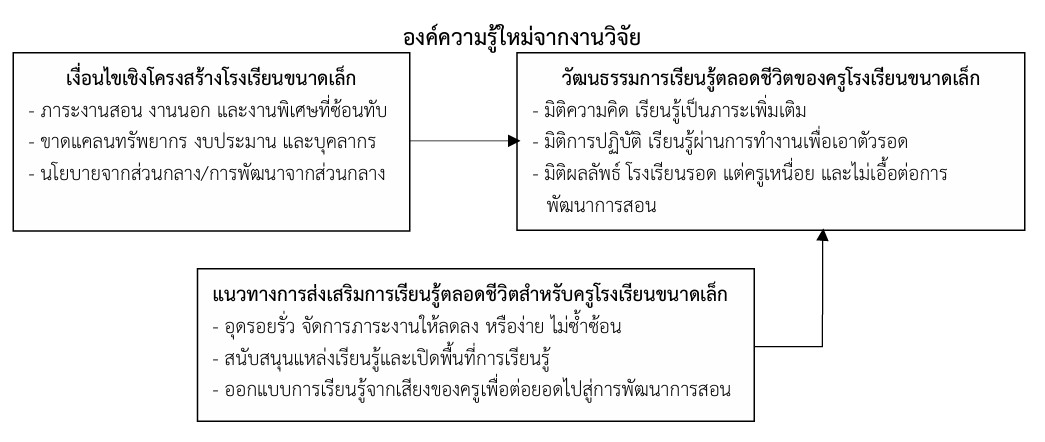
This study aims to understand the culture of lifelong learning among Thai teachers in small schools through their working lives and lived contexts, and to synthesize approaches to promoting lifelong learning that support the development of their teaching and learning practices. Using a qualitative micro-ethnographic approach, data were collected through semi-structured interviews, participant observation, and field notes involving 34 key informants, including teachers and school administrators from three small schools. The data were analyzed through thematic analysis guided by the research framework, complemented by group discussions to reflect on and validate the meanings of the findings. The findings show that teachers in small schools work under severe constraints in resources, personnel, and budgets, while also carrying substantial responsibilities beyond teaching, including administrative, project-related, and reporting tasks. Under these conditions, the culture of lifelong learning is shaped by overlapping workloads and resource limitations. As a result, teachers’ learning often takes the form of learning for survival, embedded in everyday work, immediate problem-solving, and learning through practice rather than professional development. The study also finds that promoting lifelong learning among teachers in small schools requires improving working conditions, reducing non-teaching workloads, recognizing the value of practice-based learning, and designing learning opportunities that respond to teachers’ lives and specific contexts. These approaches can transform learning into a resource for the sustainable development of teaching and learning rather than an additional burden.
Article Details

This work is licensed under a Creative Commons Attribution-NonCommercial-NoDerivatives 4.0 International License.
References
กมลพร อ่วมเพ็ง. (2560). แนวทางการพัฒนาครูโรงเรียนประถมศึกษาขนาดเล็ก กลุ่มจังหวัดภาคกลางปริมณฑลตามแนวคิดการเรียนรู้จากการปฏิบัติและการจัดการเรียนรู้แบบบูรณาการ. กรุงเทพฯ: จุฬาลงกรณ์มหาวิทยาลัย.
กัญภร เอี่ยมพญา, นิวัตต์ น้อยมณี, พรทิพย์ อ้นเกษม, อภิชาติ อนุกูลเวช และ ดาวประกาย ระโส. (2565). โรงเรียนขนาดเล็ก: ปัญหาที่ต้องตัดสินใจ. วารสารสิรินธรปริทรรศน์, 23(1), 315–329.
พระราชบัญญัติการศึกษาแห่งชาติ พ.ศ. 2542. (2542, 19 สิงหาคม). ราชกิจจานุเบกษา, 116(74 ก), 1–23.
สถาบันวิจัยเพื่อการพัฒนาประเทศไทย. (2558). แนวทางการแก้ปัญหาโรงเรียนขนาดเล็ก (รายงานทีดีอาร์ไอ ฉบับที่ 113). สืบค้นจาก https://tdri.or.th/wp-content/uploads/2015/07/TDRI-Report-march-web-preview.pdf.
สมบัติ นพรัก, สำราญ มีแจ้ง, เทียมจันทร์ พานิชย์ผลินไชย, อมรรัตน์ วัฒนาธร และ ชำนาญ ปาณาวงษ์. (2557). รูปแบบการพัฒนาครูและผู้บริหารสถานศึกษาแบบใช้โรงเรียนเป็นฐาน ในโรงเรียนขนาดเล็ก : กรณีศึกษาของจังหวัดพิษณุโลก. Journal of Education and Innovation, 16(4), 141–154.
สำนักงานเลขาธิการสภาการศึกษา. (2560). แผนการศึกษาแห่งชาติ พ.ศ. 2560–2579. กรุงเทพฯ: กระทรวงศึกษาธิการ.
Ballet, K., & Kelchtermans, G. (2009). Struggling with workload: Primary teachers’ experience of intensification. Teaching and teacher education, 25(8), 1150-1157.
Braun, V., & Clarke, V. (2006). Using thematic analysis in psychology. Qualitative research in psychology, 3(2), 77-101.
Hargreaves, A., & Shirley, D. (2020). Leading from the middle: its nature, origins and importance. Journal of Professional Capital and Community, 5(1), 92-114.
Jarvis, P. (2007). Globalisation, lifelong learning and the learning society: Sociological perspectives. London: Routledge.
Jarvis, P. (2009). Learning to be a Person in Society. London: Routledge.
Jarvis, P. (2012). Introduction. In P. J. M. Watts (Ed.), The Routledge International Handbook of Learning. London: Routledge.
Knowles, M. S., Holton, E. F., & Swanson, R. A. (2014). The adult learner: The definitive classic in adult education and human resource development. (8th ed.). London: Routledge.
Opfer, V. D., & Pedder, D. (2011). Conceptualizing teacher professional learning. Review of educational research, 81(3), 376-407.
UNESCO. (2015). Education 2030: Incheon declaration and framework for action for the implementation of Sustainable Development Goal 4. Paris: UNESCO.
Wenger, E. (1998). Communities of practice: Learning, meaning, and identity. Cambridge: Cambridge University Press.
