The development of a GKD supervision model to enhance design thinking teaching competency for teachers under the secondary educational service area office Chaiyaphum
Article Sidebar
Main Article Content
Abstract
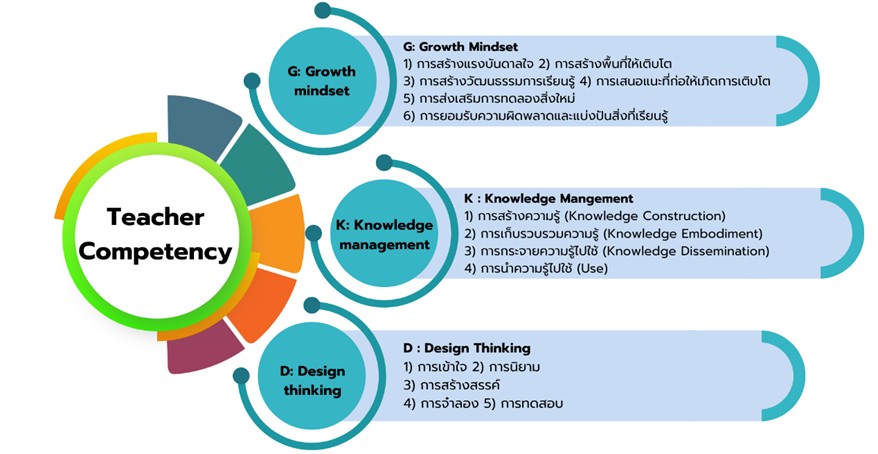
The purposes of this research were: (1) to study the current situations, problems, needs, and guidelines for promoting teachers’ design thinking teaching competency; (2) to develop the GKD Model of supervision; (3) to implement the developed supervision model; and (4) to evaluate, expand, and disseminate the GKD supervision model. The study employed a Research and Development (R&D) methodology across four phases. Phase 1 (R1): Five school administrators and 20 core teachers were purposively selected as informants. Data were collected via semi-structured interviews, classroom observations, brainstorming sessions, and focus group discussions, and were analyzed using content analysis. Phase 2 (D1): Nine experts verified the draft model, and a pilot study was conducted at one school. Phase 3 (R2): Four schools voluntarily participated, involving 8 administrators, 32 teachers, and 180 students. Data were analyzed using mean, standard deviation, and dependent-samples t-tests. Phase 4 (D2): Satisfaction was evaluated, and the model was expanded and disseminated through an international academic forum. The results revealed that: (1) regarding the current situations, teachers still lacked understanding and skills in design thinking instruction; (2) the GKD Model consisted of four components: objectives, implementation, process (comprising three steps: Growth Mindset, Knowledge Management, and Design Thinking), and output, with the overall appropriateness rated at the highest level; (3) the implementation results showed that both teachers’ design thinking teaching competency and students’ design thinking skills after the intervention were significantly higher than before at the .01 level; and (4) the evaluation results indicated that both administrators and teachers expressed their satisfaction with the supervision model at the highest level.
Article Details

This work is licensed under a Creative Commons Attribution-NonCommercial-NoDerivatives 4.0 International License.
References
กชพร จันทนามศรี, ประยุทธ ชูสอน และ วิเชียร รู้ยืนยง. (2564). การวิจัยปฏิบัติการแบบมีส่วนร่วมเพื่อพัฒนากระบวนการนิเทศภายในโดยใช้แนวคิดการศึกษาชั้นเรียนสำหรับโรงเรียนประถมศึกษา. วารสารมานุษยวิทยาเชิงพุทธ, 6(2), 82-98.
จักรพงศ์ แถลงกัณฑ์. (2565). การวิจัยและพัฒนารูปแบบการนิเทศภายในแบบบูรณาการเพื่อส่งเสริมสมรรถนะการวิจัยในชั้นเรียนของครู โรงเรียนสันติวิทยาสรรพ์. วารสารครุศาสตร์ปัญญา, 1(4), 24-34.
ทิพวรรณ ถาวรโชติ. (2564). รูปแบบการนิเทศด้วยเครือข่ายความร่วมมือเพื่อส่งเสริมประสิทธิผลของสถานศึกษา สังกัดสำนักงานเขตพื้นที่การศึกษามัธยมศึกษา. (การศึกษาดุษฎีบัณฑิต, มหาวิทยาลัยนเรศวร).
ภุชงค์ โรจน์แสงรัตน์, ปุณณรัตน์ พิชญไพบูลย์ และ ปราวีณยา สุวรรณณัฐโชติ. (2563). การพัฒนารูปแบบการสอนโดยใช้แนวคิดการคิดเชิงออกแบบเป็นฐานเพื่อสร้างสรรค์ผลงานที่ปรากฏอัตลักษณ์ไทยสำหรับนิสิตนักศึกษาระดับปริญญาบัณฑิต. วารสารครุศาสตร์จุฬาลงกรณ์มหาวิทยาลัย, 48(3), 258-273.
วชิรา เครือคำอ้าย และชวลิต ขอดศิริ. (2561). การพัฒนารูปแบบการนิเทศโดยใช้กระบวนการชี้แนะและระบบพี่เลี้ยง เพื่อส่งเสริมศักยภาพการจัดการเรียนรู้ในศตวรรษที่ 21 สังกัดสำนักงานคณะกรรมการการศึกษาขั้นพื้นฐาน จังหวัดเชียงใหม่ (รายงานการวิจัย). เชียงใหม่ : มหาวิทยาลัยราชภัฏเชียงใหม่
วนิดา ภูชำนิ. (2564). การพัฒนาสมรรถนะของครูเพื่อการจัดการเรียนรู้ในศตวรรษที่ 21 : กรณีโรงเรียนบ้านนาตาลคำข่า. (ครุศาสตรดุษฎีบัณฑิต, มหาวิทยาลัยราชภัฏสกลนคร).
วาสนา บุญมาก และ มนสิช สิทธิสมบูรณ์. (2564). การพัฒนารูปแบบการนิเทศแบบบูรณาการเพื่อส่งเสริมสมรรถนะการจัดการเรียนรู้เชิงรุกของครูระดับการศึกษาขั้นพื้นฐาน. วารสารศึกษาศาสตร์ มหาวิทยาลัยนเรศวร, 23(2), 269-280.
สถาพร สมอุทัย. (2565). “การนิเทศการศึกษา” หนึ่งตัวช่วยในการพัฒนาสมรรถนะการจัดการเรียนรู้ในศตวรรษที่ 21. วารสารวิจยวิชาการ, 5(3), 275–288.
สมถวิล ชูเนตร. (2565). รูปแบบการนิเทศที่สนับสนุนการจัดการเรียนรู้เชิงรุกเพื่อยกระดับผลสัมฤทธิ์ทางการเรียนภาษาอังกฤษของนักเรียนระดับประถมศึกษา สังกัดสำนักงานเขตพื้นที่การศึกษาประถมศึกษาขอนแก่น เขต 2. วารสารชุมชนแห่งการเรียนรู้วิชาชีพครู, 2(2), 182–200.
สำนักงานเลขาธิการสภาการศึกษา. (2560). แผนการศึกษาแห่งชาติ พ.ศ. 2560-2579. กรุงเทพฯ: พริกหวานกราฟฟิค.
Brown, T. (2008). Design thinking. Harvard Business Review, 86(6), 84-95.
Brown, T. (2009). Change by design: How design thinking transforms organizations and inspires innovation. New York: HarperCollins.
Buchanan, R. (1992). Wicked problems in design thinking. Design issues, 8(2), 5-21.
Choueiri, L. S., & Mhanna, S. (2013). The design process as a life skill. Procedia-Social and Behavioral Sciences, 93, 925-929.
Clutterbuck, D. (2004). Making the most of informal mentoring: A positive climate is key. Development and Learning in Organizations: An International Journal, 18(4), 16-17.
Cross, N. (2011). Design Thinking: Understanding How Designers Think and Work. Oxford: Berg Publishers.
Danielson, C. (2011). Evaluations that help teachers learn. Educational leadership, 68(4), 35-39.
Dorst, C. H. (2004). Investigating the nature of design thinking. In Futureground: Design Research Society, International Conference 2004, 17th - 21st November 2004, Monash University, Faculty of Art and Design, Australia: Vol. 2: proceedings (pp. 72-80). Melbourne, Victoria: Monash Universit.
DuFour, R., & Eaker, R. (1998). Professional Learning Communities at Work: Best Practices for Enhancing Students Achievement. Bloomington, Indiana: Solution Tree Press.
Dweck, C. S. (2006). Mindset: The new psychology of success. New York: Random House.
Fletcher, S. J., & Mullen, C. A. (Eds.). (2012). The SAGE handbook of mentoring and coaching in education. Thousand Oaks, California: SAGE Publications.
Glickman, C. D., Gordon, S. P., & Ross-Gordon, J. M. (2013). Super Vision and Instructional Leadership: A Developmental Approach. (9th ed.). London: Pearson.
Goldschmidt, G., & Rodgers, P. A. (2013). The design thinking approaches of three different groups of designers based on self-reports. Design Studies, 34(4), 454-471.
Hord, S. M. (1997). Professional Learning Communities: Communities of Continuous Inquiry and Improvement. Austin, Texas: Southwest Educational Development Laboratory.
Jobst B., Köppen E., Lindberg T., Moritz J., Rhinow H., Meinel C. (2012). The faith-factor in design thinking: Creative confidence through education at the design thinking schools Potsdam and Stanford? In Plattner H., Meinel C., Leifer L. (Eds.), Design thinking research (pp. 35-46). Berlin, Germany: Springer.
Knight, J. (2007). Instructional coaching: A partnership approach to improving instruction. Thousand Oaks, California: Corwin Press.
Lloyd, P. (2013). Embedded creativity: teaching design thinking via distance education. International Journal of Technology and Design Education, 23(3), 749-765.
Marzano, R. J., Frontier, T., & Livingston, D. (2011). Effective supervision: Supporting the art and science of teaching. Arlington, Virginia: Association for Supervision and Curriculum Development.
Nonaka, I., & Takeuchi, H. (1995) The Knowledge-Creating Company: How Japanese Companies Create the Dynamics of Innovation. New York: Oxford University Press.
Pajak, P. (1990). Identification of supervisory proficiency project. Athens: Department of Curriculum and Supervision, University of Georgia.
Razzouk, R., & Shute, V. (2012). What is design thinking and why is it important?. Review of educational research, 82(3), 330-348.
Sergiovanni, T. J., & Starratt, R. J. (2013). Supervision: A Redefinition. (9th ed.). Boston, MA: McGraw-Hill Higher Education.
Simon, H. A. (2009). Understanding the natural and artificial worlds. In H. Clark & D. Brody (Eds.), Design studies: A reader (pp. 106-109). New York: Berg.
