Community-based learning to promote cognitive skills for biology students at the School of Education, University of Phayao
Article Sidebar
Main Article Content
Abstract
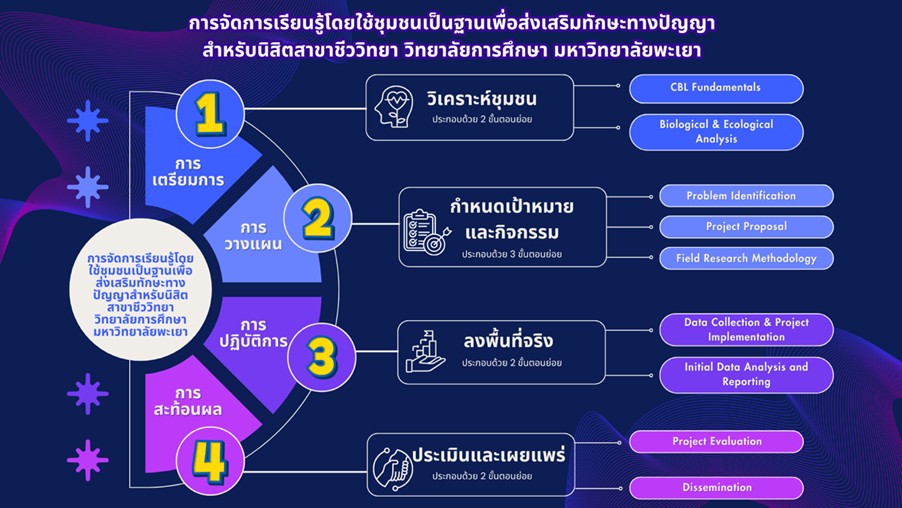
This research aims to 1) design a community-based learning management approach to promote cognitive skills, 2) compare the cognitive skills of biology students at the College of Education, University of Phayao, before and after the implementation of community-based learning management, and 3) study their satisfaction with the community-based learning management approach to promote cognitive skills. A one-group pre-test-post-test design was used. The target group consisted of 24 third-year biology students studying in the second semester of the 2025 academic year at the College of Education, University of Phayao, selected through purposive sampling. The tools used to collect data included: (1) a community-based learning management plan to promote cognitive skills, with an IOC value ranging from 0.67 to 1.00; (2) a community-based learning management assessment form to promote cognitive skills, with an IOC value ranging from 0.67 to 1.00; and (3) a student satisfaction questionnaire regarding community-based learning management to promote cognitive skills, with an IOC value ranging from 0.67 to 1.00. The statistics used to analyze the data were mean, standard deviation, and dependent t-test. The results of the study indicated that: 1) community-based learning management to promote cognitive skills consisted of (1) preparation (community analysis), (2) planning (setting goals and activities), (3) implementation (field trips), and (4) reflection (evaluation and dissemination); 2) the results of comparing the cognitive skills of students showed that after implementing community-based learning, the skills were higher than before the learning management, with a statistically significant difference at the 0.05 level; and 3) the level of satisfaction with community-based learning management to promote cognitive skills was high.
Article Details

This work is licensed under a Creative Commons Attribution-NonCommercial-NoDerivatives 4.0 International License.
References
ทิศนา แขมมณี. (2557). ศาสตร์การสอน: องค์ความรู้เพื่อการจัดกระบวนการเรียนรู้ที่มีประสิทธิภาพ. (พิมพ์ครั้งที่ 18). กรุงเทพฯ: จุฬาลงกรณ์มหาวิทยาลัย.
ประสิทธิ์ ตึกขาว, ดนุลดา จามจุรี และ ศิริยุภา พูลสุวรรณ. (2564). การพัฒนารูปแบบการเรียนรู้โดยใช้ชุมชนเป็นฐาน. วารสารการบริหารและการจัดการ, 13(1), 112–126.
วิไลภรณ์ ฤทธิคุปต์. (2561). การจัดการเรียนรู้โดยใช้ชุมชนเป็นฐาน : กลยุทธ์การจัดการเรียนรู้ที่มี ประสิทธิภาพของครูในศตวรรษที่ 21. วารสารบัณฑิตวิทยาลัย มหาวิทยาลัยราชภัฏเชียงราย, 11(3), 179-191.
สำนักงานคณะกรรมการการอุดมศึกษา. (2552). ประกาศคณะกรรมการการอุดมศึกษา เรื่อง แนวทางการปฏิบัติ ตามกรอบมาตรฐานคุณวุฒิระดับอุดมศึกษาแห่งชาติ พ.ศ. 2552. กรุงเทพฯ: สำนักงานคณะกรรมการการอุดมศึกษา.
Anderson, L. W., & Krathwohl, D. R. (2001). A taxonomy for learning, teaching, and assessing: A revision of Bloom's taxonomy of educational objectives: complete edition. Reading, Massachusetts: Addison Wesley Longman, Inc.
Astin, A. W. (1997). What matters in college?: Four critical years revisited. New Jersey: John Wiley & Sons.
Bedri, Z., de Fréin, R., & Dowling, G. (2017). Community-based learning: A primer. Irish Journal of Academic Practice, 6(1), 5.
Bloom, B. S., Engelhart, M. D., Furst, E. J., Hill, W. H., & Krathwohl, D. R. (1964). Taxonomy of educational objectives (Vol. 2). New York: Longmans, Green.
Bransford, J. D., Brown, A. L., & Cocking, R. R. (2000). How people learn (Vol. 11). Washington, DC: National academy press.
Dewey, J. (1986). Experience and Education. The Educational Forum, 50, 241-252.
Eyler, J., & Giles Jr, D. E. (1999). Where's the Learning in Service-Learning? Jossey-Bass Higher and Adult Education Series. San Francisco: Jossey-Bass.
García-Holgado, A., & García-Peñalvo, F. J. (2017, June). A metamodel proposal for developing learning ecosystems. In International Conference on Learning and Collaboration Technologies (pp. 100-109). Cham: Springer International Publishing.
Herzberg, F., Mausner, B., & Snydermann, B. (1959). The Motivation to Work. (2nd ed.) New York: John Wiley & Sons.
Hmelo-Silver, C. E. (2004). Problem-based learning: What and how do students learn?. Educational psychology review, 16(3), 235-266.
Kolb, D. A. (2014). Experiential learning: Experience as the source of learning and development. New Jersey: FT press.
Kondratova, I., Molyneaux, H., & Fournier, H. (2017, June). Design considerations for competency functionality within a learning ecosystem. In International Conference on Learning and Collaboration Technologies (pp. 124-136). Cham: Springer International Publishing.
Lopez, M., & Garcia, J. (2022). Community-Based Learning and Lifelong Learning Skills in Secondary Education. Journal of Educational Research, 11(4), 210–225.
Maslow, A. H. (1943). A theory of human motivation. Psychological review, 50(4), 370.
Office of the Education Council. (2021). Education in Thailand 2019-2021. Bangkok: Office of the Education Council, Ministry of Education.
Prince, M. J., & Felder, R. M. (2006). Inductive teaching and learning methods: Definitions, comparisons, and research bases. Journal of engineering education, 95(2), 123-138.
Ryan, R. M., & Deci, E. L. (2000). Intrinsic and extrinsic motivations: Classic definitions and new directions. Contemporary educational psychology, 25(1), 54-67.
Schön, D. A. (2017). The reflective practitioner: How professionals think in action. Oxfordshire: Routledge.
Wigfield, A., & Eccles, J. S. (2000). Expectancy–value theory of achievement motivation. Contemporary educational psychology, 25(1), 68-81.
