The Effects of Open Approach Integrated with Board Games on Exponents in Mathematics for Grade 7 Students
Article Sidebar
Main Article Content
Abstract
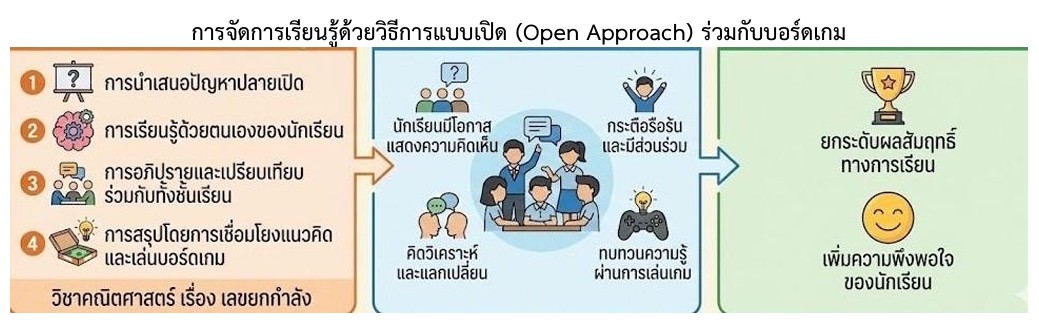
This study aimed to: 1) compare Grade 7 students’ learning achievement before and after instruction using the Open Approach integrated with a board game on the topic of exponents, and 2) investigate the students’ satisfaction with this integrated approach. The research design was a one-group pretest-posttest design. The participants consisted of 23 Grade 7 students from Nikhomsangtoneng Phimai 4 School, selected using cluster random sampling during the first semester of the 2025 academic year. The instruments used for data collection included: (1) lesson plans based on the Open Approach integrated with a board game, (2) a board game on the topic of Exponents, (3) a learning achievement test, and (4) a student satisfaction questionnaire. The data were analyzed using mean, standard deviation and dependent t-test. The findings indicated that: 1) the Grade 7 students showed significantly higher posttest scores than pretest scores at the .05 level; and 2) the students’ satisfaction with learning through the Open Approach integrated with a board game was at the highest level (M = 4.58, S.D. = 0.28).
Article Details

This work is licensed under a Creative Commons Attribution-NonCommercial-NoDerivatives 4.0 International License.
References
กระทรวงศึกษาธิการ. (2560). หลักสูตรแกนกลางการศึกษาขั้นพื้นฐาน พุทธศักราช 2551 (ฉบับปรับปรุง พ.ศ. 2560). กรุงเทพฯ: สำนักวิชาการและมาตรฐานการศึกษา.
ณิชกานต์ วงศ์แก้ว และ กรวิภา สรรพกิจจํานง. (2568). การพัฒนาผลสัมฤทธิ์ทางการเรียนวิชาคณิตศาสตร์ เรื่อง เศษส่วน ของนักเรียนชั้นประถมศึกษาปีที่ 4 โดยใช้บอร์ดเกมชุดภารกิจพิชิตดินแดนเศษส่วน. Journal of Buddhist Education and Research, 11(1), 427–437.
ทิศนา แขมมณี. (2550). ศาสตร์การสอน: องค์ความรู้เพื่อการจัดกระบวนการเรียนรู้ที่มีประสิทธิภาพ. กรุงเทพฯ: จุฬาลงกรณ์มหาวิทยาลัย.
ธนพงษ์ หัตถสาร, ปวีณา ขันธ์ศิลา และ ประภาพร หนองหารพิทักษ์. (2568). การสร้างและใช้บอร์ดเกม เรื่อง ความรู้เบื้องต้นเกี่ยวกับจำนวนจริง สำหรับนักเรียนระดับมัธยมศึกษาปีที่ 2. วารสารวิชาการสถาบันเทคโนโลยีภาคตะวันออกแห่งสุวรรณภูมิ, 4(1), 31–45.
ธิดาพร ผันผ่อน, ประภาพร หนองหารพิทักษ์ และ ปวีณา ขันธ์ศิลา. (2566). การสร้างบอร์ดเกมเพื่อพัฒนาผลสัมฤทธิ์ทางการเรียนคณิตศาสตร์เรื่องทฤษฎีบทพีทาโกรัส สำหรับนักเรียนชั้นมัธยมศึกษาปีที่ 2. วารสารครุศาสตร์อุตสาหกรรม, 22(1), 99–109.
นิลดา ชูพันธ์. (2565). ผลของการจัดการเรียนรู้โดยใช้วิธีการแบบเปิดที่มีต่อผลสัมฤทธิ์ทางการเรียนและความสามารถในการแก้ปัญหาทางคณิตศาสตร์ เรื่อง รูปสี่เหลี่ยมมุมฉาก ของนักเรียนชั้นประถมศึกษาปีที่ 4. วารสารวิชาการศึกษาศาสตร์ มหาวิทยาลัยศรีนครินทรวิโรฒ, 23(2), 113-126.
ไมตรี อินทร์ประสิทธิ์. (2547). การสอนโดยใช้วิธีการแบบเปิดในชั้นเรียนคณิตศาสตร์ของญี่ปุ่น. KKU Journal of Mathematics Education, 1(1), 1-17.
สถาบันส่งเสริมการสอนวิทยาศาสตร์และเทคโนโลยี. (2560). คู่มือการใช้หลักสูตร กลุ่มสาระการเรียนรู้คณิตศาสตร์ (ฉบับปรับปรุง พ.ศ. 2560) ระดับมัธยมศึกษาตอนต้น. กรุงเทพฯ: สถาบันส่งเสริมการสอนวิทยาศาสตร์และเทคโนโลยี.
Bloom, B. S. (1971). Mastery learning and its implications for curriculum development. In E. W. Eisner (Ed.), Confronting curriculum reform (pp. 17–49). New York: Little, Brown and Company.
Bruner, J. S. (1966). Toward a theory of instruction. Cambridge, MA: Harvard University Press.
Nohda, N. (2000). Teaching by open-approach method in Japanese mathematics classroom. In T. Nakahara, T. & Koyama, M. (Eds.), Proceedings of the 24th Conference of the International Group for the Psychology of Mathematics Education (pp. 39–53). Hiroshima: Hiroshima University.
Thorndike, E. L. (1913). Educational psychology: The psychology of learning (Vol. 2). New York: Teachers College, Columbia University.
Vygotsky, L. S. (1978). Mind in society: The development of higher psychological processes. Cambridge, MA: Harvard University Press.
