The Development of Game-Based Learning Activities Integrated with STAD Cooperative Learning to Enhance Mathematics Achievement and Motivation on Matrices of Grade 11 Students at Khemmarat Pittayakom School
Article Sidebar
Main Article Content
Abstract
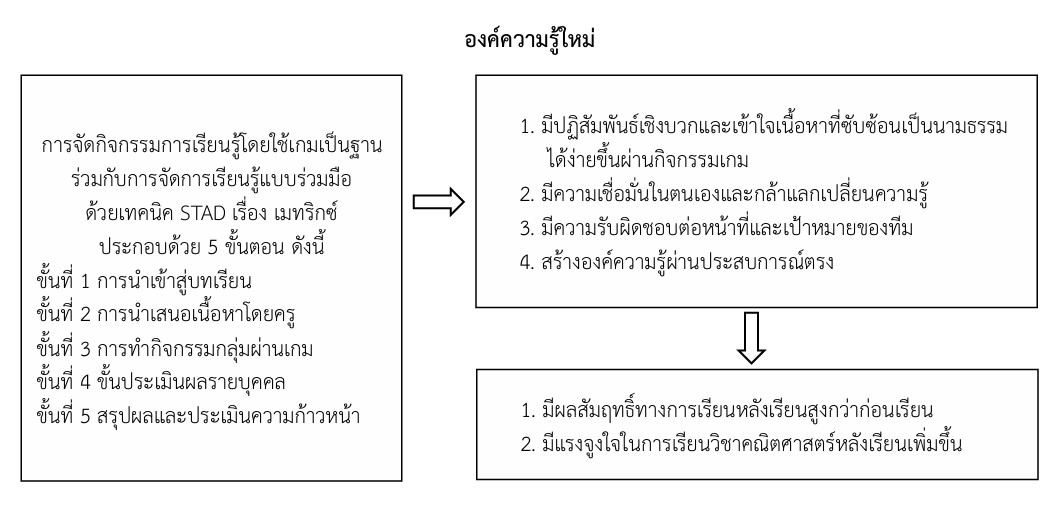
The research aimed to 1) compare the mathematics achievement on the topic of matrices of Grade 11 students before and after being taught through game-based learning combined with the Student Teams Achievement Divisions (STAD) cooperative learning technique, and 2) investigate the learning motivation in mathematics regarding matrices of Grade 11 students after receiving instruction through game-based learning integrated with STAD. The sample consisted of 40 Grade 11 students from class 5/4 at Khemmarat Pittayakom School in the first semester of the 2025 academic year, selected using cluster random sampling. The research instruments included (1) lesson plans designed with game-based learning integrated with the STAD technique, (2) a 30-item multiple-choice mathematics achievement test on matrices, and (3) a 20-item questionnaire measuring learning motivation toward mathematics concerning matrices. The data were analyzed using means, standard deviations, dependent sample t-tests, and one-sample t-tests. The findings revealed that 1) the mathematics achievement scores of Grade 11 students on matrices after receiving game-based learning combined with STAD were significantly higher than before at the .05 significance level, and 2) the students’ learning motivation in mathematics regarding matrices after receiving game-based learning integrated with STAD was overall at the highest level (M = 4.78, S.D. = 0.17).
Article Details

This work is licensed under a Creative Commons Attribution-NonCommercial-NoDerivatives 4.0 International License.
References
กระทรวงศึกษาธิการ. (2560). หลักสูตรแกนกลางการศึกษาขั้นพื้นฐาน พุทธศักราช 2551 ตัวชี้วัดและสาระการเรียนรู้แกนกลางกลุ่มสาระการเรียนรู้คณิตศาสตร์ (ฉบับปรับปรุง พ.ศ. 2560). กรุงเทพฯ: โรงพิมพ์ชุมนุมสหกรณ์การเกษตรแห่งประเทศไทยจำกัด.
เกษกานดา สุรรัตน์. (2565). การพัฒนากิจกรรมการเรียนรู้โดยใช้เกมมิฟิเคชันแบบออนไลน์ เพื่อส่งเสริมความสามารถในการแก้ปัญหาทางคณิตศาสตร์และแรงจูงใจในการเรียน สำหรับนักเรียนชั้นมัธยมศึกษาปีที่ 4. (การศึกษามหาบัณฑิต, มหาวิทยาลัยนเรศวร).
จิรพรรณ บุญยาธิการโสภณ และ อัมพร วัจนะ. (2568). การจัดการเรียนรู้โดยใช้เกมเป็นฐาน (Game-based Learning) เพื่อพัฒนาผลสัมฤทธิ์ทางการเรียน เรื่อง แคลคูลัสเบื้องต้น ของผู้เรียนชั้นมัธยมศึกษาปีที่ 6 โรงเรียนปะเหลียนผดุงศิษย์. วารสารสังคมศาสตร์ปัญญาพัฒน์, 7(1), 304–314.
ทิศนา แขมมณี. (2560). ศาสตร์การสอน: องค์ความรู้เพื่อการจัดกระบวนการเรียนรู้ที่มีประสิทธิภาพ. (พิมพ์ครั้งที่ 21). สำนักพิมพ์แห่งจุฬาลงกรณ์มหาวิทยาลัย
เนตรกนก วิทยเจียกขจร, นิราศ จันทรจิตร และ สฤษดิ์ ศรีขาว. (2561). การพัฒนากิจกรรมการเรียนรู้ โดยใช้กลุ่มร่วมมือเทคนิค STAD เพื่อเสริมสร้างทักษะการคิดวิเคราะห์ และแรงจูงใจใฝ่สัมฤทธิ์ เรื่อง ทฤษฎีบทพีทาโกรัสของนักเรียนระดับชั้นมัธยมศึกษาปีที่ 2. วารสารวิชาการหลักสูตรและการสอน มหาวิทยาลัยราชภัฎสกลนคร, 10(28), 57-65
ประภาศิริ ปราโมทย์. (2561). การพัฒนาชุดกิจกรรมการเรียนรู้คณิตศาสตร์ โดยใช้รูปแบบการเรียนรู้แบบร่วมมือควบคู่กับเกม เพื่อส่งเสริมผลการเรียนรู้และคุณลักษณะที่พึงประสงค์ทางคณิตศาสตร์ สำหรับนักเรียนชั้นประถมศึกษาปีที่ 5 (ครุศาสตรมหาบัณฑิต, มหาวิทยาลัยราชภัฏเชียงใหม่).
ปรียาภัทร เพ็งลุน, ปวีณา ขันธ์ศิลา และ ประภาพร หนองหารพิทักษ์. (2566). การพัฒนาผลสัมฤทธิ์ทางการเรียนวิชาคณิตศาสตร์ เรื่อง สมการกำลังสองตัวแปรเดียว ของนักเรียนชั้นมัธยมศึกษาปีที่ 3 โดยใช้การจัดกิจกรรมการเรียนรู้แบบ STAD ร่วมกับการใช้เกม. วารสารมนุษย์ศาสตร์ สังคมศาสตร์และนวัตกรรม มหาวิทยาลัยกาฬสินธุ์, 2(1), 80-92.
สถาบันส่งเสริมการสอนวิทยาศาสตร์และเทคโนโลยี. (2564). ผลการประเมิน PISA 2018 การอ่าน คณิตศาสตร์ และวิทยาศาสตร์. สืบค้นจาก https://pisathailand.ipst.ac.th/pisa2018-fullreport/.
สถาบันส่งเสริมการสอนวิทยาศาสตร์และเทคโนโลยี. (2566). ผลการประเมิน PISA 2022 การอ่าน คณิตศาสตร์ และวิทยาศาสตร์. สืบค้นจาก https://pisathailand.ipst.ac.th/pisa2022-fullreport/.
สำนักงานคณะกรรมการการศึกษาขั้นพื้นฐาน. (2564). นโยบายและจุดเน้นของกระทรวงศึกษาธิการ ปีงบประมาณ พ.ศ. 2564. กระทรวงศึกษาธิการ. สืบค้นจาก https://www.moe.go.th/นโยบายและจุดเน้น-2564/.
สุนารี นวลจันทร์. (2562). ผลสัมฤทธิ์ทางการเรียนวิชาคณิตศาสตร์และความสามารถในการทำงานกลุ่ม เรื่อง ระบบจำนวนจริง โดยการเรียนแบบร่วมมือเทคนิค STAD ร่วมกับเกมคณิตศาสตร์ ของนักเรียนชั้นมัธยมศึกษาปีที่ 4. (การศึกษามหาบัณฑิต, มหาวิทยาลัยทักษิณ).
Al-Azawi, R., Al-Faliti, F., & Al-Blushi, M. (2016). Educational gamification vs. game based learning: Comparative study. International journal of innovation, management and technology, 7(4), 131.
Deci, E. L., & Ryan, R. M. (1985). Intrinsic motivation and self-determination in human behavior. New York: Plenum Press.
Lestari, D. A., & Zetriuslita. (2021). The effect of Monopoly game simulation in the STAD type cooperative learning model on the learning outcomes of middle school students. Mathematics Research and Education Journal, 5(1), 8–13.
Piaget, J. (1970). Science of education and the psychology of the child. New York: Orion Press.
Slavin, R. E. (1995). Cooperative learning: Theory, Research, and Practice. Massachusetts: Allyn & Bacon.
