The Application of the Second Royal Working Principle, “Exploding from Within,” in the Development of Human Awareness
Keywords:
Application, The Second Royal Working Principle, Exploding from Within, AwarenessAbstract
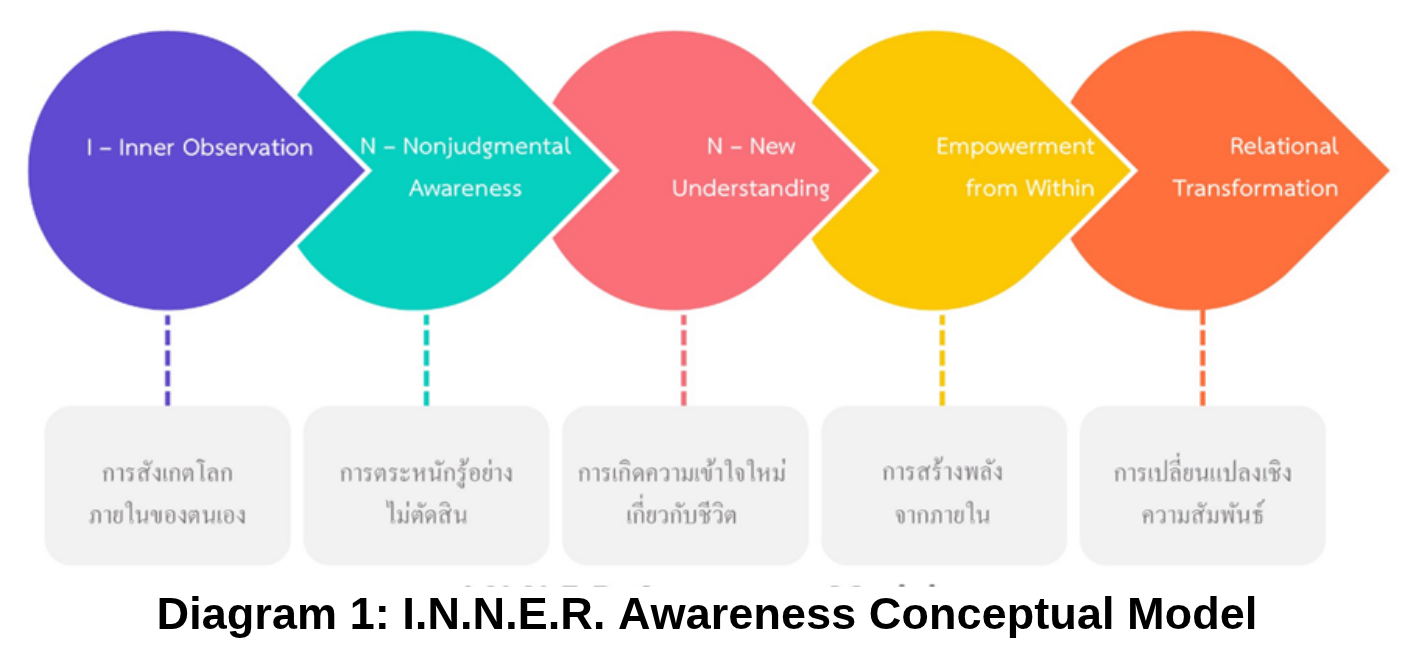
This academic article aims to study the meaning and concepts of the Second Royal Working Principle, “Exploding from Within,” analyze the concept of human awareness, and examine the application of this principle in the development of human awareness. The study employs conceptual analysis, philosophical interpretation, and knowledge synthesis derived from the King’s Philosophy, Buddhist philosophy, humanistic psychology, and holistic human development concepts. The findings reveal that the Second Royal Working Principle, “Exploding from Within,” emphasizes strengthening and transformation from within human consciousness before external change occurs. Human awareness is identified as a crucial process enabling individuals to understand themselves, recognize the realities of life, and develop balanced relationships with others and society. Furthermore, the process of developing awareness according to the principle of “Exploding from Within” consists of self-observation, reflective contemplation, intrinsic motivation, and relational transformation. The author synthesizes a new body of knowledge entitled the “I.N.N.E.R. Awareness Conceptual Model,” which represents a framework for developing human awareness from the inner dimension toward external transformation. This model can be applied to enhance quality of life, education, organizational development, and sustainable social development.
References
กีรติ บุญเจือ และคณะ. (2558). ลักษณะหลังนวยุคในทฤษฎีความพอเพียงของพระบาทสมเด็จพระเจ้าอยู่หัวภูมิพลอดุลยเดชฯ. รายงานการวิจัย. บัณฑิตวิทยาลัย : มหาวิทยาลัยราชภัฏสวนสุนันทา.
ชัยโรจน์ นพเฉลิมโรจน์. (2558). หลักคุณภาพในโครงการอันเนื่องมาจากพระราชดำริกับปรัชญาหลังนวยุค : การศึกษาเชิงวิเคราะห์ วิจักษ์ และวิธาน. วิทยานิพนธ์ปรัชญาดุษฎีบัณฑิต. บัณฑิตวิทยาลัย : มหาวิทยาลัยราชภัฏสวนสุนันทา.
ชัยโรจน์ นพเฉลิมโรจน์. (2565). การคิดนวัตกรรมด้วยหลักการทรงงานตามหลักปรัชญาหลังนวยุค. วารสารการวิจัยเพื่อพัฒนาชุมชน, 5(2), 111–117.
ชิสา กันยาวิริยะ. (2565). ระเบิดจากข้างใน : การศึกษาเชิงวิเคราะห์ วิจักษ์ และวิธาน. วารสารวิจัยธรรมศึกษา, 5(2), 250–256.
ธนากร สังเขป. (2556). การพัฒนาที่ยั่งยืน (พิมพ์ครั้งที่ 2). กรุงเทพฯ : วี.พริ้นท์ 1991 จำกัด.
พระครูวิบูลสีลพรต. (2563). ศาสตร์พระราชากับพุทธวิธีในการพึ่งตนเองตามแนวเศรษฐกิจพอเพียงของชุมชนแสงจันทร์ จังหวัดบุรีรัมย์. วารสารสันติศึกษาปริทรรศน์ มจร, 18(2), 726–736.
พระมหาประกาศิต สิริเมโธ (ฐิติปสิทธิกร). (2546). การมีส่วนร่วมของประชาชนในการพัฒนาหมู่บ้านเศรษฐกิจพอเพียงของชุมชนบ้านคลองใหม่ อำเภอสามพราน จังหวัดนครปฐม. วิทยานิพนธ์พุทธศาสตรมหาบัณฑิต. บัณฑิตวิทยาลัย : มหาวิทยาลัยมหาจุฬาลงกรณราชวิทยาลัย.
พิพัฒน์ ยอดพฤติการ. (2555). CSR กับการพัฒนาที่ยั่งยืน. วารสารเศรษฐศาสตร์สุโขทัยธรรมาธิราช, 6(2), 1–10.
มนูญ มุกข์ประดิษฐ์. (2553). ปรัชญาเศรษฐกิจพอเพียงอันเนื่องมาจากพระราชดำริกับหลักธรรมในพุทธศาสนา. (พิมพ์ครั้งที่ 2). กรุงเทพฯ : มหาจุฬาลงกรณราชวิทยาลัย.
เมธา หริมเทพาธิป. (2559). การศึกษาตามหลักปรัชญาหลังนวยุคนิยมสายกลาง : วิเคราะห์จากหลักการทรงงานของพระบาทสมเด็จพระปรมินทรภูมิพลอดุลยเดช รัชกาลที่ 9. วารสารศึกษาศาสตร์ มมร, 4(1), 120–132.
เมธา หริมเทพาธิป. (2563). การจูงใจตนเองในแนวทางหลังนวยุค. พุทธมัคค์, 5(1), 99–107.
รวิช ตาแก้ว, เอนก สุวรรณบัณฑิต และเมธา หริมเทพาธิป. (2567). แนวคิดการขับเคลื่อนปรัชญาของเศรษฐกิจพอเพียงสู่การปฏิบัติด้วยปรัชญาที่มีเป้าหมายเพื่อการพัฒนาคุณภาพชีวิตแบบองค์รวมและสมดุล. วารสารวิจัยธรรมศึกษา, 7(1), 263–275.
สำนักงานคณะกรรมการพัฒนาการเศรษฐกิจและสังคมแห่งชาติ. (2551). จากปรัชญาของเศรษฐกิจพอเพียง... สู่การปฏิบัติ. กรุงเทพฯ : เพชรรุ่งการพิมพ์ จำกัด.
สำนักงานสภาพัฒนาการเศรษฐกิจและสังคมแห่งชาติ. (2559). แผนพัฒนาเศรษฐกิจและสังคมแห่งชาติ ฉบับที่ 12 (พ.ศ. 2560–2664). สำนักนายกรัฐมนตรี.
สำนักงานคณะกรรมการพิเศษเพื่อประสานงานโครงการอันเนื่องมาจากพระราชดำริ. (2559). หลักการทรงงานในพระบาทสมเด็จพระเจ้าอยู่หัว. (พิมพ์ครั้งที่ 11). กรุงเทพฯ : สำนักงานคณะกรรมการพิเศษเพื่อประสานงานโครงการอันเนื่องมาจากพระราชดำริ.
สิงห์ สิงห์ขจร. (2558). แนวทางพระราชดำริ เข้าใจ เข้าถึง พัฒนา กับความรับผิดชอบต่อสังคมขององค์กร. วารสารอิเล็กทรอนิกส์การเรียนรู้ทางไกลเชิงนวัตกรรม, 5(2), 119–129.
สุเมธ ตันติเวชกุล. (2554). การทรงงานพัฒนาประเทศของพระบาทสมเด็จพระเจ้าอยู่หัว. กรุงเทพฯ: สำนักงานคณะกรรมการพัฒนาการเศรษฐกิจและสังคมแห่งชาติ.
Deci, E. L., & Ryan, R. M. (2000). The “What” and “Why” of Goal Pursuits: Human Needs and the Self-Determination of Behavior. Psychological Inquiry, 11(4), 227–268.
Freire, P. (1970). Pedagogy of the Oppressed. New York: Continuum.
Goleman, D. (1995). Emotional Intelligence. New York: Bantam Books.
Heidegger, M. (1962). Being and Time. Oxford: Blackwell.
Maslow, A. H. (1968). Toward a Psychology of Being. New York: Van Nostrand Reinhold.
Mezirow, J. (1997). Transformative Learning: Theory to Practice. New Directions for Adult and Continuing Education, 74(1), 5–12.
Rogers, C. R. (1961). On Becoming a Person. Boston: Houghton Mifflin.
Sartre, J. P. (1956). Being and Nothingness. New York: Philosophical Library.
Downloads
Published
How to Cite
Issue
Section
License
Copyright (c) 2026 Institute of Sufficiency Journal

This work is licensed under a Creative Commons Attribution-NonCommercial-NoDerivatives 4.0 International License.