Business Management Based on Upekkhā Pāramī
Keywords:
Ethical Decision-Making, Upekkha Parami, Business Administration, LeadershipAbstract
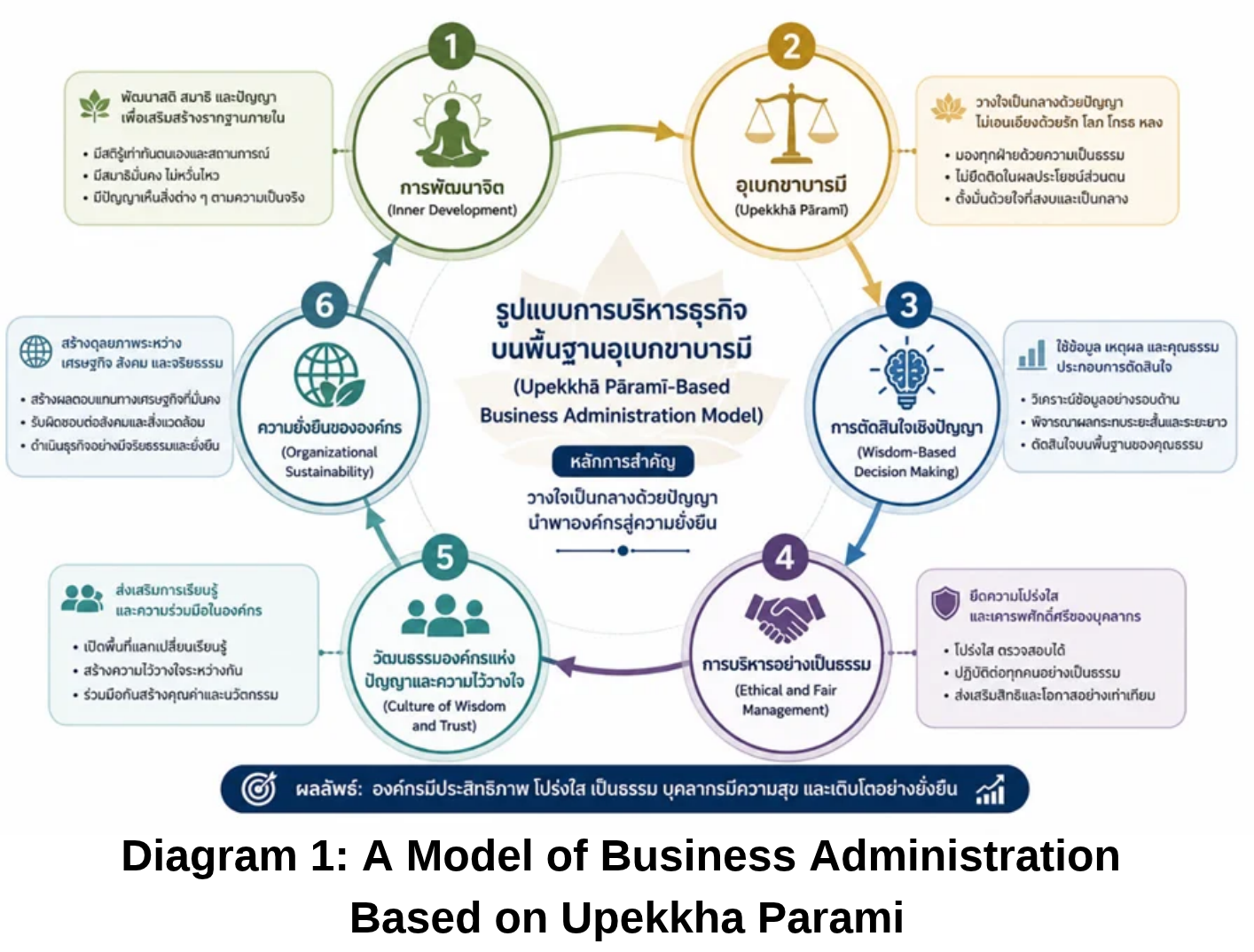
This academic article aims to examine the concept of Upekkha Parami (equanimity) in Buddhism, analyze its integration with business management concepts, and synthesize guidelines for its application in organizational management. The study employed a conceptual analysis and integrative synthesis of primary sources, including the Pali Tipitaka and Buddhist scriptures, and secondary sources, comprising textbooks and research works related to business management, selected based on reliability and relevance to leadership and business ethics. Data were analyzed using interpretive content analysis and knowledge synthesis. The results reveal that: 1) Upekkha Parami refers to mental stability and impartiality grounded in wisdom, rather than mere indifference; 2) regarding management concepts, developing internal virtues among executives based on Upekkha Parami serves as a foundational basis for establishing good governance, business equilibrium, and sustainable organizational development (noting that this framework represents a preliminary proposal requiring empirical testing); and 3) regarding its application, it can be applied to enhance ethical decision-making, human resource management, conflict management, and the establishment of a fair organizational culture. Furthermore, the article proposes a novel body of knowledge termed "Business Management Based on Upekkha Parami" highlighting that the cultivation of internal executive virtues is crucial for fostering governance, balancing business efficiency with ethics, and achieving sustainable growth.
References
จิรชฎา เชียงกูล. (2566). อุเบกขาในการเจริญภาวนากรรมฐานกับความสำเร็จในทางโลก. วารสารพุทธจิตวิทยา, 8(1), 143–153.
ประมวล เพ็งจันทร์. (2561). ความสุขจากความว่าง: พุทธจิตวิทยาว่าด้วยการปล่อยวาง. กรุงเทพฯ: สำนักพิมพ์มิ่งมิตร.
พระธรรมกิตติวงศ์ (ทองดี สุรสเตโช). (2552). พจนานุกรมพุทธศาสน์ ฉบับประมวลธรรม ประมวลวินัย. วัดราชโอรสาราม.
พระธรรมปิฎก (ป.อ. ปยุตฺโต). (2544). พุทธธรรม. กรุงเทพฯ: มูลนิธิพุทธธรรม.
พระธรรมปิฎก (ป.อ. ปยุตฺโต). (2557). ธรรมะกับชีวิต. กรุงเทพฯ: มูลนิธิพุทธธรรม.
พระประมวล ธมฺมยุตโต. (2562). การสร้างแรงจูงใจด้วยหลักพรหมวิหาร 4. พระนครศรีอยุธยา: มหาวิทยาลัยมหาจุฬาลงกรณราชวิทยาลัย.
พระพรหมคุณาภรณ์ (ป.อ. ปยุตฺโต). (2551). พจนานุกรมพุทธศาสตร์ ฉบับประมวลธรรม (พิมพ์ครั้งที่ 16). กรุงเทพฯ: เอสอาร์.พริ้นติ้ง แมสโปรดักส์.
พระพรหมคุณาภรณ์ (ป.อ. ปยุตฺโต). (2559). บารมี 10 ประการ. กรุงเทพฯ: สถาบันธรรมวรรณศิลป์.
พระพุทธโฆสาจารย์เถระ. (2551). คัมภีร์วิสุทธิมรรค. สมเด็จพระพุฒาจารย์ (อาจ อาสภมหาเถร) แปลและเรียบเรียง (พิมพ์ครั้งที่ 6). กรุงเทพฯ: บริษัท ธนาเพรส จำกัด.
พระไพฑูรย์ เมธิโก (มหาบุญ). (2554). การประยุกต์พรหมวิหาร 4 เพื่อการปฏิบัติงานของบุคลากรเทศบาลตำบลอ้อมใหญ่ อำเภอสามพราน จังหวัดนครปฐม (วิทยานิพนธ์พุทธศาสตรมหาบัณฑิต). พระนครศรีอยุธยา: มหาวิทยาลัยมหาจุฬาลงกรณราชวิทยาลัย.
ภัทร์ระพี วารีดี. (2565). ภาวะผู้นำทางจิตวิญญาณในองค์กร. กรุงเทพฯ: มหาวิทยาลัยศรีนครินทรวิโรฒ.
มะสุกรี ตายะกาเร็ง. (2564). แนวคิดภาวะผู้นำเชิงบารมีในพระพุทธศาสนา. พระนครศรีอยุธยา: มหาวิทยาลัยมหาจุฬาลงกรณราชวิทยาลัย.
ราชบัณฑิตยสภา. (2556). พจนานุกรมฉบับราชบัณฑิตยสถาน พ.ศ. 2554. กรุงเทพฯ: ราชบัณฑิตยสภา.
สมเด็จพระญาณสังวร (เจริญ สุวฑฺฒโน). (2541). อุเบกขา: การวางเฉยอย่างถูกวิธี (พิมพ์ครั้งที่ 2). พระนครศรีอยุธยา: มหาวิทยาลัยมหาจุฬาลงกรณราชวิทยาลัย.
เอกชัย อุไรสินธ์. (2564). แนวปฏิบัติตามปฏิปทาของพระโพธิสัตว์ในสังคมไทยปัจจุบัน. กรุงเทพฯ: มหาวิทยาลัยธรรมศาสตร์.
Drucker, P. F. (2008). Management (Rev. ed.). New York, NY: HarperCollins.
Elkington, J. (1997). Cannibals with Forks: The Triple Bottom Line of 21st Century Business. Oxford: Capstone.
Freeman, R. E. (1984). Strategic Management: A Stakeholder Approach. Boston, MA: Pitman.
Goleman, D. (1995). Emotional Intelligence. New York, NY: Bantam Books.
Harvey, P. (2013). An Introduction to Buddhism: Teachings, History and Practices (2nd ed.). Cambridge: Cambridge University Press.
Mintzberg, H. (2009). Managing. San Francisco, CA: Berrett-Koehler.
Northouse, P. G. (2021). Leadership: Theory and Practice (9th ed.). Thousand Oaks, CA: Sage.
Porter, M. E., & Kramer, M. R. (2011). Creating shared value. Harvard Business Review, 89(1–2), 62–77.
Robbins, S. P., & Coulter, M. (2018). Management (14th ed.). Harlow, England: Pearson.
Senge, P. M. (2006). The Fifth Discipline: The Art and Practice of the Learning Organization (Rev. ed.). New York, NY: Doubleday.
Downloads
Published
How to Cite
Issue
Section
License
Copyright (c) 2026 Institute of Sufficiency Journal

This work is licensed under a Creative Commons Attribution-NonCommercial-NoDerivatives 4.0 International License.