Business Administration Based on Metta Parami
Keywords:
Business Administration, Metta Parami, Moral LeadershipAbstract
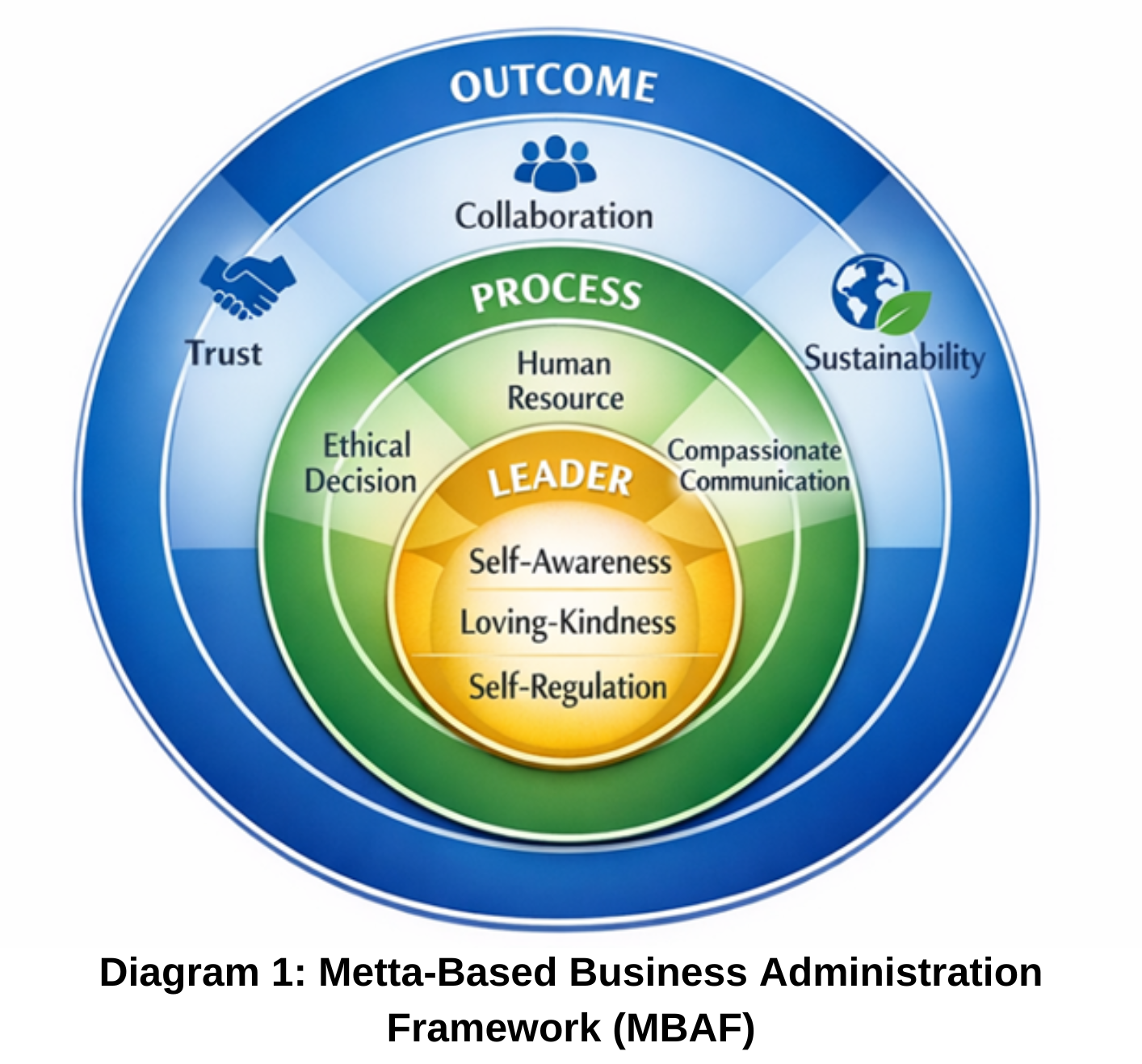
This academic article analyzes the concept of Metta Parami (loving-kindness) in Buddhist philosophy and synthesizes it into a conceptual framework for business administration, focusing on integrating leaders' inner virtues with managerial processes and organizational outcomes. The study adopts an approach based on documentary analysis and conceptual synthesis of Buddhist texts and related academic literature. The findings show that Metta Parami can be understood as a progressively developing virtue that plays a significant role in guiding decision-making, fostering relationships, and managing human resources within organizations. The study further proposes a new body of knowledge - the Metta-Based Business Administration Framework (MBAF) - comprising three dimensions: the Leader Dimension, the Process Dimension, and the Outcome Dimension, with Metta Parami functioning as the inner mechanism systematically connecting all three. The framework demonstrates that effective and sustainable business administration is not driven solely by resource management but is fundamentally grounded in the development of human consciousness and relational quality within organizations. This knowledge offers practical guidance for organizations seeking to balance business performance with ethical value, leading to long-term sustainability.
References
พระธรรมปิฎก (ป.อ. ปยุตฺโต). (2544). พุทธธรรม. กรุงเทพฯ: มูลนิธิพุทธธรรม.
พระพุทธโฆสาจารย์ (อาจ อาสภมหาเถระ). (2551). คัมภีร์วิสุทธิมรรค. สมเด็จพระพุฒาจารย์ (อาจ อาสภ มหาเถร) แปลและเรียบเรียง. พิมพ์ครั้งที่ 6. กรุงเทพฯ : บริษัท ธนาเพรส จำกัด.
พระมหาวุฒิพร อภิวฑฺฒโน. (2553). การแผ่เมตตา หนึ่งแง่งามของจิตใจ. พิมพ์ครั้งที่ 3. กรุงเทพฯ : อาทรการพิมพ์.
ภัทร์ระพี วารีดี. (2565). ภาวะผู้นำทางจิตวิญญาณในองค์กร. กรุงเทพฯ : มหาวิทยาลัยศรีนครินทรวิโรฒ.
มะสุกรี ตายะกาเร็ง. (2564). แนวคิดภาวะผู้นำเชิงบารมีในพระพุทธศาสนา. มหาวิทยาลัยมหาจุฬาลงกรณราชวิทยาลัย.
มหาจุฬาลงกรณราชวิทยาลัย. (2539). พระไตรปิฎกฉบับมหาจุฬาลงกรณราชวิทยาลัย. กรุงเทพฯ : โรงพิมพ์มหาจุฬาลงกรณราชวิทยาลัย.
สถิระ ราชรินทร์. (2561). วิเคราะห์เมตตาในฐานะเป็นฐานแนวคิดภราดรภาพ. วารสาร มจร ปรัชญาปริทรรศน์, 1(2), 1-13.
เอกชัย อุไรสินธ์. (2564). แนวปฏิบัติตามปฏิปทาของพระโพธิสัตว์ในสังคมไทยปัจจุบัน. มหาวิทยาลัยธรรมศาสตร์.
Cameron, K. S., Dutton, J. E., & Quinn, R. E. (2003). Positive organizational scholarship. San Francisco: Berrett-Koehler.
Drucker, P. F. (2008). Management: Revised edition. New York: HarperCollins.
Elkington, J. (1997). Cannibals with forks: The triple bottom line of 21st century business. Oxford: Capstone.
Freeman, R. E. (1984). Strategic management: A stakeholder approach. Boston: Pitman.
Fry, L. W. (2003). Toward a theory of spiritual leadership. The Leadership Quarterly, 14(6), 693–727. https://doi.org/10.1016/j.leaqua.2003.09.001
Goleman, D. (1995). Emotional intelligence. New York: Bantam Books.
Gotsis, G., & Grimani, K. (2016). The role of servant leadership in fostering inclusive organizations. Journal of Management Development, 35(8), 985–1010. https://doi.org/10.1108/JMD-07-2015-0095
Greenleaf, R. K. (1977). Servant leadership: A journey into the nature of legitimate power and greatness. New York: Paulist Press.
Porter, M. E., & Kramer, M. R. (2011). Creating shared value. Harvard Business Review, 89(1–2), 62–77.
Robbins, S. P., & Coulter, M. (2018). Management (14th ed.). Harlow, UK: Pearson.
Seligman, M. (2011). Flourish: a visionary new understanding of happiness and wellbeing. Policy, 27(3), 60-61
Senge, P. M. (2006). The fifth discipline: The art and practice of the learning organization (Rev. ed.). New York: Doubleday.
Downloads
Published
How to Cite
Issue
Section
License
Copyright (c) 2026 Institute of Sufficiency Journal

This work is licensed under a Creative Commons Attribution-NonCommercial-NoDerivatives 4.0 International License.