Leadership Development through the Perfection of Metta Parami
Keywords:
Development, Leadership, Metta ParamiAbstract
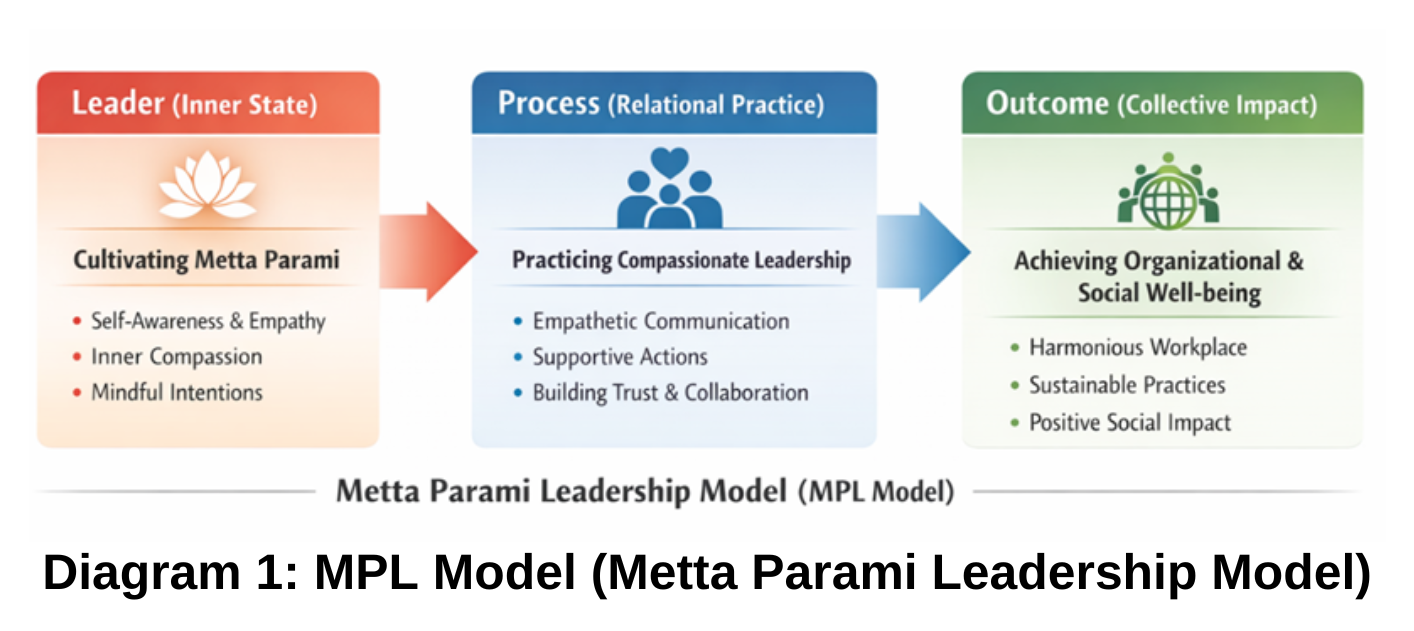
This research article aims to analyze leadership development through the perfection of Metta Parami. The study employs qualitative research methodology, particularly documentary analysis and philosophical interpretation, drawing from Buddhist scriptures, academic literature, and modern leadership theories. The findings reveal that Metta Parami serves as a fundamental basis for spiritual leadership development, emphasizing unconditional goodwill toward others. It can be developed into leadership competencies across three levels: self-transformation, relational leadership, and collective impact. Moreover, Metta Parami enhances trust, collaboration, and sustainability within organizations, aligning with concepts of servant leadership and spiritual leadership. The study proposes a new body of knowledge in the form of the “Metta Parami Leadership Model (MPL Model)” as a framework for leadership development in contemporary contexts.
References
พระธรรมปิฎก (ป.อ. ปยุตฺโต). (2544). พุทธธรรม. กรุงเทพฯ: มูลนิธิพุทธธรรม.
พระพุทธโฆสาจารย์. (2551). คัมภีร์วิสุทธิมรรค. สมเด็จพระพุฒาจารย์ (อาจ อาสภ มหาเถร) แปลและเรียบเรียง. พิมพ์ครั้งที่ 6. กรุงเทพฯ : บริษัท ธนาเพรส จำกัด.
พระอธิการสุรพล ฐานจาโร. (2557). การศึกษาวิเคราะห์ขันติบารมีของพระโพธิสัตว์ในพุทธศาสนา. วารสารวนัมฎองแหรกพุทธศาสตรปริทรรศน์, 1(1), 133-141.
ภัทร์ระพี วารีดี. (2565). ภาวะผู้นำทางจิตวิญญาณในองค์กร. กรุงเทพฯ : มหาวิทยาลัยศรีนครินทรวิโรฒ.
มหาจุฬาลงกรณราชวิทยาลัย. (2539). พระไตรปิฎกฉบับมหาจุฬาลงกรณราชวิทยาลัย. กรุงเทพฯ : โรงพิมพ์มหาจุฬาลงกรณราชวิทยาลัย.
มะสุกรี ตายะกาเร็ง. (2564). แนวคิดภาวะผู้นำเชิงบารมีในพระพุทธศาสนา. มหาวิทยาลัยมหาจุฬาลงกรณราชวิทยาลัย.
Elkington, J. (1997). Cannibals with forks: The triple bottom line of 21st century business. Oxford: Capstone.
Freeman, R. E. (1984). Strategic management: A stakeholder approach. Boston: Pitman.
Fry, L. W. (2003). Toward a theory of spiritual leadership. The Leadership Quarterly, 14(6), 693–727. https://doi.org/10.1016/j.leaqua.2003.09.001
Goleman, D. (1995). Emotional intelligence. New York: Bantam Books.
Greenleaf, R. K. (1977). Servant leadership: A journey into the nature of legitimate power and greatness. New York: Paulist Press.
Mintzberg, H. (2009). Managing. San Francisco: Berrett-Koehler.
Northouse, P. G. (2021). Leadership: Theory and practice (9th ed.). Thousand Oaks, CA: Sage.
Porter, M. E., & Kramer, M. R. (2011). Creating shared value. Harvard Business Review, 89(1–2), 62–77.
Senge, P. M. (2006). The fifth discipline: The art and practice of the learning organization (Rev. ed.). New York: Doubleday.
Downloads
Published
How to Cite
Issue
Section
License
Copyright (c) 2026 Institute of Sufficiency Journal

This work is licensed under a Creative Commons Attribution-NonCommercial-NoDerivatives 4.0 International License.