The Integration of the Second Royal Working Principle, “Exploding from Within”, with Inner Development Goals for Curriculum Development to Enhance Life Skills, Thinking Skills, and Relational Competencies (Non-Technical Skills)
Keywords:
Life Skills, Thinking, Relationships, Royal Working Principle, Exploding from WithinAbstract
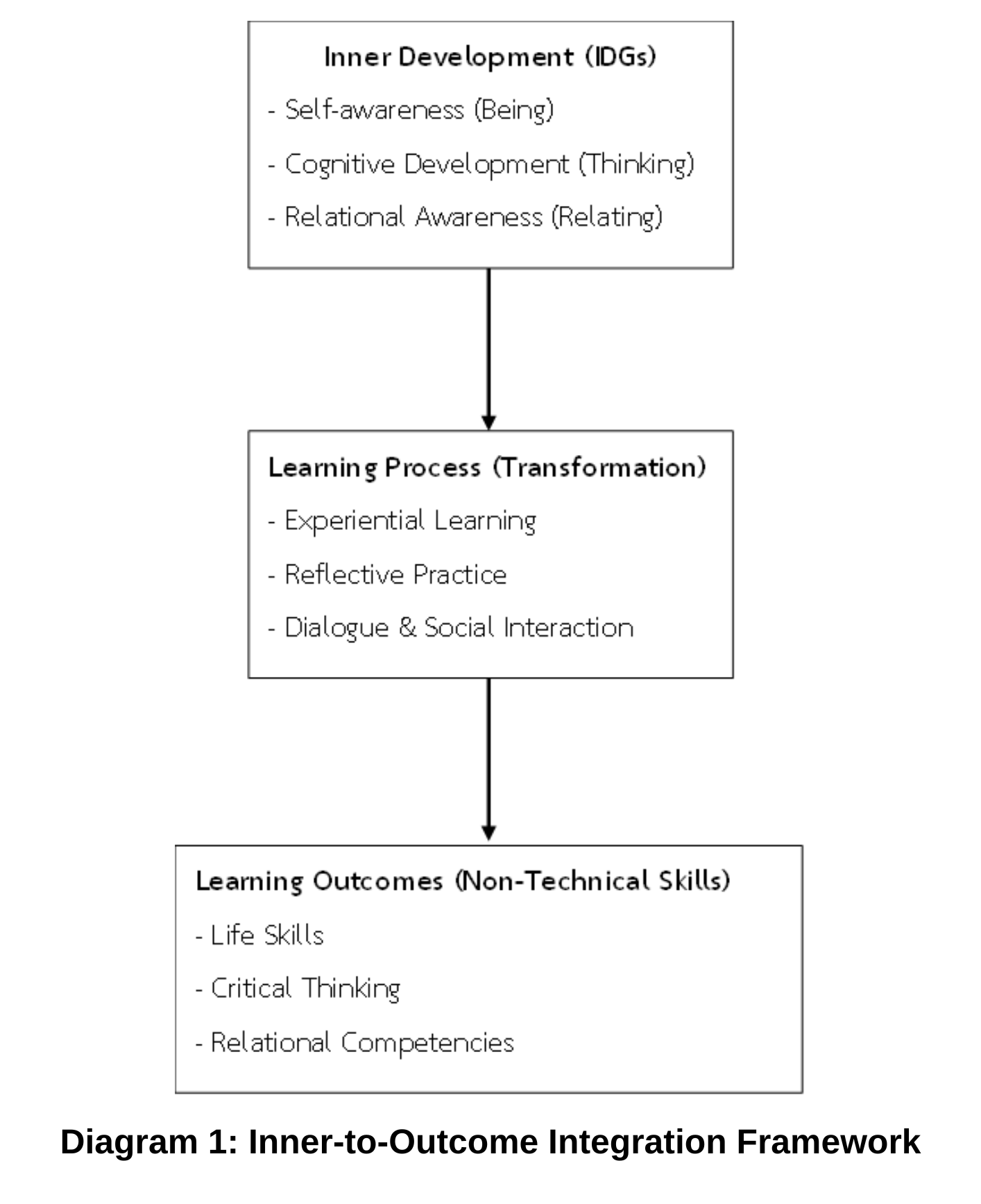
This qualitative research aimed to analyze and synthesize the integration of the Second Royal Working Principle, “Exploding from Within,” with the Inner Development Goals (IDGs) as a conceptual framework for curriculum development aimed at enhancing non-technical skills, including life skills, cognitive skills, and relational competencies. The study employs a qualitative approach through document analysis and conceptual synthesis. The findings indicate that the principle of “Exploding from Within” aligns closely with the IDGs framework in emphasizing inner human development, particularly in terms of self-awareness, inner transformation, and the extension of internal change into sustainable external practices. The integration of these two frameworks contributes to the design of curricula that emphasize experiential learning, reflective practice, and social interaction. Such an approach effectively promotes life skills, critical thinking, and the ability to build meaningful relationships. The knowledge derived from this study provides a practical foundation for developing holistic educational curricula that respond to the demands of human development in the 21st century.
References
ชัญญานุช โมราศิลป์, & ทักษญา สง่าโยธิน. (2562). แนวทางการน้อมนำหลักการทรงงานของพระบาทสมเด็จพระปรมินทรมหาภูมิพลอดุลยเดช บรมนาถบพิตร ไปใช้ในการปฏิบัติงานขององค์กรธุรกิจ. Humanities, Social Sciences and Arts, 12(1), 710–735.
รัชนี อิ่มอก. (2564). การพัฒนารูปแบบการจัดการเรียนรู้ตามหลักการทรงงานของพระบาทสมเด็จพระเจ้าอยู่หัวรัชกาลที่ 9 เพื่อส่งเสริมความเป็นพลเมืองดีที่ใส่ใจในสังคม. วารสารสังคมศาสตร์และมานุษยวิทยาเชิงพุทธ, 6(12), 204–220.
สำนักงานคณะกรรมการพิเศษเพื่อประสานงานโครงการอันเนื่องมาจากพระราชดำริ (สำนักงาน กปร.). (2559). หลักการทรงงานในพระบาทสมเด็จพระเจ้าอยู่หัว. (พิมพ์ครั้งที่ 11). กรุงเทพฯ : สำนักงาน กปร.
Bonwell, C. C., & Eison, J. A. (1991). Active learning: Creating excitement in the classroom. Washington, DC: George Washington University.
Bronfenbrenner, U. (1979). The ecology of human development: Experiments by nature and design. Harvard University Press.
Endsley, M. R. (1995). Toward a theory of situation awareness in dynamic systems. Human Factors, 37(1), 32–64.
Fletcher, G., Flin, R., McGeorge, P., Glavin, R., Maran, N., & Patey, R. (2003). Anaesthetists’ non-technical skills (ANTS): Evaluation of a behavioural marker system. British Journal of Anaesthesia, 90(5), 580–588. https://doi.org/10.1093/bja/aeg112
Flin, R., O’Connor, P., & Crichton, M. (2008). Safety at the sharp end: A guide to non-technical skills. Ashgate.
Gordon, M., Darbyshire, D., & Baker, P. (2012). Non-technical skills training to enhance patient safety: A systematic review. Medical Education, 46(11), 1042–1054. https://doi.org/10.1111/j.1365-2923.2012.04343.x
Inner Development Goals. (2023). Inner Development Goals: Transformational skills for sustainable development. Stockholm: IDG Initiative.
Irwin, A. (2023). Non-technical skills in forestry operations: A scoping review. Safety Science, 163, Article 106145. https://doi.org/10.1016/j.ssci.2023.106145
Jordan, T. (2021). Inner transformation and sustainability: A theoretical perspective. Sustainability Science, 16(3), 901–912.
Klein, G. (2008). Naturalistic decision making. New York, NY: Lawrence Erlbaum Associates.
Kolb, D. A. (1984). Experiential learning: Experience as the source of learning and development. Englewood Cliffs, NJ: Prentice Hall.
Luft, J. (1970). Group processes; an introduction to group dynamics (2 ed.). Palo Alto, California: National Press Books.
Mezirow, J. (1991). Transformative dimensions of adult learning. San Francisco, CA: Jossey-Bass.
O’Connor, P. (2024). When I say… non-technical skills. Medical Education, 58(2), 219–220. https://doi.org/10.1111/medu.15091
Reader, T. W., Flin, R., Lauche, K., & Cuthbertson, B. H. (2006). Non-technical skills in the intensive care unit. British Journal of Anaesthesia, 96(5), 551–559. https://doi.org/10.1093/bja/ael067
Salas, E., Rosen, M. A., Burke, C. S., & Goodwin, G. F. (2009). The wisdom of collectives in organizations: An update of the teamwork competencies. Team Performance Management, 15(1/2), 7–28. https://doi.org/10.1108/13527590910937763
Schön, D. A. (1983). The reflective practitioner: How professionals think in action. Basic Books.
Seligman, M. E. P. (2011). Flourish: A visionary new understanding of happiness and well-being. Free Press.
Wamsler, C. (2020). Education for sustainability: Fostering inner transformation. International Journal of Sustainability in Higher Education, 21(1), 112–130.
World Health Organization. (1997). WHOQOL: Measuring quality of life. Author.
World Health Organization. (1999). Partners in life skills education: Conclusions from a United Nations inter-agency meeting. Author.
Downloads
Published
How to Cite
Issue
Section
License
Copyright (c) 2026 Institute of Sufficiency Journal

This work is licensed under a Creative Commons Attribution-NonCommercial-NoDerivatives 4.0 International License.