Leadership Development through the Perfection of Adhitthana Paramita
Keywords:
Development, Leadership, Adhitthana ParamitaAbstract
This research article aims to analyze leadership development through the Adhitthana Paramita (Perfection of Determination) by employing philosophical methodology and documentary research, utilizing hermeneutical interpretation and conceptual synthesis drawn from Buddhist scriptures, leadership literature, business ethics, and management theory, in order to elucidate the interconnection between the leader's inner dimensions and organizational structure, processes, and outcomes.
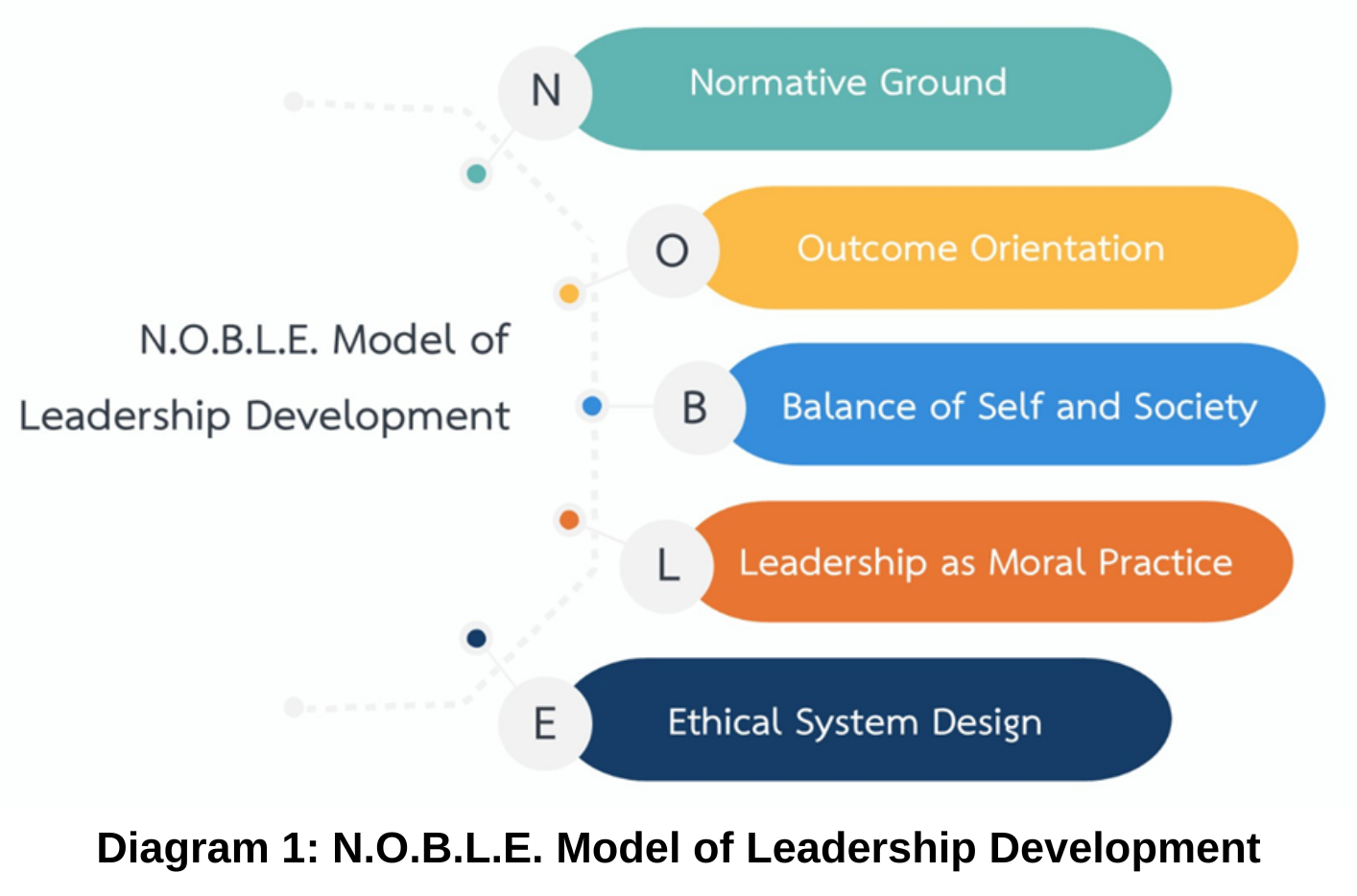
The findings reveal that Adhitthana Paramita can function as a force of ethical steadfastness that drives leadership development from the individual level toward organizational culture and governance systems, as reflected through three developmental levels: Paramita, Upa Paramita, and Paramattha Paramita. The new body of knowledge derived from this research is the N.O.B.L.E. Model of Leadership Development (Normative and Outcome-Based Leadership for Ethics), which describes normative value standards, orientation toward meaningful outcomes, balance between self and society, leadership as moral practice, and ethical system design. This model can serve as a foundation for policy design, leadership curriculum development, and further research in business ethics and leadership across diverse contexts.
References
พระธรรมปิฎก (ป.อ. ปยุตฺโต). (2544). พุทธธรรม. กรุงเทพฯ: มูลนิธิพุทธธรรม.
ภัทร์ระพี วารีดี. (2565). ภาวะผู้นำทางจิตวิญญาณในองค์กร. นครนายก: มหาวิทยาลัยศรีนครินทรวิโรฒ.
มะสุกรี ตายะกาเร็ง. (2564). แนวคิดภาวะผู้นำเชิงบารมีในพระพุทธศาสนา. กรุงเทพฯ: มหาวิทยาลัยมหาจุฬาลงกรณราชวิทยาลัย.
เอกชัย อุไรสินธ์. (2564). แนวปฏิบัติตามปฏิปทาของพระโพธิสัตว์ในสังคมไทยปัจจุบัน. กรุงเทพฯ : มหาวิทยาลัยธรรมศาสตร์.
Bodhi, B. (2005). In the Buddha’s Words: An Anthology of Discourses from the Pali Canon. Boston, MA: Wisdom Publications.
Carroll, A. B., & Brown, J. A. (2018). Corporate social responsibility: A review of current concepts, research, and issues. in J. Weber & D. Wasieleski (Eds.), Corporate Social Responsibility (pp. 39–69). Bingley: Emerald Group Publishing.
Drucker, P. F. (1974). Management: Tasks, Responsibilities, Practices. New York: Harper Business.
Fayol, H. (1949). General and Industrial Management. London: Sir Isaac Pitman & Sons.
Harvey, P. (2013). An Introduction to Buddhism: Teachings, History and Practices. (2nd ed.). Cambridge: Cambridge University Press.
Kast, F. E., & Rosenzweig, J. E. (1972). General systems theory: Applications for organization and management. Academy of Management Journal, 15(4), 447–465.
Mayo, E. (1933). The Human Problems of an Industrial Civilization. New York: Macmillan.
Mintzberg, H. (2009). Managing. San Francisco: Berrett-Koehler Publishers.
Nanamoli, B., & Bodhi, B. (1995). The Middle Length Discourses of the Buddha: A Translation of the Majjhima Nikaya. Boston, MA: Wisdom Publications.
Porter, M. E. (1985). Competitive Advantage: Creating and Sustaining Superior Performance. New York: Free Press.
Qirem, I. A. E., et al. (2023). The impact of sustainability accounting on financial reporting quality: Evidence from the pharmaceutical and chemical sectors on the ASE. Journal of Logistics, Informatics and Service Science, 10(4), 62–71.
Robbins, S. P., & Coulter, M. (2018). Management. Boston: Pearson.
Taylor, F. W. (2012). The principles of scientific management [Kindle edition]. Dover Publications. (Original work published 1911)
Zsolnai, L. (2012). Spirituality and business: An interdisciplinary overview. Society and Economy, 34(3), 489–514.
Downloads
Published
How to Cite
Issue
Section
License
Copyright (c) 2026 Institute of Sufficiency Journal

This work is licensed under a Creative Commons Attribution-NonCommercial-NoDerivatives 4.0 International License.