An Analytical Study of the Definition of Non-Technical Skills in the Context of Life Skills, Thinking, and Relationships
Keywords:
Non-Technical Skills, Life Skills, Thinking, RelationshipsAbstract
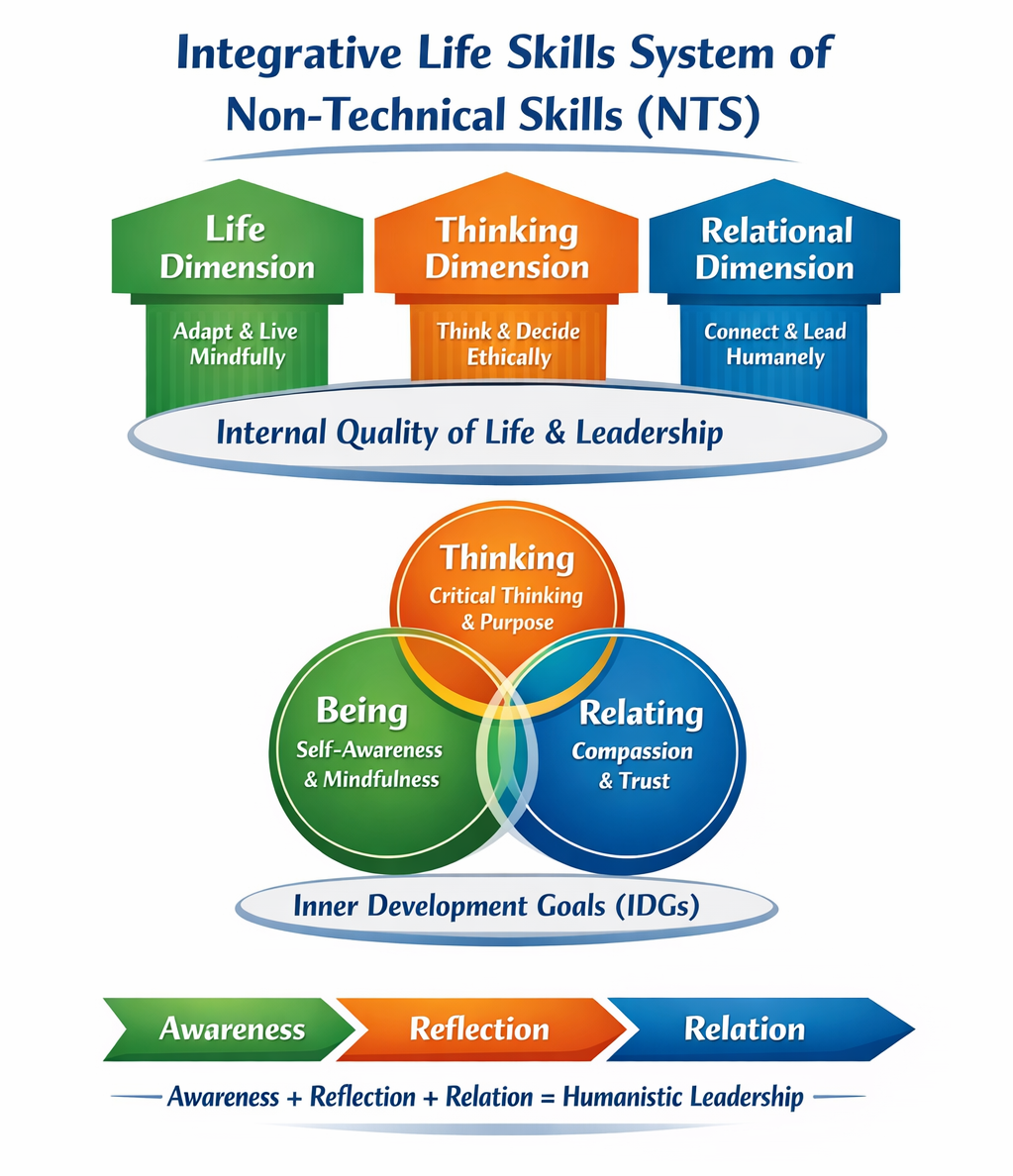
This philosophical research aimed to study the definition of Non-Technical Skills (NTS) and to analyze it within the context of life skills, thinking, and relationships. The study employed conceptual analysis, comparative analysis, and hermeneutic interpretation. The results revealed that NTS were not merely supplementary skills for professional performance but rather an “Integrative Life Skills System” consisting of three interrelated dimensions: Life (the ability to adapt and act mindfully), Thinking (critical and ethical reasoning), and Relating (empathic and constructive relationships). These dimensions reflected an individual’s capacity for adaptation, critical judgment, and compassionate connection with others. Moreover, NTS were found to align with the Inner Development Goals (IDGs) framework, particularly the dimensions of Being, Thinking, and Relating, indicating that NTS functioned as an inner operational mechanism integrating awareness, wisdom, and compassion to enhance quality of life, humanistic leadership, and organizational as well as social sustainability.
References
ธาตรี ขวัญสังข์. (2562). ทักษะรอบด้านของพนักงานต้อนรับบนเครื่องบินเพื่อเสริมความปลอดภัย : การวางแผนการอบรมสําหรับสายการบินนานาชาติ. ดุษฎีนิพนธ์ศึกษาศาสตรดุษฎีบัณฑิต. บัณฑิตวิทยาลัย : มหาวิทยาลัยรังสิต.
พิศมัย จารุจิตติพันธ์ (2557) การพัฒนาเกณฑ์ประเมินพฤติกรรมด้านทักษะที่ไม่ใช่เทคนิคของนักบินไทย. วารสารครุศาสตร์อุตสาหกรรม, 13(3), 51-58.
มาลี คำคง, ยุวนิดา อารมรมย์ และสุระพร ปุ้ยเจริญ. (2563). ทักษะที่ไม่ใช่ทางเทคนิค : การจัดการเรียนรู้ภาคปฏิบัติทางการพยาบาล. วารสารเครือข่ายวิทยาลัยพยาบาลและการสาธารณสุขภาคใต้, 7(2), 312-323.
สิทธิเดช ม่วงสิน และพิศมัย จารุจิตติพันธ์. (2557). การพัฒนาเกณฑ์การประเมินพฤติกรรมด้านทักษะที่ไม่ใช่เทคนิคของนักบินไทย, วารสารคุรุศาสตร์อุตสาหกรรม, 13(3), 51-58.
Arquero, J. L., Byrne, M., Flood, B., & Gonzalez, J. M. (2022). Overconfidence among accounting students: A cross-cultural study of miscalibration. Education + Training, 64(6/7), 741–759. Bingley, UK: Emerald Publishing. https://doi.org/10.1108/ET-08-2021-0309
Bailey, S. (2014). Non-technical skills for success in a technical world. Journal of Information Technology Education: Research, 13, 1–12. Santa Rosa, CA: Informing Science Institute.
Fletcher, G., Flin, R., McGeorge, P., Glavin, R., Maran, N., & Patey, R. (2003). Anaesthetists’ Non-Technical Skills (ANTS): Evaluation of a behavioural marker system. British Journal of Anaesthesia, 90(5), 580–588. Oxford, UK: Oxford University Press. https://doi.org/10.1093/bja/aeg112
Flin, R., & Martin, L. (2001). Behavioural markers for Crew Resource Management: A review of current practice. International Journal of Aviation Psychology, 11(1), 95–118. London, UK: Taylor & Francis. https://doi.org/10.1207/S15327108IJAP1101_6
Flin, R., O’Connor, P., & Crichton, M. (2008). Safety at the sharp end: A guide to non-technical skills. Aldershot, UK: Ashgate Publishing.
Gamborg, M. L., Klemsdal, L., & Aase, K. (2024). Training technical or non-technical skills: An arbitrary distinction? A scoping review. BMC Medical Education, 24(1451), 1–9. London, UK: BioMed Central. https://doi.org/10.1186/s12909-024-06419-6
Gordon, M., Darbyshire, D., & Baker, P. (2012). Non-technical skills training to enhance patient safety: A systematic review. Medical Education, 46(11), 1042–1054. Hoboken, NJ: Wiley-Blackwell. https://doi.org/10.1111/j.1365-2923.2012.04343.x
Irwin, A. (2023). Non-technical skills in forestry operations: A scoping review. Safety Science, 163, 106145. Amsterdam, Netherlands: Elsevier. https://doi.org/10.1016/j.ssci.2023.106145
Klein, G. (2008). Naturalistic decision making. New York, NY: Lawrence Erlbaum Associates (Taylor & Francis Group).
O’Connor, P. (2024). When I say… non-technical skills. Medical Education, 58(2), 219–220. Hoboken, NJ: Wiley-Blackwell. https://doi.org/10.1111/medu.15091
Reader, T. W., Flin, R., Lauche, K., & Cuthbertson, B. H. (2006). Non-technical skills in the intensive care unit. British Journal of Anaesthesia, 96(5), 551–559. Oxford, UK: Oxford University Press. https://doi.org/10.1093/bja/ael067
Salas, E., Rosen, M. A., Burke, C. S., & Goodwin, G. F. (2009). The wisdom of collectives in organizations: An update of the teamwork competencies. Team Performance Management, 15(1/2), 7–28. Bingley, UK: Emerald Publishing. https://doi.org/10.1108/13527590910937763
Seligman, M. E. P. (2011). Flourish: A visionary new understanding of happiness and well-being. New York, NY: Free Press.
World Health Organization. (1997). WHOQOL: Measuring quality of life. Geneva, Switzerland: World Health Organization.
World Health Organization. (1999). Partners in life skills education: Conclusions from a United Nations inter-agency meeting. Geneva, Switzerland: World Health Organization.
Downloads
Published
How to Cite
Issue
Section
License
Copyright (c) 2026 Institute of Sufficiency Journal

This work is licensed under a Creative Commons Attribution-NonCommercial-NoDerivatives 4.0 International License.