Business Administration Based on the Practice of Khanti Parami
Keywords:
Business, Administration, Business Administration, Khanti ParamiAbstract
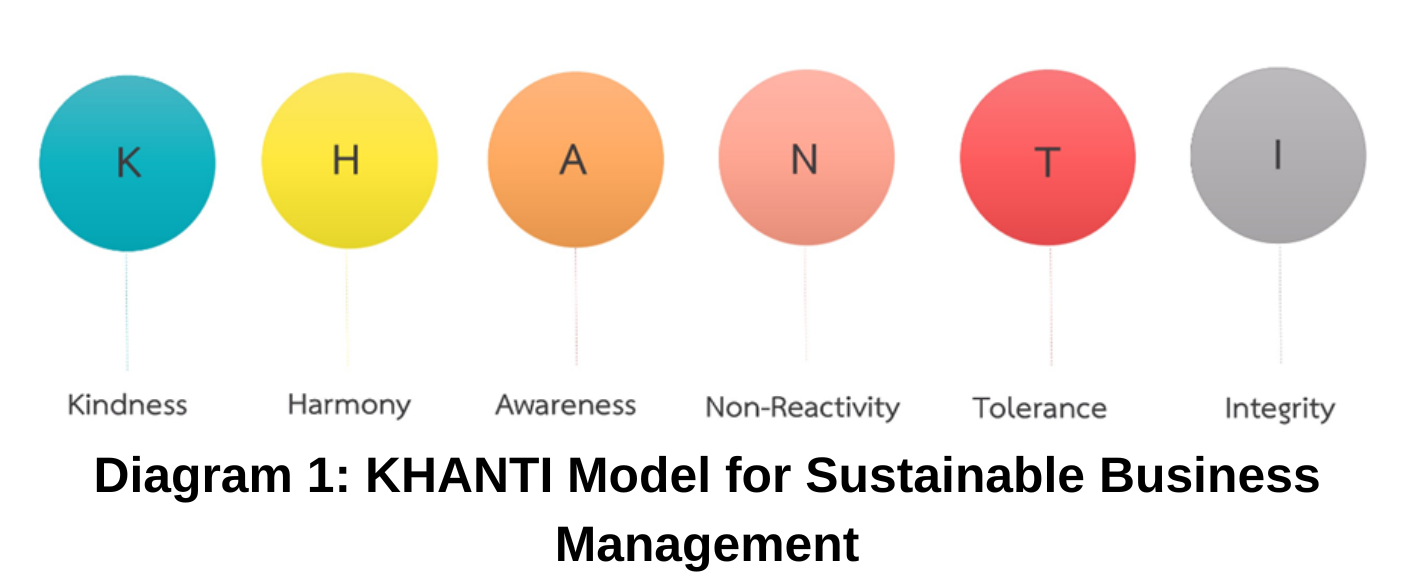
This academic article titled “Business Administration Based on Khanti Parami” aimed to analyze the concept of Khanti Parami (the perfection of patience) as a spiritual virtue that could be applied to modern business administration for sustainable success. The study draws on a Buddhist philosophical framework and connects it with modern management studies using philosophical–interpretive analysis. The findings revealed that Khanti Parami was not merely passive endurance but an active state of awareness and understanding of causal conditions, enabling leaders and organizations to manage challenges with wisdom and mindfulness rather than impulse or dominance. The article proposes a new conceptual framework called the K-HANTI Model for Business Administration, which consisted of six core elements: Kindness, Harmony, Awareness, Non-Reactivity, Tolerance, and Integrity. Each element represented an application of Khanti Parami at personal, interpersonal, and organizational levels, fostering balance between internal peace and external performance. The model highlighted that patience, when cultivated as a managerial virtue, enhanced emotional resilience, ethical leadership, and harmonious teamwork, thereby supporting both Inner Development Goals (IDGs) and Sustainable Development Goals (SDGs).
References
พระธรรมปิฎก (ป.อ. ปยุตฺโต). (2544). พุทธธรรม. กรุงเทพฯ: มูลนิธิพุทธธรรม.
ภัทร์ระพี วารีดี. (2565). ภาวะผู้นำทางจิตวิญญาณในองค์กร. มหาวิทยาลัยศรีนครินทรวิโรฒ.
มะสุกรี ตายะกาเร็ง. (2564). แนวคิดภาวะผู้นำเชิงบารมีในพระพุทธศาสนา. มหาวิทยาลัยมหาจุฬาลงกรณราชวิทยาลัย.
เอกชัย อุไรสินธ์. (2564). แนวปฏิบัติตามปฏิปทาของพระโพธิสัตว์ในสังคมไทยปัจจุบัน. มหาวิทยาลัยธรรมศาสตร์.
Carroll, A. B., & Brown, J. A. (2018). Corporate social responsibility: A review of current concepts, research, and issues. Business & Society, 57(1), 7–23.
Drucker, P. F. (1974). Management: Tasks, responsibilities, practices. Harper Business.
Fayol, H. (1949). General and Industrial Management. Sir Isaac Pitman & Sons.
Harvey, P. (2013). An introduction to Buddhism: Teachings, history and practices (2nd ed.). Cambridge University Press.
Kast, F. E., & Rosenzweig, J. E. (1972). General systems theory: Applications for organization and management. Academy of Management Journal, 15(4), 447–465.
Mayo, E. (1933). The human problems of an industrial civilization. New York : Macmillan.
Mintzberg, H. (2009). Managing. Berrett-Koehler Publishers.
Porter, M. E. (1985). Competitive advantage: Creating and sustaining superior performance. Free Press.
Qirem, I. A. E., et al. (2023). The impact of sustainability accounting on financial reporting quality. Journal of Logistics, Informatics and Service Science, 10(4), 62–71.
Robbins, S. P., & Coulter, M. (2018). Management (14th ed.). Pearson.
Taylor, F. W. (1911). The principles of scientific management. Harper & Brothers.
Zsolnai, L. (2011). Spirituality and business: An interdisciplinary overview. Society and Economy, 34(3), 489–514.
Downloads
Published
How to Cite
Issue
Section
License
Copyright (c) 2026 Institute of Sufficiency Journal

This work is licensed under a Creative Commons Attribution-NonCommercial-NoDerivatives 4.0 International License.