The Application of the 21th Royal Working Principle : Working with Happiness
Keywords:
Application, 21th Royal Working Principle, Working, Happiness, Working with HappinessAbstract
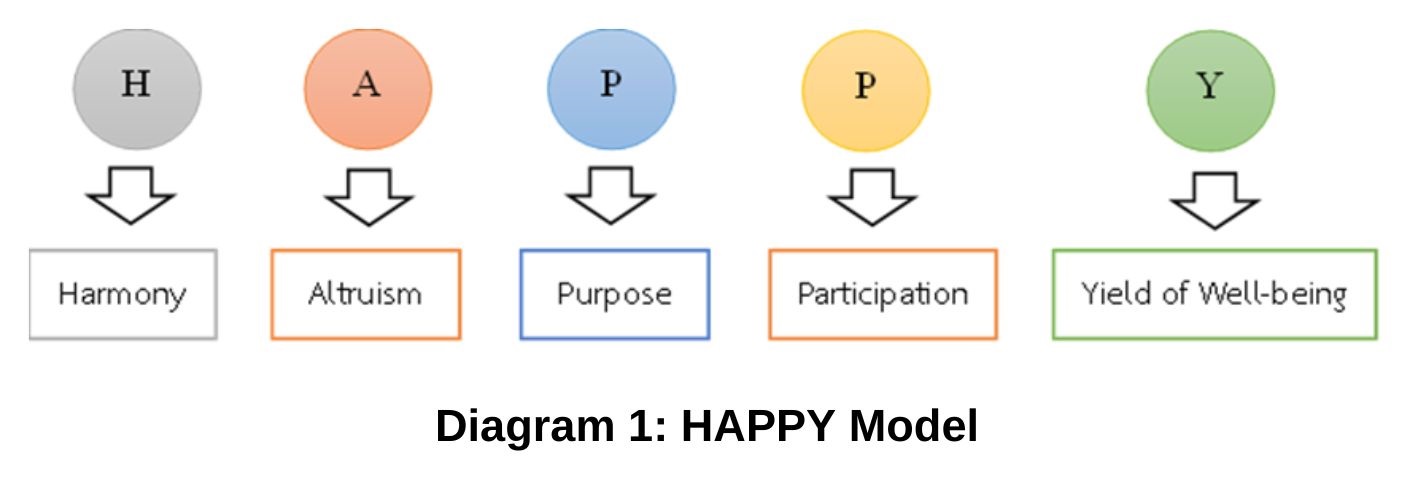
This study aimed to analyze the application of the 21st Royal Working Principle: Working with Happiness. The objectives were: (1) to analyze the philosophical dimensions of working with happiness, (2) to examine the approaches for applying the 21st Royal Working Principle at individual, organizational, and societal levels, and (3) to propose new knowledge derived from its application at these levels. The research employed documentary research and philosophical research methodology through Buddhist philosophical analysis, hermeneutics, and reflexive thinking. The findings indicated that working with happiness integrated values and meaning into work, corresponding with Buddhist philosophy and Western concepts. Moreover, the principle could be practically applied across multiple levels, ranging from individuals, organizations, and communities to sustainable development at the societal and global scales. In addition, the study generated new knowledge in the form of the HAPPY Model, which comprised Harmony, Altruism, Purpose, Participation, and Yield of Well-being, all interconnected as mechanisms that transformed work into a source of happiness, meaning, and sustainable quality of life.
References
ชัญญานุช โมราศิลป์ และทักษญา สง่าโยธิน. (2019). แนวทางการน้อมนำหลักการทรงงานของพระบาทสมเด็จพระปรมินทรมหาภูมิพลอดุลยเดช บรมนาถบพิตร ไปใช้ในการปฏิบัติงานขององค์กรธุรกิจ. Veridian E-Journal, Silpakorn University, 12(1), 710–727.
ชัยโรจน์ นพเฉลิมโรจน์ และเมธา หริมเทพาธิป. (2565). การทำงานอย่างมีความสุขตามหลักการทรงงานของพระบาทสมเด็จพระบรมชนกาธิเบศร มหาภูมิพลอดุลยเดชมหาราช บรมนาถบพิตร. วารสารวิจัยธรรมศึกษา, 5(2), 231-239.
พระพรหมคุณาภรณ์ (ป.อ. ปยุตฺโต). (2542). พุทธธรรม. กรุงเทพฯ: มหามกุฏราชวิทยาลัย.
ศุภฤกษ์ สังข์แก้ว. (2563). การเพิ่มประสิทธิภาพการปฏิบัติงานของผู้นำท้องที่โดยการประยุกต์ใช้หลักการทรงงานของในหลวง รัชกาลที่ 9. รัฐประศาสนศาสตรมหาบัณฑิต. กรุงเทพฯ: บัณฑิตวิทยาลัย มหาวิทยาลัยรามคำแหง.
สำนักงานคณะกรรมการพัฒนาการเศรษฐกิจและสังคมแห่งชาติ. (2542). เรียนรู้เศรษฐกิจพอเพียง. กรุงเทพฯ: สำนักงานคณะกรรมการพัฒนาการเศรษฐกิจและสังคมแห่งชาติ.
สำนักงานคณะกรรมการพัฒนาการเศรษฐกิจและสังคมแห่งชาติ. (2554). การทรงงานพัฒนาประเทศของพระบาทสมเด็จพระเจ้าอยู่หัว. กรุงเทพฯ: ศูนย์การพิมพ์เพชรรุ่ง.
Aristotle. (2009). Nicomachean ethics (W. D. Ross, Trans.). Oxford: Oxford University Press.
Bauman, Z. (1993). Postmodern ethics. Oxford: Blackwell.
Gotsis, G. (2023). Happiness, sustainability and the well-being economy: An integrative perspective. Futures, 152, 103218. Oxford: Elsevier. https://doi.org/10.1016/j.futures.2023.103218
Payutto, P. A. (1994). Buddhist economics: A middle way for the market place. Bangkok: Buddhadhamma Foundation.
Downloads
Published
How to Cite
Issue
Section
License
Copyright (c) 2025 Institute of Sufficiency Journal

This work is licensed under a Creative Commons Attribution-NonCommercial-NoDerivatives 4.0 International License.